
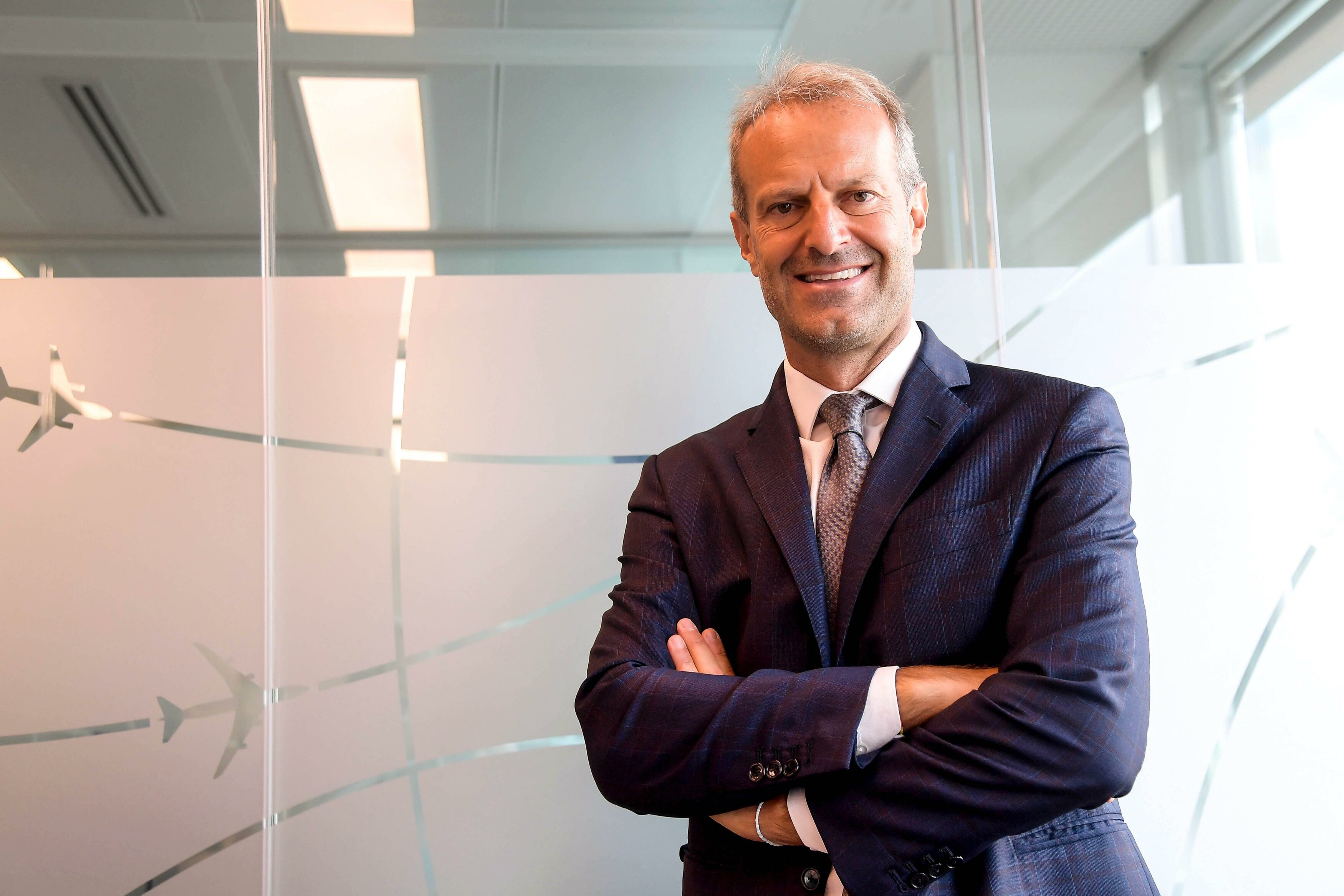
Marco Troncone, born in 1971, is the CEO of Airports of Rome (ADR) since 2020, driving Fiumicino and Ciampino airports with a vision that combines innovation and sustainability. Graduated in Chemical Engineering at the Federico II University and with an MBA at SDA Bocconi, he gained international experience in strategy and M&A in infrastructure, energy and telecommunications, working for reality like AT Kearney, Sintonia and Atlantis. Under his leadership, ADR has introduced cutting-edge services and the airport of Rome Fiumicino has won for seven consecutive years the title of “Best Airport of Europe” from Airports Council International (ACI) Europe, consolidating its international reputation. Troncone also holds important international positions, including Vice-President elective Infrastructures for the growth of Unindustria, member of the board of ACI Europe – Airport Council International and President of the Foundation “Patto per la Decarbonizzazione del Trasporto Aereo”. We interviewed him for IlNewyorkese.
The future of air transport is played on sustainability, innovation and global cooperation: only with solid international partnerships we can transform the energy transition into an opportunity for growth for all airports
ADR anticipated at 2030 the objective of zero direct emissions and integrated a state-of-the-art “ClimateChange Risk Analysis”, which presented at the UN’s Private Sector Forum Global Compact. How is this approach concretely strengthening the competitiveness of Fiumicino?
The fight against climate change is not only a regulatory obligation but it is now a precise demand for the market. Passengers want to fly more and more sustainably, minimizing their environmental impact. Being a modern, effective and “green” infrastructure therefore means responding to this question, increasing the attractiveness of the airport and ensuring the compatibility of our operations with the sustainability goals of our partners, firstly airlines. In this sense, a sustainable airport becomes a key factor in competitiveness: not only through mitigation activities – bringing the airport to zero emissions to 2030 and breaking down everything that contributes to climate heating – but also thanks to the adaptation strategies, i.e. the protection of infrastructures with the inevitable effects of climate change. It is a topic that we have also discussed at the UN: adaptation means changing existing infrastructures and designing future ones so that they are resilient to new environmental challenges – from floods to droughts, to increasing temperatures. These interventions are essential for competitiveness because the quality of an infrastructure is not only measured in terms of service or capacity, but also of availability, reliability and operational continuity. All this contributes to attract more traffic, increase revenues and consolidate the competitive positioning of our airport.
The airport of Fiumicino has reached with several months in advance the target SAF (SustainableAviation Fuel) of 2% provided by the regulation set by the European Union for 2025. What are the obstacles still to be overcome to further increase the share of sustainable biofuels?
It is a long process that will accompany us until 2050, the time horizon within which the mandates and objectives are defined. There will be many intermediate stages: we are now successfully overcoming the first milestone – 2% expected for 2025 – and we look with reasonable optimism also to the second goal, 6% fixed for 2030. For 6% of 2030 we believe we can achieve it thanks to the initiatives defined and promoted within our Fondazione Pacta, which are attended by many actors, including Eni. During the last congress we have verified that the production plans and programs of new biorefineries of Eni are adequate to guarantee the production of biofuel necessary to meet that 6% within the expected time. From 2030 to 2035 the target will grow further: 6% will become 20%, more than triple. At that stage the challenges will become more complex, but there is still time to prepare. The main fronts on which to intervene are two. On the one hand biofuels require an increase in production capacity, with more biorefineries to meet growing demand. On the other hand, the production chain must be strengthened, ensuring the availability of the biomass needed to transform them into biofuel in the required quantities. It is therefore necessary to develop and consolidate a solid production chain.
The PACTA Foundation involves industrial and institutional stakeholders on decarbonization. How do you imagine that this experience can influence European policies in the coming years, even internationally?
Remaining on the subject of biomass availability, it serves a strong industrial and political focus, with a coherent plan and industrial policy. Our Pacta Foundation works because European mandates are reflected in the production fabric, developing more biorefineries, a solid biomass supply chain and integration into national plans. When biofuels begin to run out, synthetic fuels – obtained from carbon dioxide and green hydrogen – will have to sub-enter synthetic fuels – but technology and production chain are still immature and require strong investments in research, development and creation of a new industry. Costs remain a crucial challenge: biofuels cost up to three times more than traditional, while synthetics up to ten times so much. This is why it is necessary to consolidate the path on biofuels with a concrete industrial plan, on the other hand to develop almost from scratch the synthetic fuel industry investing in technology, infrastructure and productive capacity. European policies must also support the objectives of concrete enabling factors – incentives, funds and resources for research and development – so as to transform political commitments into an industrial reality and ensure the energy transition on both sides.
This summer Fiumicino recorded record numbers: over 15 million passengers with an increase in traffic to the United States by 3.5% compared to 2024 and 34% compared to 2019. What are the key factors that have made this growth so constant and structural?
After the pandemic the air traffic is strongly divided, especially towards Europe and the tourist destinations of the Mediterranean. In this scenario Rome stands out: in 2024 traffic grew by 22% on the previous year, the highest rate in Europe, twice as high as in countries like Spain or Greece. Rome continues to be an extremely attractive destination, especially for US passengers, due to the attractiveness of the capital – supported by the favorable change and the Italian tourist offer “value for money”. It is not only a question of passively accepting the demand generated by market dynamics, but of actively promoting the airport with dedicated initiatives and strategies, as part of a long-term structural vision.
What role do new connections play with the US in this expansion and what do they “main” routes still to complete the transatlantic network? How are you collaborating with tourist operators and institutions to maximize the economic return of these flows?
Over the years we have built a constant dialogue and a solid business development activity in the United States with major airlines – Delta, United, American Airlines – based on trust and long term relationships. Rome stands out as an extremely attractive and internationally recognized airport: the achievement of the 5-star Skytrax rating – a recognition reserved just over a dozen airports around the world – represents a true quality brand that airlines can value towards their passengers, consolidating the image of the port of call as an infrastructure of highest quality and increasingly oriented to the experience of the travellerThe growth of links with the United States continues structurally: We are now close to reaching 20 direct destinations between Italy and the USA, with two new routes introduced this year – Denver and Minneapolis – and an additional extension planned for summer 2026 with the entrance of Alaska Airlines, which will connect Seattle directly to Rome. The arrival of American Airlines on the same route is also expected. This network is accompanied by a very extensive network of indirect flights: For example, Delta, through its hub in Atlanta, connects Rome to dozens of US airports, thus feeding the entire North American network. At the same time we carry on intense work with the territory and with the institutions – Roma Capitale, Lazio Region – to promote the destination not only in the United States, but also globally. The goal is to strategically promote and manage quality tourism in Rome, enhance the city’s brand and govern tourist flows. These synergies, together with the institutional and commercial partnerships already active, further strengthen the position of the Roman port as an international hub of reference and accelerate the integration of Rome in the great transatlantic tourist and commercial flows.
You set the goal of reaching 100 million passengers in 2046. What infrastructure or innovations will be necessary to manage such high traffic volumes without compromising quality and punctuality?
Fiumicino is growing rapidly as a traffic generator and can still slightly increase the capacity, but soon it will reach the maximum limit. To manage future flows, estimated at 100 million passengers over the next 20 years, structural adjustment is required.
This is why we have developed a clear answer, a masterplan that outlines the airport of the future. The master plan provides a new terminal and a reorganization of the tracks to increase the capacity by reducing the acoustic impact and respecting the highest standards of punctuality, quality and sustainability. The future airport will be emissions zero, hyper-efficient, with modern management of resources and optimized tracks to reduce noise by removing the acoustic impact from the inhabited centers.
Growth and sustainability feed each other: the resources generated by traffic support electrification, biofuels and energy efficiency. Over the past 12 years, 3 billion euros have been invested, created 2,000 jobs only in airports in Rome and transformed Fiumicino into a hub of excellence. The plan is being evaluated and ready to go as soon as the freeway arrives, following the example of large international hubs.
L’articolo Marco Troncone: Fiumicino towards the future between innovation and sustainability comes from IlNewyorkese.
