
Global Sumud Flotilla, an expedition that began in the past few weeks to bring humanitarian aid to Gaza, was almost completely intercepted by the Israeli authorities during the trip. All 42 vessels were stopped in international waters and dozens of activists, including parliamentarians and humanitarian workers, were transferred to Ashdod port for expulsions or legal proceedings. The interception of Flotilla has provoked protests in several Italian cities, including Rome, Naples, Milan and Turin, with thousands of people protesting against Israeli action.
A first group of Italian activists who had taken part in the mission, including MPs Arturo Scotto, Annalisa Corrado, Benedetta Scuderi and Marco Croatti, returned to Italy, after days of arrest and interrogation.
In parallel, Donald Trump’s call came from Washington to stop the bombing on the Gaza Strip. The interruption of hostilities marks a fragile turning point in a crisis that, for months, has shaken the international consciousness.
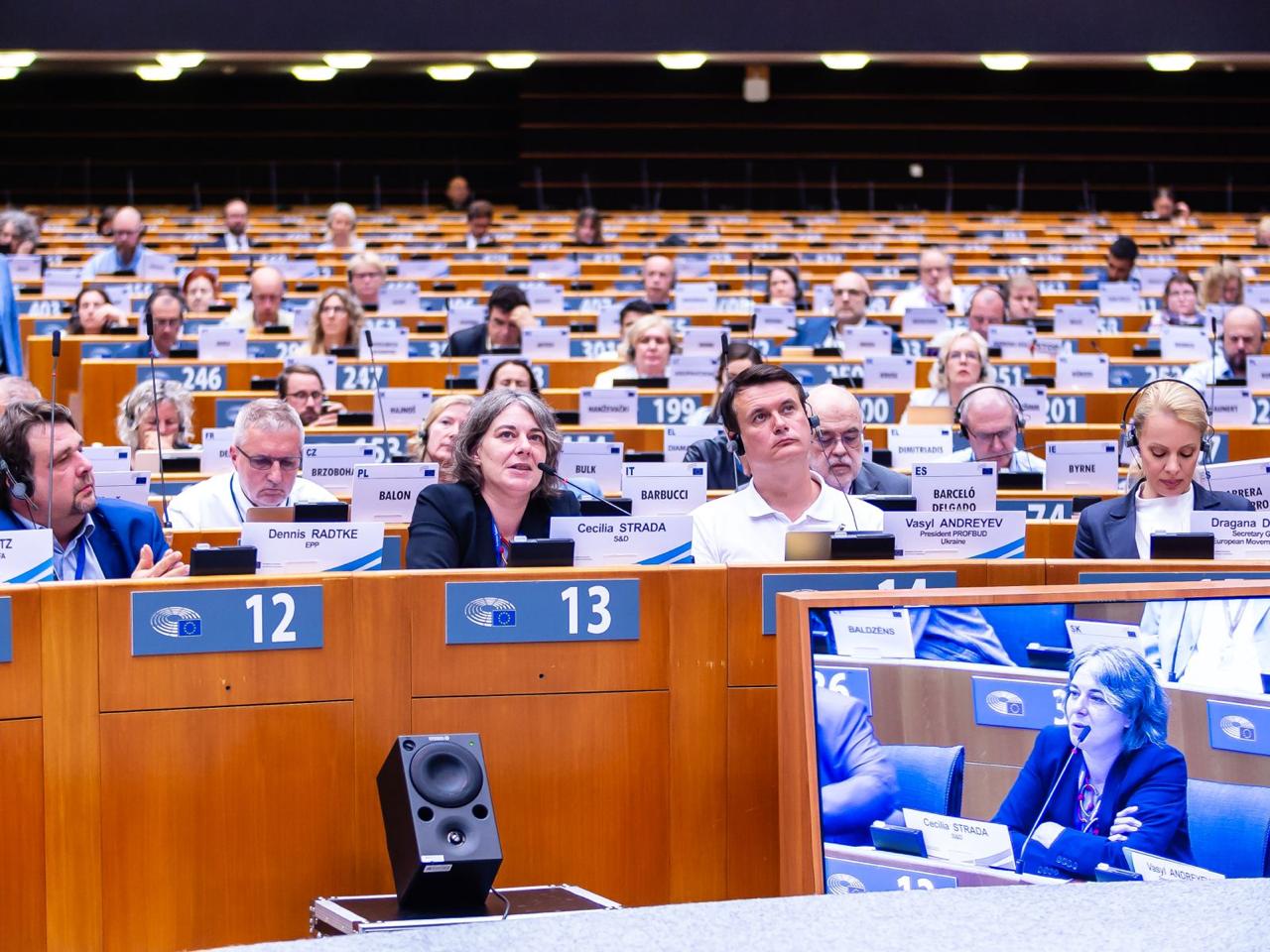
In this evolving scenario, the words of Cecilia Strada, Euro MP and former president of Emergency, resonate with particular force. His reflection intertwines humanitarian and political commitment, and invites us to question the meaning of solidarity today: when civil society decides to act where politics is silent.
After years in front of Emergency, the organization founded by your father Gino Strada, you went to European politics. What prompted you to take this path and what continuity do you see with your father’s legacy?
My father and my mother, I would say. And all the people who built Emergency, because it was a collective project: normal people who, together, manage to do extraordinary things that no one alone could accomplish. For years, in my public meetings and conferences, I was telling what we were doing: caring for those who could not care, helping those who risked life. But we did it because politics did not do its part.
After so many years as an activist and humanitarian worker, I began to wonder if there was a way to increase the impact of my work. This reflection was born at sea, during rescue missions with the Rescue People. We saved dozens of people, but back to the ground we saw that politics condemned the next to death. I was tired of putting patches on the fractures.
Then Elly Schlein proposed me to evaluate a direct political commitment. I thought and decided to accept.
Continuity with previous experience is total: I continue to fight against inequalities, the right to health, life, peace, international law and the rights of migrants. I fight the same battles, only in a different place, within the institutions, where I believe it is urgent to defend the fundamental values of the European Union, today put at risk by those who want to reduce rights and freedoms.
Staying at sea was more rewarding, because you immediately saw the result of your actions. Here the work passes through slow and often frustrating negotiations. But it’s not a reason to back off: That’s why we need to be there.
What practical teachings do you bring from your humanitarian experience in political work?
I think I have a great advantage over many colleagues who have only dealt with politics: I have seen with my eyes the consequences of political choices on people’s skin.
I know the smell of war hospitals, I know what an antipersonnel mine does, I know what an inhuman migration policy means. I touched the scars, consoled the women who survived the Libyan lager, heard gasoline and salt water on the drifting barcons. All this gives me a clear moral compass: I know what is acceptable and what is not.
For me the compromise has a limit: when it leads to results I know, that I have seen, and that they are no longer tolerable. Perhaps this makes me a “rompipalle”, but I hope it also makes me a good policy.
You have repeatedly criticised the EU’s response to the Gaza crisis. What concrete and immediate actions should the European Union take today?
The EU must really use the tools it has available: suspend the Agreement of the EU-Israel Association until human rights are guaranteed, impose an embargo on arms, in both directions, and suspend any form of economic or technological cooperation that may fuel violence.
It is necessary to stop trade with the colonies and block European funds for Israel, including those related to research programmes such as Horizon. All this should accompany the request for respect for international law, the dismantling of the colonies and the restoration of legality in the West Bank.
What does Flotilla represent for you and for the pacifist movement?
Flotilla was a gesture of people, a civil initiative of enormous symbolic value. It is a demonstration that, in the face of the inaction of governments, civil society can still organize itself to affirm the principles of humanity and solidarity. I am very proud of my friends and colleagues who have taken part in the mission, including Annalisa Corrado, of my own delegation. I couldn’t sail for personal reasons, but I would have gone.
Looking at the future, what message of hope or responsibility would you like to come to you, today MEP, to whom has known you as an activist?
I’m here and do my best in a very difficult context. But it must be done, because it is right. Martin Luther King said that “the faith is to climb the ladder when you do not even see the first step”: and this is the scale we must continue to climb, even when it seems impossible.
I am concerned with the risk that so many people lose confidence in politics, seeing governments denying rights to migrants, criminalizing those who manifest, or remain complicit in wars. But it’s time for us to believe more. If in the last European elections more people believed in the possibility of changing things, today Parliament and the Council would have a different composition, and perhaps some decisions would have already been taken to stop the massacres.
Politics is not just institutions: is of those who choose to participate. There are those who have chosen it and those who do not have it. Those who have the opportunity to choose also have the responsibility to do it well.
When I decided to run, I reconsidered a guy I saved from a shipwreck. He said: “Don’t thank me, because I had no choice. You do.
Well, I think each of us, if you have a choice, should use it to do the right thing. As someone else said, do what you have to do, what can happen.
L’articolo Flotilla in Gaza, Cecilia Strada: “A victory of civil society, not politics” comes from IlNewyorkese.
