
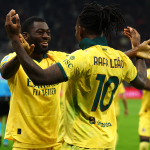
On Matchday 7, Milan came from behind to beat Fiorentina and climb to the top of the Serie A table. Inter conquered the Olimpico, Napoli fell in Turin, and Juventus collapsed in Como.
Let’s start from the end: in Sunday night’s late match, Milan claimed first place with a comeback win over Fiorentina—a significant victory, powered by a Leão brace. The Portuguese forward, absent until now, might just be the key player to give Allegri’s team the final push in a title chase that looks increasingly real. I’ve been saying it for a while: the Rossoneri can truly aim to win the Scudetto. This team is strong, complete in every department, and the man on the bench is, trophy in hand, the most successful coach in today’s Serie A. Without the distraction (and fatigue) of European competitions, Milan, to me, is one of the three top contenders for the title.
To find the second candidate, you don’t have to go far from Milanello: across the city, Inter seems to be experiencing a genuine rebirth under Chivu. The Romanian coach doesn’t have Allegri’s experience, but he’s already navigated an early rough patch—two straight losses against Udinese and Juventus that could have floored a horse—and quickly steered the team back on track with his clear footballing ideas, which have shown results both in performances and on the scoreboard. Four consecutive wins, the latest away to Roma, a historically tricky opponent that came into the match as league leaders. At the Olimpico, Inter dominated the first half—helped by Gasperini’s lineup mistakes—and held on under pressure in the second, managing, with a bit of luck, to secure what Chivu himself called “one of those wins that can change the course of a season.”
From Roma’s perspective, the defeat doesn’t erase the team’s progress but leaves a bitter taste because of the first-half disaster and the attacking inefficiency: Dovbyk (whom I’ve always defended, but enough is enough) and Ferguson couldn’t score even with their hands. If those two strikers don’t get going, Gasperini’s side—who, not by chance, started Dybala as a false nine, a failed experiment—will find their Champions League push increasingly uphill.
Napoli’s defeat in Turin should set off alarm bells for Conte. It’s their second loss in the last three games, and in between came a labored home win against Genoa. This Napoli isn’t running smoothly: there are physical issues and tactical flaws, and Conte must step in quickly to fix things.
If Napoli is struggling, Juventus under Tudor seems to be in free fall. After their Matchday 3 win over Inter, which looked like a launchpad into the title race, came three draws and, this Sunday, a loss to Como. Four straight games without a win is a terrible sign for a club that lives by the motto “winning is the only thing that matters.” Tudor’s position is shaky—he’s only safe for now because there’s no credible alternative on the bench—but it’s well known that the Croatian wasn’t the board’s first choice. His time to turn things around may be running out.
A mention for Juric’s Atalanta: on the one hand, they’re still unbeaten—the only Serie A team with that distinction, alongside Bayern Munich, Porto, and Feyenoord in Europe’s top leagues. On the other, five draws in seven matches won’t get you to heaven—or even the Champions League. It’s no coincidence that Atalanta sit eighth, five points behind the leaders, despite never losing. In the era of three points per win, drawing too often is more of a vice than a virtue. But the table is still tight, and there’s time to change course.
Let me end on a bitter note: this Serie A weekend, pending Monday’s Cremonese–Udinese fixture, was remarkably poor in goals. So poor it’s sour: just 9 goals in 9 matches, with four goalless draws. At a time when Italian football is trying to relaunch itself and attract new markets—like our own SMIT editorial project expanding to reach not only Italian-Americans but also American soccer fans—such a calling card could be damaging.
In the Premier League last weekend, 19 goals were scored, with no 0-0 results. In the Bundesliga, 30 (with one fewer game). In La Liga, 20. In Ligue 1, 40 (with one more game). In the Eredivisie, 34. The only major European league with fewer goals than Italy’s was Portugal’s Primeira Liga—because it wasn’t being played.
Italian football has always been more “tactical” than the others, which isn’t a flaw in itself—but in the past, it compensated for that with stars who thrilled fans and filled scorelines with brilliance and goals. Today, the stars and the magic are gone—and if the goals disappear too, matches risk becoming flat and dull.
In the last two rounds before this one, 25 and 27 goals were scored, respectively, so hopefully this was just an off weekend. Because if, after only a handful of matches, the smaller sides—Lecce, Sassuolo, Pisa, Verona, Genoa, Parma (not coincidentally named)—are already resorting to a conservative approach even in direct clashes, focusing first on not conceding rather than trying to play, then we’re in for many boring, “zero-visibility” games. By “zero visibility,” I mean matches watched live only by a few thousand diehards—and skipped entirely in the highlights, because there’s literally nothing to see in a 0-0 draw.
The big clubs must do their part too. Juventus–Inter on Matchday 3 had raised our hopes with that wild 4-3. Last week we saw a spectacular Lazio–Torino 3-3. The problem is that these games stick in our memory because they’re rare exceptions in Serie A—whereas looking at other European leagues, they’re the norm.
If Serie A wants to keep up with the times, it needs to show us more goals. And referees must help by blowing the whistle less—because their constant interruptions are becoming an issue too.
L’articolo Serie A: Milan Alone at the Top. A Goal-Scant Matchday 7 proviene da Soccer Made In Italy.
