
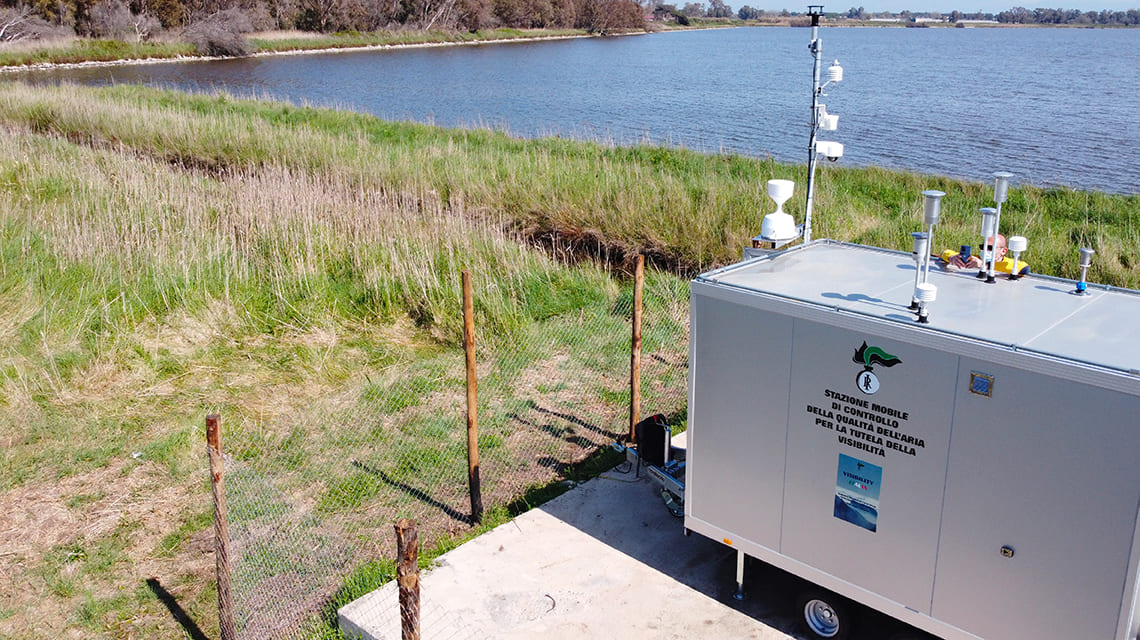
ROMA (ITALPRESS) – The atmospheric visibility index in Italian national parks as a parameter to assess the impact of air pollution: on this is based the project “Visibility”, coordinated by the Carabinieri Corps – Command Units Forest, Environmental and Agro-Food, to which ENEA also participates that is carrying out the analysis on the samples collected. A unit measures the main pollutants by sampling – one every three days – lasting 24 hours. The first station was located near the lake of the Monaci, in the Circeo National Park (Latina), and is equipped with particulate samplers and analyzers for polluting gases, panoramic camera, weather control unit. For the first time in Europe the I.M.PRO.V.E (Interagency monitoring of protected visual environment) methodology was applied to estimate visibility by the US Agency EPA – Environment Protection Agency: through the algorithm developed by Colorado State University, a coefficient is quantified, the so-called light attenuation index, which assesses the impact of atmospheric pollutants on visual sharpness. The reduction of visibility is, in fact, a recognizable effect of air pollution.
“With the ‘Visibility’ project we intend to contribute to the protection of the landscape, a resource for future generations,” observes the scientific manager for Ettore Petralia, researcher of the Model Laboratory and measures for air quality and climate observations of the Sustainability Department. “To process the atmospheric visibility index, we are performing in the laboratory the chemical-physical analysis of the samples collected between March 2021 and August 2025.” Preliminary results show that an increase in light attenuation index values corresponds to a decrease in long distance optical visibility. Spiega Petralia: “In terms of polluting sources, the factors that adversely affect are both of anthropic origin, such as the vehicular and harbour traffic and combustion from domestic, agricultural and industrial activities, is of natural origin, as the transport of soil material. Instead, the main compounds responsible for this reduction are those related to secondary pollutants (such as nitrate ammonium and sulphate ammonium), i.e. not emitted directly into the atmosphere but resulting from successive reactions.” From Circeo Park the monitoring was extended to mountain areas: the samples were also carried out in the Natural Reserve of Vincheto di Celarda (Feltre, Belluno), managed by CUFAA within the National Park of the Belluno Dolomites.
“An environmental situation – comments the researcher – different from that of the Circeo Park, since it is a prealpine wet area. This allowed further verification of methodology applicability and visibility index.” “Visibility” is part of the wider framework of the Ue Life modern project (NEC), which sees CUFAA again as coordinator and ENEA as a partner. The project aims to fulfil the obligations of reducing emissions and monitoring pollution impacts on forest and freshwater ecosystems, provided by the European Directive 2016/2284 NEC (National Emission Ceilings).
– photo print office ENEA –
(ITALPRESS).
