
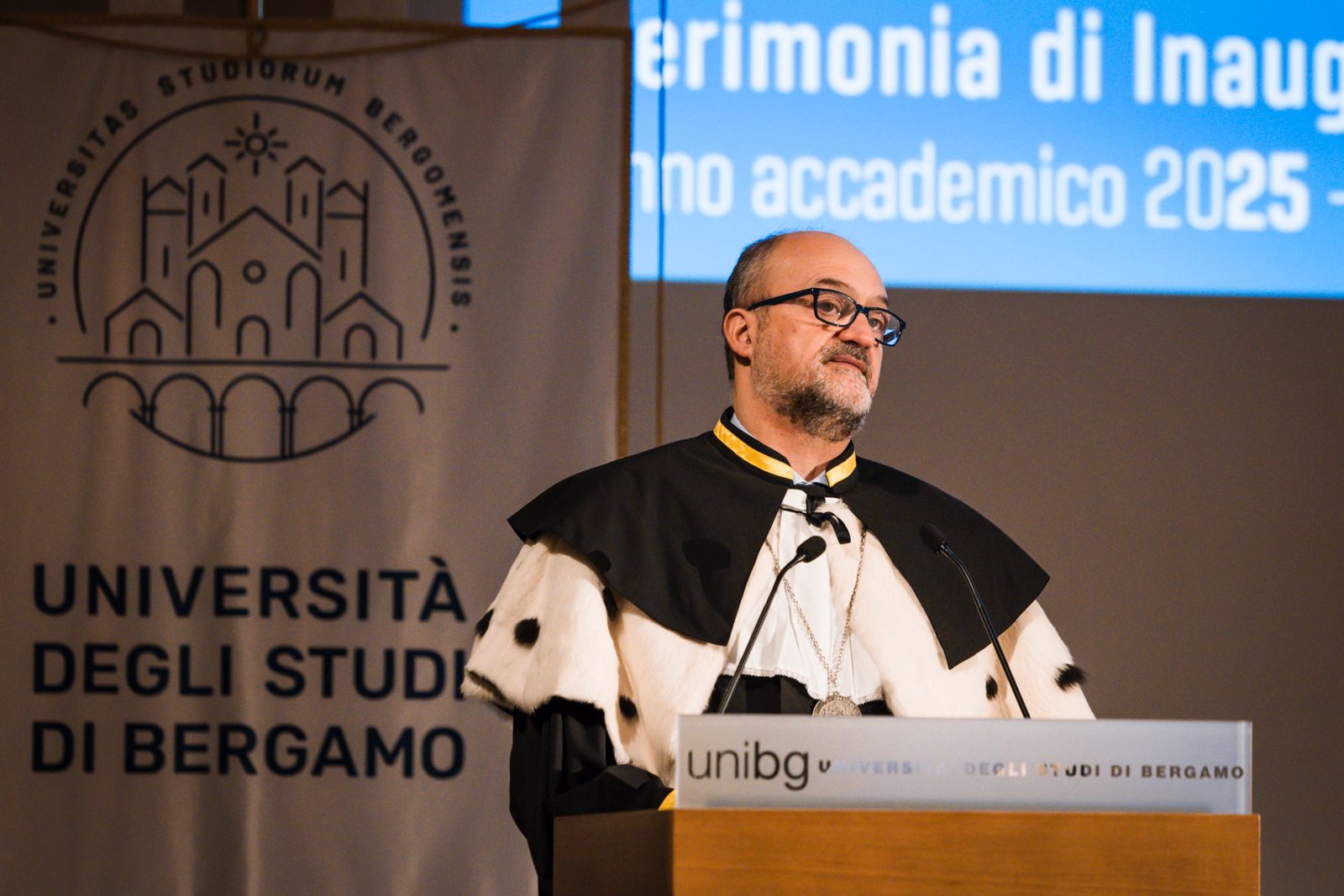
BERGAMO (ITALPRESS) – In the midst of an unprecedented revolution, led by digital and artificial intelligence, the role of the University is decisive to address together the challenges of change, with tools of knowledge and shared responsibility. With this spirit and these goals officially started today, Wednesday 26 November, the Academic Year 2025-2026 of the University of Bergamo. The Aula Magna di Sant’Agostino, which for the occasion has changed face with industrial robots, monitors and interactive panels on AI set up in collaboration with Intellimech and JOiNT Lab, has welcomed the academic community and numerous city authorities, including the mayor of Bergamo Elena Carnevali, the vice president of the Umberto Valois Province, the president of the Lombardy Region Attilio Fontana and the advisor of the Minister of the After the academic procession and the interventions of Michela Farina, representative of the Component of technical, administrative and librarian staff in the President of the University Quality, and of the President of the Council of students and students of UniBg, Giorgia Morotti, the word passed to the rector Sergio Cavalieri, who in his prolusion recalled the scope of the “new cognitive revolution” in action: a profound change, able to transform the same knowledge.
“Automation, robotics and artificial intelligence are redesigning the relationship with the work and functioning of economic, social and cultural relations,” said Cavalieri, underlining how digital transformation “is already changing our cognitive processes and how we think”. The challenge, according to the rector, is to prevent innovation from eating new inequalities: “Many people risk staying on the edge of an increasingly digital economy. We need new tools to understand knowledge just as the world changes under our eyes. In this scenario the role of universities is decisive“. In his speech, Cavalieri retraced UniBg’s commitment to artificial intelligence: from the constitution of the Interdepartmental Table on AI to the publication of an AI research agenda, from the activation of the PhD in Artificial Intelligence for Sustainable Futures to the Guidelines for ethical and conscious use of AI. The Center for Responsible AI will soon be born, designed to bring together skills and design in collaboration with international national research centres. Ample space has also been dedicated to internationalisation, considered a strategic lever to respond to training needs and the increase of graduates at national level.
UniBg now has over 280 foreign language teachings, 490 international agreements, 12 master’s degrees and 1 three-years in English, as well as 19 double active titles. “The goal is to be more and more attractive, especially towards foreign students,” said Cavalieri. The central point of Athens programming is also the theme of infrastructure and the right to study. In his speech the rector recalled the start of the work on the Montelungo-Colleoni compendium, which will lead to 282 beds reserved for the right to study thanks also to the important contribution of Region and Fondazione Cariplo, 170 beds in free market and 7 new classrooms. The Student Office of Via Calvi is also being completed, an impulse to the works already started on the Polo di Via Statuto, the full reuse of the sports facilities of Loreto, scheduled for next spring. The ceremony ended with the Lectio Magistralis of Prof. Oliver Riedel of the University of Stuttgart, dedicated to the role of digital twins and AI in new generation production systems, confirming the strong link between the two universities – among the main European poles of innovation – preceded by the performance for the first time of the Inno dell’Università degli Studi di Bergamo, “O vos, est aetas”, introduced by Professor Virgil.
Sergio Cavalieri, Rector of the University of Bergamo said: “In our role we are called to look with responsibility to the future of young people. We live a period marked by geopolitical tensions and a very rapid technological transformation, to which we often respond with concern or resignation. On the other hand, it is essential to convey confidence and awareness, enhancing the investments that the country allocates to training. The University must promote a constructive vision of the future, able to make our students and our students protagonists and not spectators of change.” Elena Carnevali, mayor of the Municipality of Bergamo added: “The University of Bergamo is a fundamental ally for the development of the city. Investing in knowledge, research and training means building a stronger Bergamo, more attractive and able to grasp the transformations of the present. With the Bergamo City University Manifesto we chose to strengthen this collaboration and give it a shared strategic horizon. As Administration we are committed to working alongside the University to consolidate an ecosystem of knowledge and innovation articulated around the three strategic backbones – health, mechatronics, culture and creativity – and capable of networking expertise, enterprises and institutions. A path that generates new opportunities for young people and confirms the role of Bergamo as a city that grows and looks forward”.
For Umberto Valois, vice president of the Province of Bergamo “Every inauguration of the academic year represents much more than the start of the teaching and scientific activities: it is the renewal of a pact. A pact between the University, its students and the community surrounding it. A mutual commitment to grow together, to generate knowledge and to transform it into development throughout the territory. Our University has been able to build over the years a solid and irreplaceable role in our territory, combining openness and international look and at the same time strong rooting with the Bergamo land. On the part of the Province I express a sincere thanks to the Magnificent Rector for the constant collaboration and always oriented to the construction of effective synergies”.
Attilio Fontana, president of the Lombardy Region said that “The ceremony represents the highest and symbolic moment of the University’s life, a true act of trust in the capacity of the University and the entire academic community to be a guide in change to the advantage of the collective fabric. We live in a time when the digital revolution permeates our everyday life and the way to study, produce and communicate requires new tools and, above all, new knowledge. Education and research are what allows us to govern innovation and guide it towards a fair and sustainable future, tracing the strategic direction of the University and its role in building an open, international and responsible innovation ecosystem. The University is first of all community: a meeting between peers, a shared experience made of comparison and collective construction of knowledge. This is the right time to assume responsibility for study, growth and change. The opportunities of digital technologies are linked thanks to the ability of the University to be part of the global networks that shape the future of industry and society, as demonstrated by international cooperation programmes, from China to India, which testify to the desire to anticipate change and contribute to building it. The task of the University is to generate shared progress, opening up to the international context and the territory, alongside businesses and citizens, to protect our most valuable asset: well-being. The wish is that the new academic year is a year of commitment, discovery and new opportunities for the whole community.”.
Alessandra Gallone, Minister of the University and Research Minister Anna Maria Bernini concluded: “Bringing the greeting of Minister Anna Maria Bernini to the University of Bergamo, my University, was a great pleasure. Today we have remembered that this is really the time of choices: a time in which universities, research, AFAM, enterprises, health, public administration and territory must work together to build a new humanism capable of facing the technological and social challenges that we have ahead. Minister Bernini is translating this vision into concrete actions: an FFO at the highest historical level, the confirmation of the resources for the right to study that allows to more than 40% of Italian students – and Bergamo – to be free from taxes, investments for young researchers and for the continuity of National Centres, Partnerships and Complementary Plans, up to the full valorization of AAFAM as the third pillar of knowledge. Bergamo is becoming increasingly a university city, with a strong ecosystem made of culture, innovation, sport and community. To the students I addressed the most important message: there is no happiness without freedom and there is no freedom without courage. Training is the true revolution of the country, and we will continue to support it with determination”-
– UniBg press office photos –
(ITALPRESS).
