
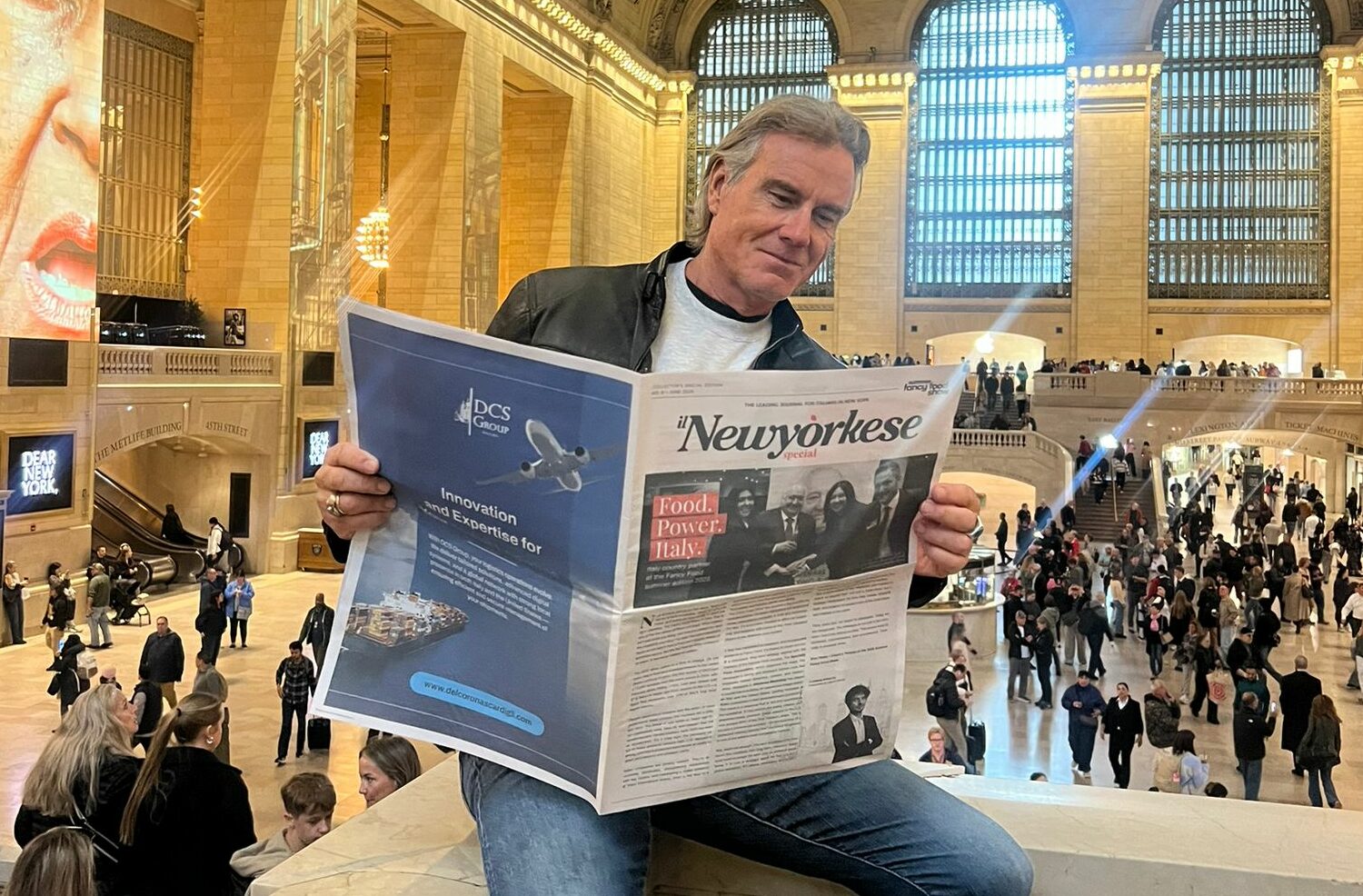
Jimmy Ghione (profile IG) tells how parmesan, prosciutti style and powdered wines threaten the cultural and economic value of Made in Italy, especially during Christmas, the richest period of the year, and calls on the Italian community: “Let us defend authenticity before it is too late.”.
Jimmy, in your investigations you have often denounced the phenomenon of Italian sounding. What is it and what is widespread in New York?
Italian sounding is an increasingly widespread phenomenon that consists in the use of images and words that refer to Italianity, making the consumer believe that a product is Italian despite having nothing to do with Italy. It’s a deception. For years, with Striscia la Notizia and with Coldiretti I carry on a battle to defend Italian products, food and not only, from spreading imitations. We Italians are very good at creating quality and gastronomic culture… and in the world they try to copy. The problem is that these copies hurt everyone: They deceive the consumer from a sound and visual point of view and damage our economy on the short and long term.
In New York, which is the center of the world, you find “finto Italian” products everywhere: on the shelves there are packaging with tricolors, names like macaroni, parmesan, salami bologna logos that recall our imagination as the Tuscan hills for example. The consumer thinks he buys Italy, but there is nothing Italian. And this generates cultural and gustatory confusion: if you habitate people to fake products, then when they taste the original they risk not to really appreciate it.
That is why I ask the Italian community in New York to be a spokesman for this battle: who knows authentic Italy must defend it.
Many “Italian” products, from parmesan to ham style, invade the shelves in the Christmas period. How much does this imitation affect the economic and cultural value of the true Made in Italy?
The phenomenon of the false Made in Italy in the world exceeds the 100 billion euros abundantly, and during the holidays it grows even more. At Christmas people are willing to spend, wants to make beautiful figure with relatives and friends, and ends up filling the cart of products that look Italian but are not.
The damage is double: on the one hand it subtracts market to our companies, on the other it devalues our gastronomic culture. When they sell you an industrial cheese such as “parmesan”, or a generic salami as “prosciutto italiano style”, it compromises the perception of the value of the real DOP and IGP products. Made in Italy must be certification, quality and tradition: If we confuse it with the fuff, we lose it.
You talked to New York consumers and restaurateurs: can they really distinguish a 100% Italian product from one that “mima” it? Is awareness growing?
Depends. Many serious restaurateurs import directly from Italy through reliable channels and know well what they put in the kitchen. Others, however, buy in second line to save: it is there that comes the non-Italian mozzarella, the generic tomato, the sausages “in the way”. And in a pizza, for example, you don’t even notice if it’s fake mozzarella.
The risk is huge: getting used to New Yorkers eating something that is not Italian… convincing them that it is Italian. And so we lose identity. There is still too much confusion because of deceptive packaging and marketing: tricolor graphics, admirable names, slogans that recall Italy. You have to be on guard.
To be sent and communicator, what can Italian institutions, media and companies do to defend our agri-food reputation, especially abroad during peak periods such as Christmas?
We need strong surgery. Tarot products spread because there is not enough protection. Compared to countries like France, we are still back in the policies of protection and promotion of our supply chain. Executives change, strategies as well: there is no continuity. Coldiretti is one of the few organisms that constantly works to defend the true Made in Italy. The state should do the same, intervening also against questionable instruments such as the food traffic light: you will find extra virgin olive oil or red parmesan because “too fat”, while the industrial cola may be green. That’s absurd.
In Canada and Sweden I discovered factories where the wine is produced in powder, with real kits, then sold as Italian wine, Barolo, Chianti, just to say a few. And then fake hams, synthetic salami, things that have nothing to do with our gastronomy. We must act seriously.
Do you think that new generations, more sensitive about sustainability and traceability, can be the key to overcoming Italian sounding?
I hope very much in young people. But it serves education: if a boy grows by eating “parmesan” instead of Parmigiano Reggiano, he risks not recognizing the taste of the original. The habit to false is the main danger. However, 90% of the effort must be made by the government, with clear controls and policies. Young people don’t go to the pizzeria to ask for cheese certification. We have to explain to him: at school, in the media, in families.
What message do you want to launch to American consumers and Italians abroad to really choose Made in Italy when they want to bring “the taste of Italy” to the table?
My message is simple: dedicate two more minutes to read the label well. Check the origin, check that there are certifications, avoid “simil-italiani”. Choosing the authentic product is not only a matter of taste, but of health and respect for those who produce quality in a serious way.
I also pay attention to online shopping, especially at Christmas when Italian baskets go out of fashion: often contain stuff that Italian is not. Always prefer the original: is good, it is better and supports the true Made in Italy.
L’articolo Jimmy Ghione warns New York: fakes threaten Italian Christmas proviene da IlNewyorkese.
