
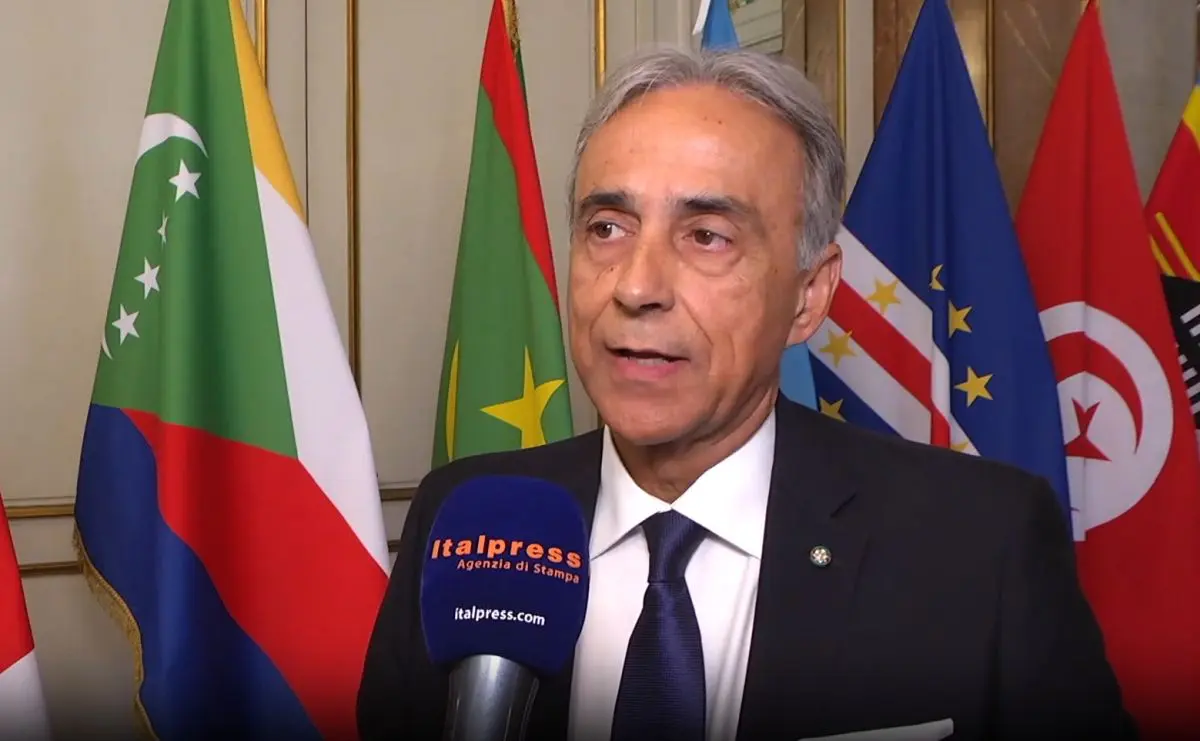
ROMA (ITALPRESS) – The demonstrations of the square in Iran are a “indirect test” for the ability of the regime to remain “a state that more or less works and faces the economic crisis that bites the population, even in the presence of external sanctions, even in the presence of a latent military threat and with a fragile economy and a tired society”. It is the opinion of Ambassador Ettore Sequi, former secretary general of the Farnesina, interviewed by the Italpress agency.
The disorders of recent days arise from unstoppable inflation and a substantial loss of value of the Iranian currency, but it can be said that these same disorders are providing a broader reading, for a country that seems to slip from “an economic crisis in a sovereign crisis”. According to Sequi, a “simultaneous deteration” of the three pillars on which the stability of a regime such as the Iranian regime, subjected to foreign sanctions, can be seen. “These three pillars are represented first of all by an economic performance that is at least at a level of ‘minimum union’, to prevent the crisis from affecting the population. The second pillar is the possibility by the State, the regime, to have effective control of the public order. The third pillar, finally, is the problem of legitimacy. These manifestations are questioning the same legitimacy of the regime,” the diplomat observed.
The protest of these days, therefore, sees as detonators inflation and the exchange rate “but the long mice is an accumulation of social frustration, of erosion of income and of perception of corruption and incompetence”, said Sequi. This is the game that the regime plays within the country but there is one, according to the ambassador, that at the same time continues outside, six months from the so-called “ 12-day war”, which saw first the Israeli military intervention and then also the American one from the ninth day, with the bombardment of three Iranian nuclear sites.
“The recent visit by Israeli President Netanyahu in the United States has not been unnoticed. There is a great concern that this moment of weakness can be interpreted as an opportunity to strike again the regime and possibly make it collapse. We know that the U.S. request is to avoid resumption of uranium enrichment, but we also know that Netanyahu told Trump that Iranians are restarting the enrichment process and that they are sending forward the program for the construction of missiles and vectors,” Sequi noted. If, from the internal point of view, the messages are sometimes conflicting, with a part of the political elite trying to contain the manifestations without triggering, at least for now, “a response of maximum violence” precisely because aware of the fragility of the situation, outside the message that the authorities of Tehran try to send is “not to take advantage of these manifestations, of these difficulties, to try to strike the regime”.
The ambassador’s analysis ends with a plastic image, which sees “three corners that fit each other”. The first is that “Iran is not only in front of an episodic protest, but a process of internal, economic and political looming, even in view of the debate already begun on the succession of the Supreme Khamenei Guide, now old and sick”. The second corner “is that the response that the regime is giving is not yet of maximum violence, with promises of dialogue and at the same time threats of arrests”, thus trying to give signals of availability, but at the same time they are not interpretable as weakness. The third aspect, finally, according to Sequi “is that of an unstable balance, because the protest arises from an economic crisis that has no rapid exit and because the external, international environment, obviously makes any internal solution more difficult”.
– Photo screenshot video Italpress –
(ITALPRESS).
