
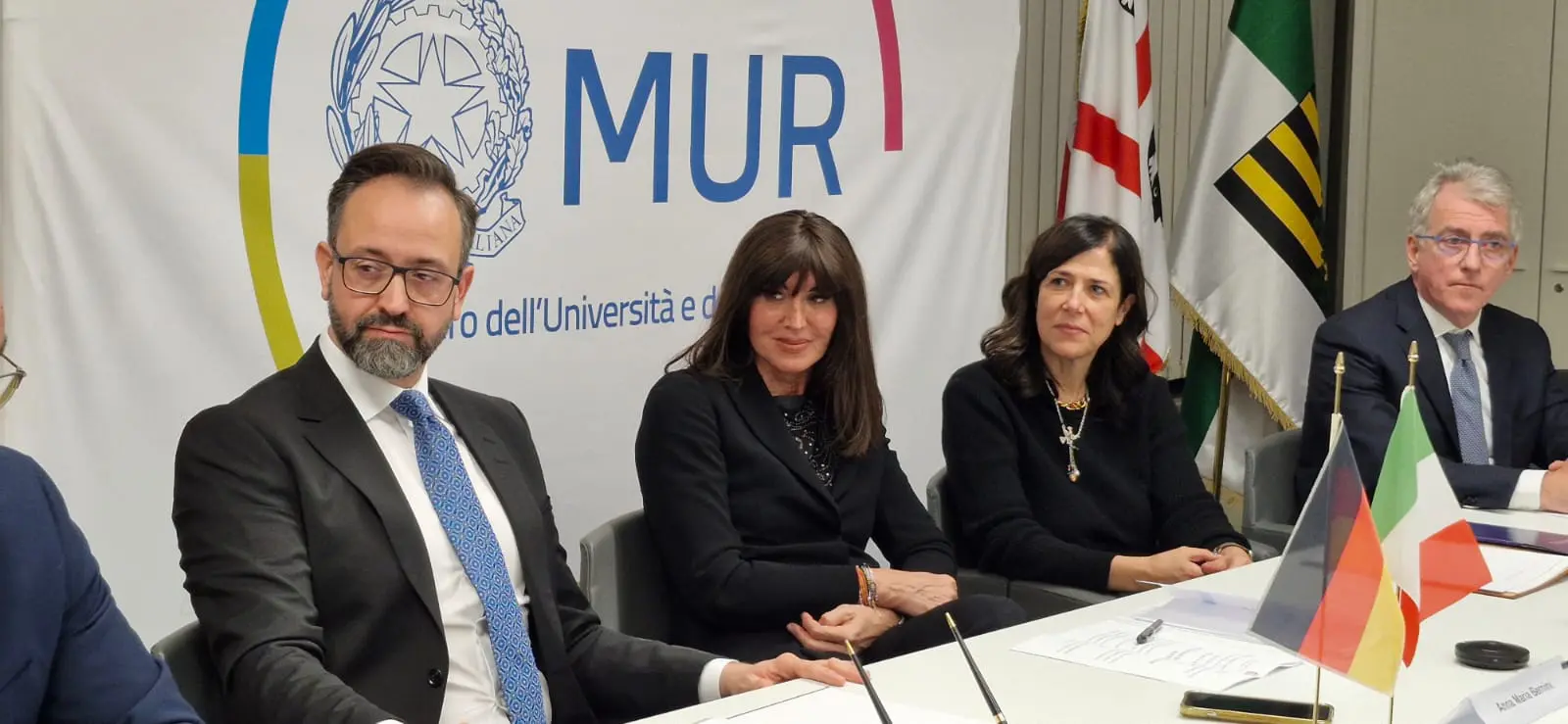
ROMA (ITALPRESS) – Sardinia and Saxony united towards a single goal: to host together in their respective territories the Einstein Telescope, the last generation gravitational wave detector that will allow the international scientific community to study the history of the universe, since its origins. The formality of cooperation between Italy and Germany has arrived today with the declaration of intent signed by the Autonomous Region of Sardinia and the Free State of Saxony at the headquarters of the Ministry of University and Research.
Event attended by Minister Anna Maria Bernini, President of the Sardinia Region Alessandra Todde, Minister President of Saxony, Michael Kretschmer (remotely), Minister of Science Sebastian Gemkow, and representatives of the two scientific communities. Both regions are candidates to realize the important technological infrastructure: Sardinia in the area around the former mining site of Sos Enattos in Lula (Nuoro), Saxony in Lusazia. The strategic agreement was signed considering the option of configuring the Double L Einstein Telescope, which provides for the possibility of building two twin observers, conformation that would allow the interferometer to maximize sensitivity in search of weak gravitational signals.
“The agreement between Sardinia and Saxony strengthens a common vision and ambition: to develop a solid and long-term collaboration in the field of gravitational waves, one of the most advanced sectors of global scientific research, also thanks to the support of the Ministry of Foreign Affairs and International Cooperation and thanks to the spirit of institutional collaboration demonstrated by the President of the Sardinian Region, Alessandra Todde, who contributed decisively to the strengthening of dialogue and common work,” says the Minister of the University and Research. “Einstein Telescope is a great research infrastructure and represents a strategic investment in the future of fundamental science, advanced technologies and Europe’s ability to remain competitive and attractive in a rapidly changing global context. The cooperation between Sardinia and Saxony demonstrates how different territories for history, geography and traditions can work together to build a common scientific future, founded on excellence, openness and mutual trust”, the Minister concludes.
“Today is a crucial day of the ambitious path we have embarked on with the application of the Sos Enattos website to host the ETA,” commented the President of the Region, Alessandra Todde. “From the very first moment – the president explains – we did not understand the candidacy of Saxony as a further obstacle on our path. On the contrary, we have grasped the possibility of joining forces to arrive together with a goal which, moreover, is hoped also by the scientific community. The same Nobel Prize for Physics, Giorgio Parisi (president of the technical-scientific committee established by MUR in support of the Italian candidature) has channeled this solution”. “The collaboration with another European peripheral region such as Saxony – continues Todde – represents an added value for us. We arrive at this milestone through a work built over time, along with the Ministry of University and Research, the scientific community, the Ministry of Foreign Affairs and Ambassador Sequi. A patient work, made of relationships, data, continuous comparisons, for which I thank all, starting from the ministra Anna Maria Bernini who has always supported the project in the framework of a loyal and fruitful institutional collaboration”.
“The scientific collaboration between the Italian community and the Saxon community, in particular in the context of the Einstein Telescope project, has been solid and started for a long time, as evidenced by the letter of intent signed at the end of 2024 between the INFN and the DZA and the common scientific activities in progress in the candidate sites,” says Infn President Antonio Zoccoli. “The fact that this collaboration now extends to political institutions is a further fundamental step, which strengthens the candidatures of the two regions to host the future observatory of gravitational waves.”.
Already in December 2024, the Infn and the Dza signed a letter of intent in which they engaged for cooperation on the Einstein Telescope. In June last, in Dresden an important meeting was held between the Minister of Science of Saxony, Sebastian Gemkow, and an Italian delegation composed of representatives of MUR, MAECI, the Sardinia Region and the Infn, who represented the opportunity to discuss the possible synergies between Italy and Saxony within the framework of the ET project and set the basis for the agreement that will be signed in January. Finally, last November a joint team of researchers from INFN, DZA and the Karlsruhe Institute of Technology (KIT) installed an advanced measuring station for electromagnetic noise near Bautzen, in Saxony, on the candidate site to host ET, strengthening collaboration between the two scientific communities.
-Photo xi2/Italpress-
(ITALPRESS).
