
by Stefano Vaccara
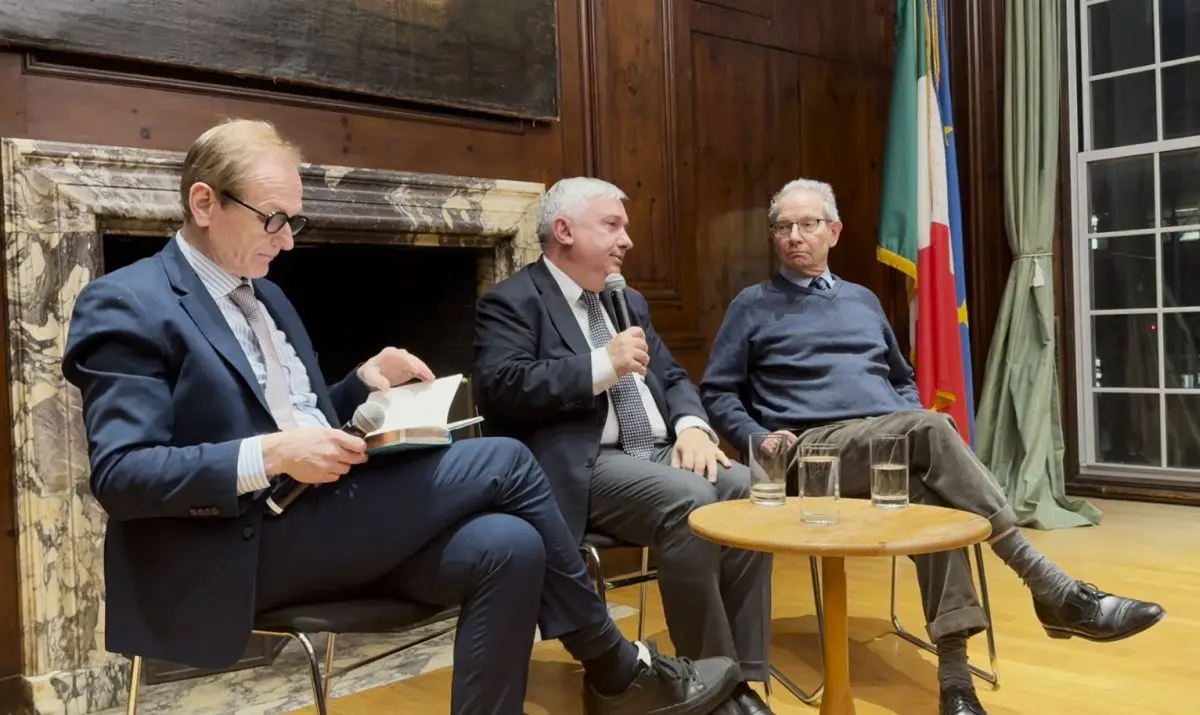
NEW YORK (UNITED STATES) (ITALPRESS) – At the Italian Institute of Culture in New York, directed by Claudio Pagliara, the presentation of Maurizio Molinari’s “The global shock” (Mondadori 2025) turned into a tight discussion on how to read Donald Trump’s foreign policy. Pagliara moderated the comparison between the author and professor Charles Kupchan, professor of international relations at Georgetown University, with questions from the public on Europe, Greenland, AI and new forms of conflict.
Molinari opened up with a framework of hybrid threats that, in his words, are changing the rules. He recalled episodes of drones not identified over sensitive infrastructure and the feeling, now widespread in Northern Europe, that war is no longer an abstract hypothesis. From here his reading of the global competition: Russia, says, returns to a “traditional” offensive, while China acts with technological tools and positioning, from superiority in the microchip chains to the digital control capacity, to pressure in the South China Sea with a constant and “immobile” naval presence, similar to an encirclement strategy.
The key point, for Molinari, is the American reaction: behind apparently disconnected moves, he sees a logic centered on raw materials, especially on oil. The thesis is that Trump points to strengthen the ability of the United States to influence energy prices and, therefore, to put under pressure rivals and opponents, from Russia that finances war with energy revenue, to China still dependent on imports.
Kupchan, however, challenged the idea of a coherent strategy. In his opinion Trump governs by impulses and contradictions, oscillating between isolationism and neo-imperial temptations, often influenced by the last person who convinced him. Venezuela and Iran, he observed, fall into the long history of American interventions. The real fracture would be Greenland: any coercion towards a NATO ally would mark a historical breakpoint, risking the survival of the Alliance. In the dialogue, there has also emerged a “eighteenth century” reading of trumpism, between protectionism, unilateralism and a modern version of the manifest destiny, with the idea of expanding territory, resources and prestige. For this reason, Kupchan concluded, the question is not only what Trump wants, but how much Western institutions react, in the United States and in Europe, in front of a policy made of sharpness and continuous shocks.
– Photo xo9/Italpress –
(ITALPRESS).
