
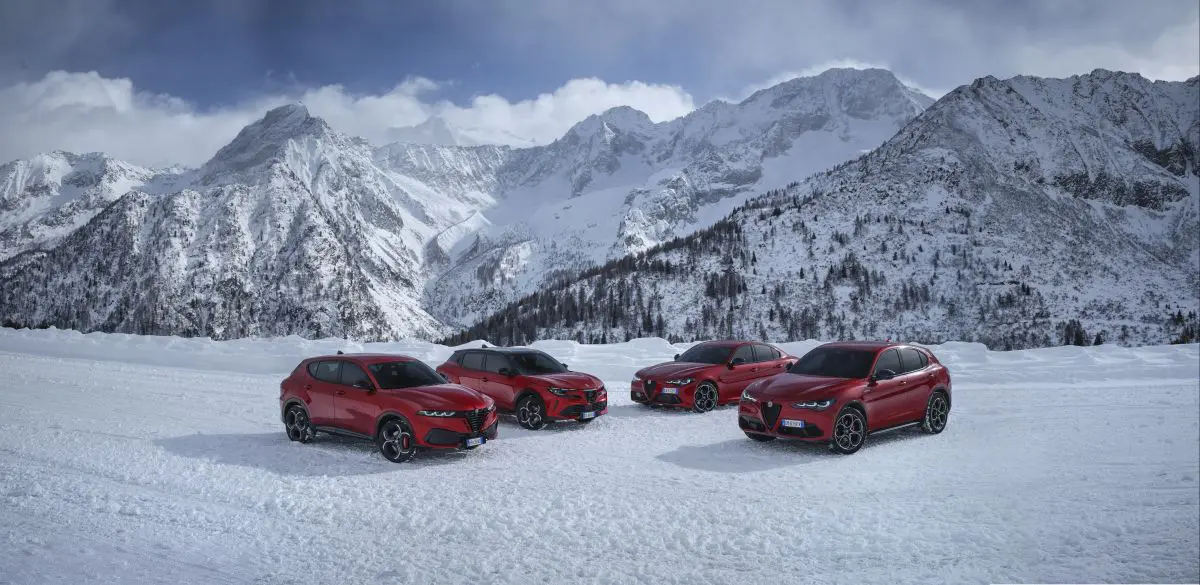
TORINO (ITALPRESS) – Ensure maximum sportiness and the best possible traction even in the most difficult conditions of adherence, without sacrificing the dynamic precision that always represents the essence of the brand. This is the principle behind the Q4 system, the integral traction of Alfa Romeo today adopted on different models of the range through two different architectures but united by the same design philosophy: on the one hand the mechanical solution applied to the high-performance sedan Giulia and the Stelvio SUV, on the other the electrified technology used on the hybrid versions of Junior and Tonale.
The integral traction is part of Alfa Romeo’s technical history for almost a century. Already in the 1920s the brand experienced the first prototypes with 4×4 scheme, but the first concrete application arrived in 1951 with the 1900M “Matta”, designed with an integral traction system of outstradistic setting.
In the 1980s, with the growing diffusion of four-wheeled motorsports, Alfa Romeo brought this technology back to the center of its offer debuting in 1984 with the Alfa 33 4×4, initially proposed in the Giardinetta version and later also on the sedan.
The system was then evolved with the introduction of an electromagnetic joint. A decisive step came in 1991 with the concept Protèo and with the presentation of the 33 Permanent 4, equipped with permanent integral traction with viscous joint. Since 1992 all Alfa Romeo integral versions adopted the name Q4, applied to models such as 33, 155 and 164. Precisely the competition cars derived from the 155 Q4 gained important sports successes, including the 1992 Italian Superturismo Championship and the 1993 DTM.
Today Q4 technology is projected towards a new generation by integrating electrification and innovation. On the hybrid versions of Junior and Tonale the integral traction is obtained thanks to the combination of thermal motor on the front axle and electric motor dedicated to the rear, without mechanical connection between the two axes. This architecture allows quick and predictive torque distribution, reducing weight and inertia, while guaranteeing high mobility and efficiency.
Giulia and Stelvio are the most traditional expression of Alfa Romeo integral traction. The Q4 system uses an active referral box (Active Transfer Case) with a new generation electronic clutch that physically connects the two axes and modulates the distribution of the pair in real time.
In normal conditions the car favours the rear traction to preserve agility and driving accuracy, transferring couple to the front only when necessary to improve stability and mobility.
The importance of this technology is also confirmed by the numbers: in 2025 the Q4 versions represented 26% of the Alfa Romeo sold globally, with a particularly high diffusion on Stelvio and Giulia. A result that demonstrates how integral traction continues to be a fundamental component of the pleasure of driving the brand, capable of combining sportiness, safety and versatility in every condition of use.
photo: ufficiom stampa Stellantis
(ITALPRESS).
