
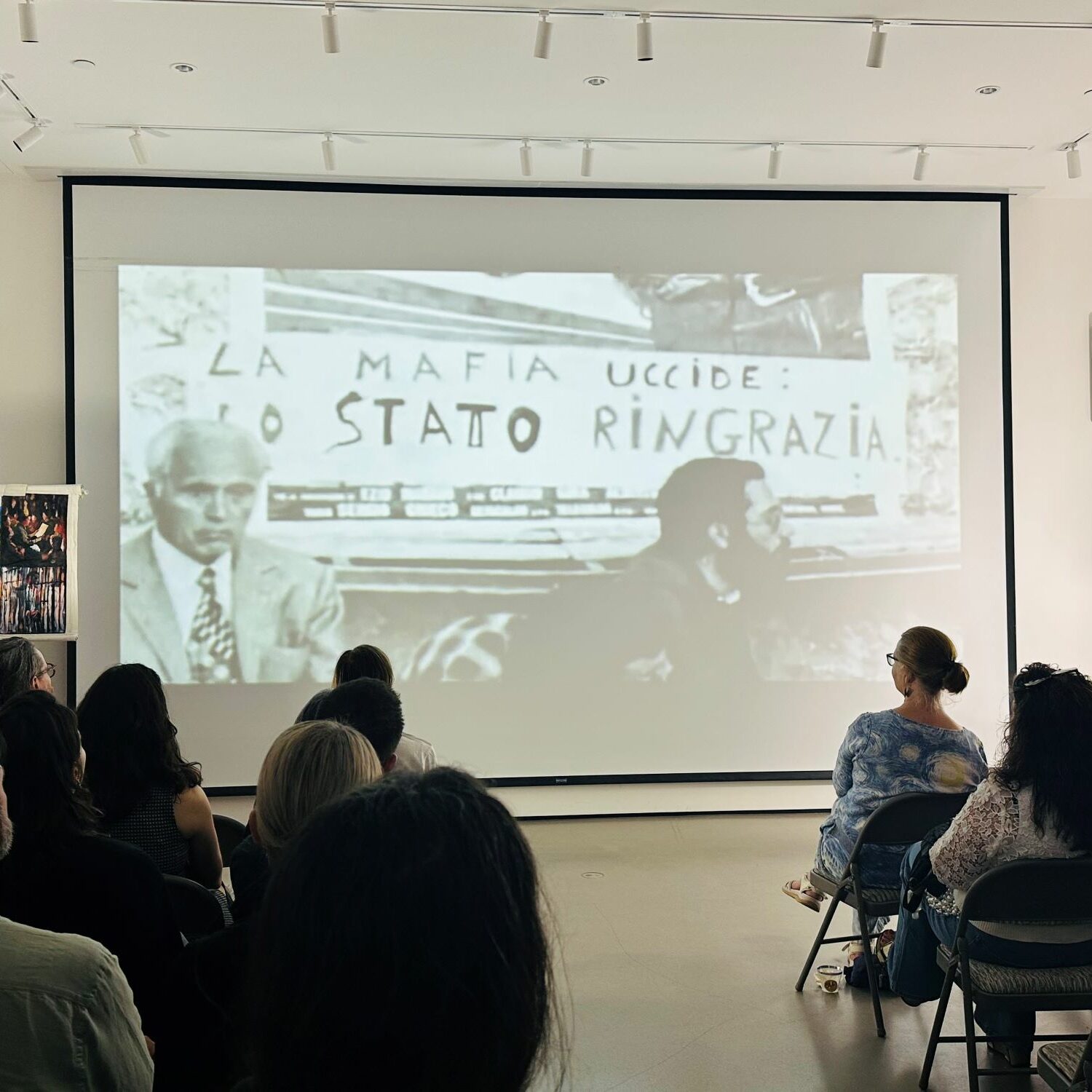
The event An evening of Sicilian culture, held on 17 April, at the Italian American Museum, in the heart of Little Italy, revolved around the show written and interpreted by Ignazio Chessa, built as a monologue of about an hour. On stage, Chessa crosses multiple registers and multiple voices: the mother of Peppino Impastato, a mafia boss and the same Impastato. The story goes on alternating moments of direct narration and more theatrical passages, with references to the tradition of cantastorie that make the story immersive and almost familiar.
The historical context remains in the background, but it is never neutral. The Seventies in Italy are evoked as a period in which terrorism, mafia and politics intertwined often opaque, between violence and collusion. It is in this scenario that the story of Impastato, activist and founder of Radio Aut, killed in 1978 after having publicly denounced Cosa Nostra through satire. His transmission, “Onda Pazza”, was aimed at political and mafia power with a direct and irreverent language, capable of breaking the monopoly of official information.
In the scenic narrative, this dimension also emerges through the figure of the singers, who introduces and accompanies the story as he would in a Sicilian square. It is a narrative choice that holds together memory and prayer, transforming a story already known in a shared experience with the public.
Alongside the theatrical dimension, a visual level is also developed. The animations and illustrations do not work as a simple background, but accompany the narrative, underline some passages and help make it more immediate.
After the show, the rhythm becomes more relaxed but does not change direction. The tasting of Sicilian wines led by Debora Greco of the winery Baglio Bonsignore, together with the aperitif curated by Norma Gastronomia, maintains the connection with the territory. It is not only a convivial moment, but an extension of the story: Sicily remains the guiding thread, declined through flavors and products.
At the end of the evening, what remains is the story of a voice that has tried to make itself felt in a hostile context and that, after decades, continues to circulate even far from the places where it was born. Because some stories, when they find the right way to be told, do not remain firm in the past but continue to speak to the present. As Impastato said: “If beauty was taught to people, it would be a weapon against fear, resignation and omerity.” This is precisely the point: educating beauty, because men and women never lose curiosity and amazement.
L’articolo A Sicilian culture evening at the Italian American Museum proviene da IlNewyorkese.
