
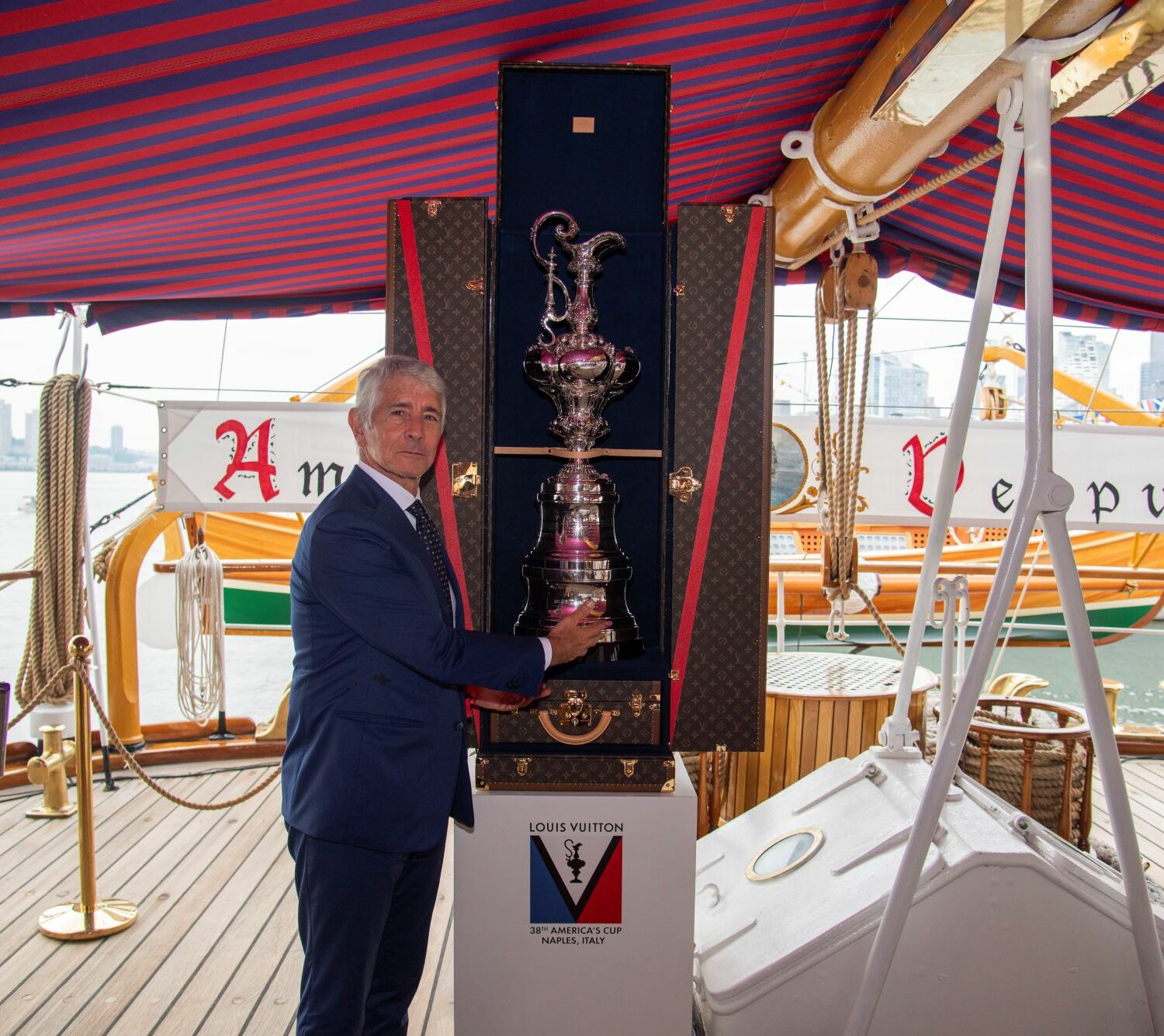
On board Nave Amerigo Vespucci, during the stay in New York for the two hundred and fifty years of American independence, we met Andrea Abodi, Minister for Sport and Youth. With him we talked about the candidacy of Italy at Euro 2032, new stadiums, the legacy of Milan-Cortina and the basic sport, between great events and peripheries
Minister, the Euro 2032 dossier enters a decisive phase. Beyond the respect of UEFA deadlines, what occasion is this candidacy to really change the face of Italian sports facilities and strengthen the image of the country abroad?
Euro 2032 is an opportunity more than a challenge: the possibility of changing face to our stadiums. This circumstance shows that sometimes we need a stimulus or an expiration to do what is necessary to do, but I wish to change the paradigm regarding infrastructure, trusting that in the future there is no need for an event to make investments necessary to modernize them. That is why I believe it is very important that in 2026 a ‘institutional authority’ is fully operational for the benefit of what must happen in 2032. For the first time, in fact, the Italian Government has put together a package of solutions of an administrative and financial nature, precisely to remove every alibi, to remove any resistance and any bond to the improvement of the system. It is no coincidence that we have ten stadium projects that are developing, starting from Rome and Milan, and this is the signal that we have undertaken the right direction. They are stadiums with international characteristics, thanks also to investments of foreign property, often American matrix. Milan and Inter in Milan and Rome have exactly these characteristics, and the hope is that culture, know-how and international marketing can contribute to the evolution of the football system as a whole. From the most purely sporting point of view we are winning and convincing in many disciplines, it is football to have remained a step back, testify to the eternal absence of Italy to the World Championship and the difficulty with which our teams go ahead also at European level.
Among the stages that could enter the dossier there is also the future plant of Rome in Pietralata. What will be the decisive elements in the final choice and what idea of stage has in mind for Italy of the next decades?
The stage of Rome is having an acceleration of the administrative process, so today we can say with reasonable certainty that it will be realized, also thanks to the work of the Commissioner of Government, the engineer Massimo Sessa, who has the tools to reduce and compress the times of the procedures. It will be a fantastic stage, also of new conformation, an asymmetric stage in which the curve of the fans of the house will be even more monumental than the rest of the system, demonstrating the will to make the presence and passion of the public, that is the motor of football. In general, the new stages we are making will be characterized by functionality, accessibility and economic and environmental sustainability. Most of them will have a positive energy balance, because I am convinced that the roofing of the stadiums should provide a photovoltaic system. Nothing particularly extraordinary, but for us in Italy it is a novelty that I hope will be an example for the realization of other sports infrastructures and that can be a good example also for civil society, optimizing the relationship between production and energy consumption.
A few days ago he also met the new president of FIGC Giovanni Malagò. You also talked about the completion of the work of Milan-Cortina and the Youth Olympic Games of 2028. What is the legacy that these great events should leave the territories and citizens once the spotlight is turned off?
There are three important inheritances. The first is that of the material infrastructure, the permanent ones, because they continue to live even after the Games and do not become, as sometimes happened in the past, abandoned places. The second element is the promotion of Olympic values, practice and sports culture, factors that help make society better. The five circles are not only the symbol of sport, but also the symbol of coexistence, confrontation, sociality and respect. It is a legacy that we must and can continue to feed also thanks to the 2028 youth Olympics, which will allow us to work very much, especially within schools, for the wider diffusion and the consequent rooting of these values. The third is that of the economic and tourist relapse on the territory. The enormous global visibility has allowed the whole world to know less well-known but beautiful places in our country, and I am convinced that this will determine over time a different way of conceiving tourism, more seasonally adjusted and distributed on the territory. Then there is another inheritance that we must manage, the financial one, because Milan-Cortina was a planetary success, recognized by all, but it made necessary investments not entirely covered by revenues. Together with President Malagò and the Fondazione Milano-Cortina we will also have to manage this aspect, which is not secondary. And when we talk about public resources, we are used to doing it with great respect.
From the Olympics to the Europeans, great events are increasingly opportunities for comparison between countries, but also diplomacy. Can Italy play a leading role in promoting sport as a language of peace, cooperation and dialogue among peoples?
That’s what we’re already doing. The government is totally aligned to do its part, respecting the roles and autonomy of sport, to give every support to this diplomatic component. The second part of the twentieth century was also marked by the ability of individual sports disciplines to be a factor of cultural mediation, and we are convinced that a phase like this, even more widely conflicted, needs a sport dialogue that produces its effectiveness, along with political diplomacy.
Alongside the great international events, the challenge of basic sport remains. How can you make sure that investments for events such as Euro 2032 and Milan-Cortina also produce benefits for amateur sports companies, schools and young people who practice sports every day?
From the moment of our settlement, we have changed method to affirm our vision that we are transforming into a model, following also the indications of paragraph seven of article 33 of our Constitution which provides for the recognition of the value of sport as an educational, social and promotion of psychophysical well-being. This is for us a very strong reference that relates the great competitions and the great performance with the social dimension of sport. Thanks to this government chaired by Giorgia Meloni the Italian sports model is consecrating itself on the balance between the two souls, as never before: the one that promotes the competitive dimension up to the highest level and the one that develops the offer of the basic sport to which we are giving increasing financial support in favor of the socially more exposed dimension: the urban peripheries, the internal areas, the people with disabilities and the poorer families, with contributions. This inevitably goes through schools, which, contrary to Anglo-Saxon culture, are not a place where sport has consecrated itself. We are investing a lot of resources to improve the school’s sports facilities and have reorganized after ten years the Youth Games, the competition between schools and Italian students that symbolically represents the political agenda of the relationship between school and sport. A model that we are also expanding to the university system, which is certainly not like the American one, where the NCAA culture is rooted and very strong, but is nevertheless aimed at enhancing sports practice in the university, also strengthening the tools of the ‘double career’. The goal of this pillar: to make the sports base strong, to contrast the sedentary and to contribute to the physical and mental well-being of people.
L’articolo Andrea Abodi and the future of Italian sport, from Euro 2032 stages to schools proviene da IlNewyorkese.
