
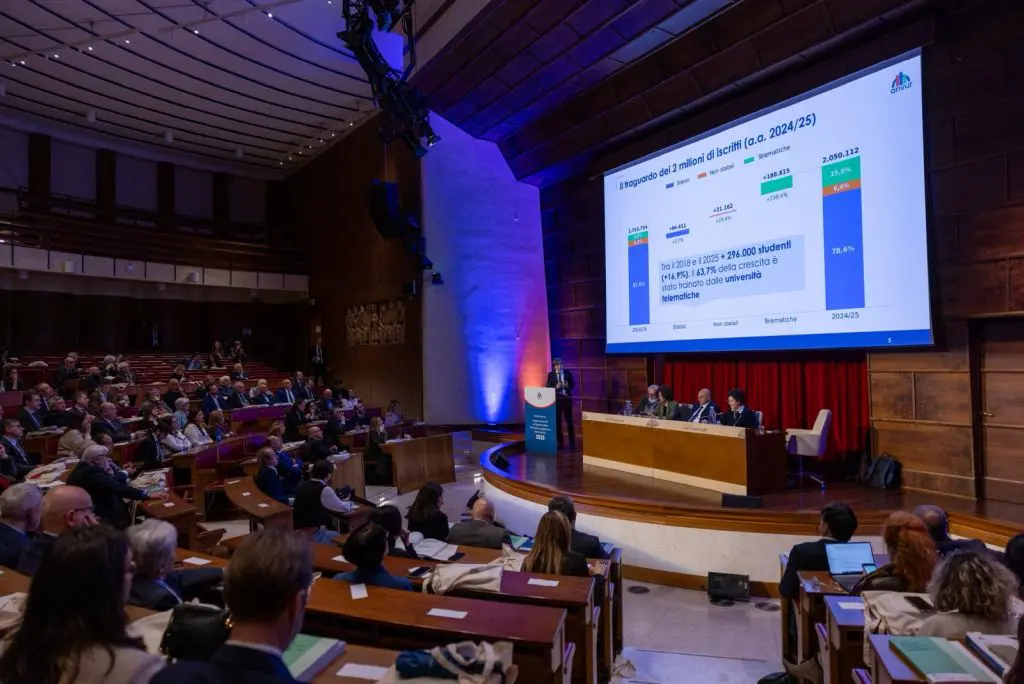
ROMA (ITALPRESS) – The Italian university system reaches in 2024/25 the 2.050.112 members, the absolute historical maximum, with 100 universities, 413.943 graduates, 65.617 teachers and overall income for 19.5 billion euros. The total growth compared to 2018/19 is 296.000 registered (+16.9%), but the most characteristic of this period is its composition: 63.7% of this increase has been the telematic universities, which in six years have passed from 6.8% to 15% of the total student population. This is what emerges from the Report 2026 on the system of higher education and research published this morning by Anvur. At its 5th edition, the Report offers an updated and detailed representation of universities, AFAM institutions and public research bodies, outlining the national framework, international positioning and system evolution from the pre-pandemic period to today. The increase in subscribers is distributed in a homogeneous way on the national territory. In the North 80% of the universities recorded an increase of inscriptions, at the Centre 2 atenei on 3, while in the Mezzogiorno almost 1 ateneo on 2 (48%) evidences a contraction, with a strong reduction in the economic-legal area. In this context, the growth of telematics (+158.6% in six years) is characterized by the presence of almost 4 telematic students on 5 who would have an alternative in presence within 60 minutes, sign that the choice of the telematic channel responds more to personal needs of cost, work and accessibility than to a real lack of supply on the territory. On the geographical level, moreover, the data on the stay in the area of residence are detectors: in the Mezzogiorno almost 1 master student on 2 studies far from home, against rates of stay greater than 70% in the Center-North. The system is therefore a significant factor in spatial mobility, with more intensive output flows from southern regions. Universities in Italy are present in 274 municipalities in 50% of which (127 offices) with a number of enrolled under 500 students. Many of the small venues host courses in health professions, but it should be noted that in 50% of the university offices there are only 1% of students (about 17,000). The Report shows a significant increase in the presence of students with foreign diplomas, doubled in six years from 52.493 to 111.566 and equal to 5.4% of total enrollment. The incidence is higher in non-State universities (8.5%) than state universities (6.0%), while telematics is marginal (1.1%). The main countries of origin are Iran (12.7%), Turkey (7.7%) and China (6.4%), followed by India, Tunisia and Pakistan. However, there are significant differences in spatial distribution: in the North-West, 36.3% of students with foreign diplomas are concentrated in the Centre on 28.3%, in the North-East 22.5%, while the Mezzogiorno – considering South and Islands – only 9.9%. The system grows, but it keeps less than it looks. In the cohort 2018/19, six years after enrollment, 62.7% of enrolled in three-year degree courses earned the title, while 26.4% interrupted their studies. A dispersion that aggregate numbers on subscribers tend not to highlight. Trends by type of atheneum go in opposite directions. In state universities the rate of abandonment between first and second year to three-year degrees is at 13.3%, while in non-states falls at 6.4%. In telematics, on the contrary, it rises to 18.8% (it was 13.7% in 2018/19) – the highest value of the system, constantly growing – indicating how a significant share of the subscriber does not pass to the second year. The loss of students is in fact concentrated in the initial stages of the course, suggesting the need to strengthen orientation activities and the ability to early intercept fincoming rallies. The Report deepens the theme of the relationship between graduates and teachers: in the telematics in which 69.2 graduates per teacher are registered, in front of 5.1 in the state. Telematics within them are however very different (the data oscillates between a minimum of 10.2 and a maximum of 121.8). On the side of the teaching requirements, the report points out that 6 telematic universities on 11 do not meet the minimum requirements in the face of 100% compliance of state universities. A structural difference that refers to the ‘theme of scalability’: the same degree of study is achieved in very different conditions. The university staff grew by +20.9% between 2018 and 2025, passing from 54.261 to 65.617 units and with a structural recomposition that sees the relative weight of ordinary and associated professors growing by 9,1 points. Despite this increase, the Italian academic system is the oldest in Europe: 55.4% of teachers are at least 50 years old, while only 1% are under 30 years old, compared to 22.6% registered in Germany. The average age of entry into the qualification of ordinary professor in 2025 was 51.7 years. The opposite of the genus emerges contrasting dynamics. Women represent the majority of registered (55.7%), enrolled (56.8%) and graduated (57.7%), but are still underrepresented in the apical positions, with 29% of ordinary professors and 24.5% of rectors. The gap tends to expand along career progressions, although promising signs of advancement in higher levels are observed compared to 2018. The Ordinary Fund (FFO) has structurally exceeded the threshold of 9 billion euros, reaching in 2025 9,368 billion (+27.6% from 2018), However, inflationary erosion recorded over the last 7 years reduces growth in real terms to +7.3%. The geographical distribution of the FFO shows a divergent effect: the standard cost and the rewarding share are more favourable to the northern anestheses (+33.4% North-West, +32,2% North-East), while the Islands record a more contained increase (+15.9%). On the side of the right to study, the cover of eligible grants reached 97.7%, thanks also to the resources PNRR that brought the fund to almost 882 million in 2024. AFAM: 94,000 members and the first PhDs. The institutions of the High artistic, musical and choreutical formation count in 2024/25 93.539 members (+17.5% in 4 years). The international component is significant, with almost one student on six of foreign citizenship, of which 50% from China. The first cycle of AFAM doctorates started with 476 members and 62 courses, but the sector still expects a complete regulatory reorganization, beginning with national artistic skill. The 14 public research bodies (EPR) count about 10,500 researchers, strongly concentrated in the CNR (62.6%). Between 2023 and 2024 the fixed-time staff doubles, indicating a pressure on the post-PNRR system that can be lightened with the stabilization paths. 57.5% of role researchers are at least 50 years old and only 8.4% less than 40 years old, highlighting the need to strengthen generational replacement through an entry of young researchers. State funding is also growing, with the FOE reaching 1,486 billion euros in 2025 and scores a +17.6% compared to 2018. In international comparison, Italy recorded the second growth in Europe by number of members of tertiary education between 2019 and 2023 (+14.4%), but the share of graduates between 25 and 34 years stood at 31.6%, still significantly lower than the OECD average (48.4%). The distribution of graduates at the level of the title shows that the gap is mainly concentrated in three-year courses (13.5% against 26.1% OECD), while in master’s degrees (17.4%) Italy exceeds the OECD level (16.1%). Sa reduction of 9,6 percentage points between 2021 and 2024 is observed in the NEET (18-24 years), the best result in Europe. The figure for STEM graduates, which is 40.3%, is approximately 5 points higher than the EU average. In research, Italy improves its share of funding in Horizon Europe (from 9.2% to 9.4%), but at a lower rate than Germany and France, which grow with greater intensity, respectively from 16.4% to 17,3% and from 11.9% to 12.4%. The Italian system, therefore, participates more, but risks losing ground in the international competition for resources destined for excellence. ‘The report we presented today is full of ideas of reflection, but it is also an opportunity to propose a complete representation of the university system and research – commented Antonio Felice Uricchio, president Anvur -. The data are comforting: the numbers of members, graduates and teachers grow, the regret remains to denote territorial inequalities that are amplified with the need to find support tools for the weakest areas.‘It is a very rich edition this year with interesting thematic focus: we are faced with a season of relaunching the university system, especially in terms of members, with a general geography of the modified system – The challenge for the future will be to understand which model of university adopt, taking into account that we remain behind compared to other European countries by number of graduates in the youth group. We will also touch the Afam system, which has seen great news in recent years as the new PhD, launched by the Pnrr. The system of research bodies has grown in terms of numbers and results, but it is a system with a stabilisation period with 4 out of 14 collecting 90% researcher.
– photo print office Anvur –(ITALPRESS).
