
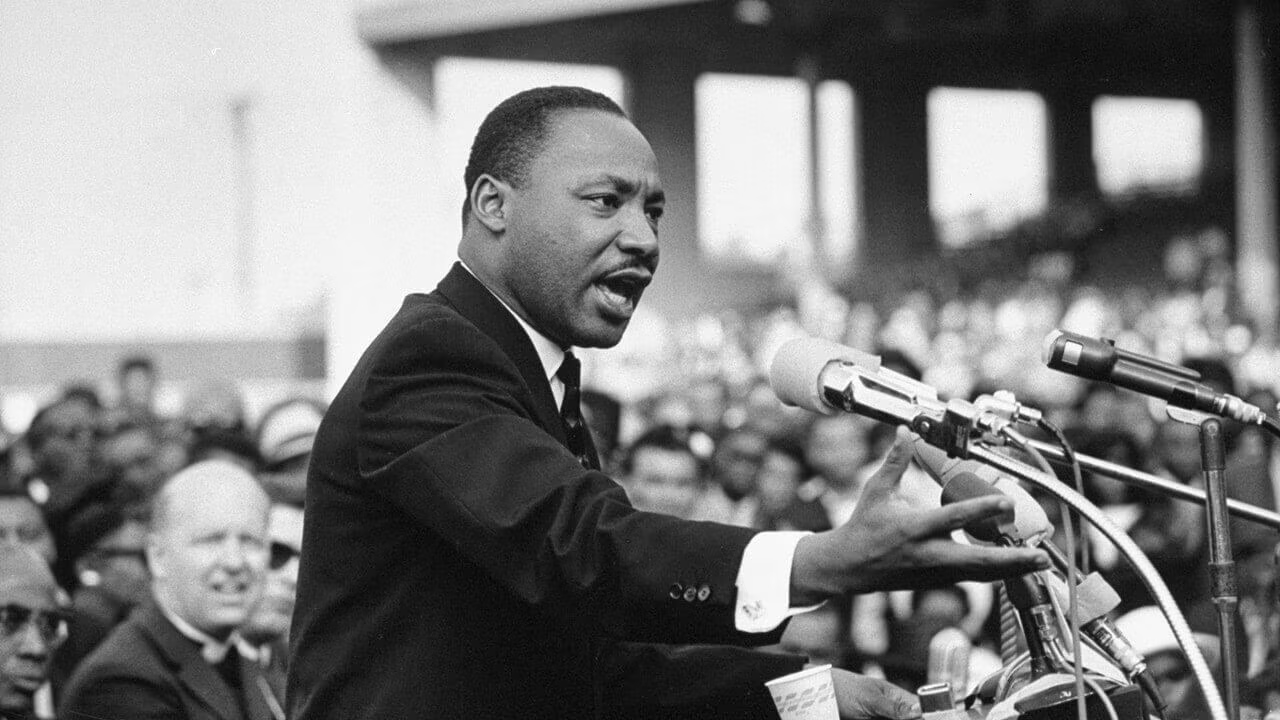
It is natural to think so, if not to speculate: with the declassification of secret documents on the November 22, 1963 Dallas bombing, will details be found connected to April 4, 1968? Day on which the Protestant pastor and Nobel Peace Prize winner in 1964 and who became legendary a year earlier for his famous speech entitled ‘I Have a Dream’ – Martin Luther King – was assassinated? It was April 4, 1968 when it happened, and the entire African-American community felt dying.
In Memphis, in the state of Tennessee, the civil rights leader was killed, at 6 p.m. local time, and there was nothing more for the reverend to do. His death, in addition to anticipating that of Robert Francis Kennedy by two months, provoked a wave of protests in almost all the United States of America by the African American community. Vehement protests dictated by despair at the loss not so much of one of the many landmarks of the era, but if anything, at the passing of a true beacon that illuminated the world in those particular 1960s.
A death, that of Mlk, on which the classic phrase ‘case closed’ cannot yet be affixed to the file. The dots, the details, on this obscure affair are still many and who knows if they will ever be revealed in their entirety and completeness, since then-President Donald Trump declassified the documents related to his tragic death. And not only his own, also those related, as mentioned above to the Dallas bombing, in which President John Kennedy was killed on November 22, 1963, and that related to the bombing in the Ambassador Hotel in which to fall victim, under the blows of a lone bomber, was John’s brother, then Senator Robert Francis Kennedy, on the night of June 5-6, 1968.
Yet, on this very day related to his sad anniversary it also seems quite natural to wonder if he had not been killed on that fourth day of April, other than that march on Washington against the Viet-Nam war, how would he have continued the struggle for civil rights? Perhaps he would have survived to the present day? By crossing the 96-year age line? Maybe yes or maybe no.
Perhaps he would have lived to be at least 80 years old to finally see the first African American president in U.S. history? Forty years after the same Rfk, had they not both been killed, would have given him the chair of vice president of the United States of America. And what would he have said about not only the first, but also the second Trump presidency? What would he have thought about the Black Lives Matter protests? These are the questions that even now run through our minds as we face the anniversary of his tragic departure.
Martin Luther King was born in the city of Atlanta, in the state of Georgia, on January 15, 1929. He came into the world in the America that was about to enter and face the maelstrom of the Great Economic Depression a few months later because of the Wall Street Crash. He, like his people, however, had entered another vortex far meaner, far more cowardly: that of racism. Cut off from the rest of society because of the color of their skin.
That crazy situation, called ‘racial segregation,’ legalized by Jim Crow laws. All blacks did not have the same rights as whites, and Martin Luther King, the son of a Protestant pastor, followed in his father’s footsteps to try to stir the pot, to stir consciences. Eventually, he succeeded, only, to make his voice heard, he, of course, needed the right opportunity.
Opportunity that came on December 1, 1955. Thanks to that civilized refusal of that sweet little seamstress, named Rosa Parks, who would not give up her seat to go to the last seats at the back of the tour bus that would take her home, because those ahead were all reserved for whites after a hard day’s work. That fuse started something that is still called heroic and in turn ‘legendary’ today.
His protests, his sermons, his words and, above all, the way in which he enabled the achievement of achievements, which had all the flavor of social victories, represented, for the black community itself, a real godsend, enlightened the consciences of the entire U.S. society. His peaceful protest reached its zenith on August 28, 1963, with the immortal phrase, ‘I Have a Dream.
Schools, universities, transportation, offices were beginning to be open to blacks at last. Then, most likely, the biggest challenge. That was to stop the escalation of the Viet-Nam war with another big demonstration in Washington. Demonstration that, unfortunately, never happened.
A sniper ended his life, as mentioned, on April 4, 1968, and since then, even for him, there has been speculation upon speculation, rumor upon rumor, without ever arriving at the truth, the one taken to the grave, in 1988, by the one who would appear to be the real killer of civil rights leader James Earl Ray. So, does hope really lie in the declassification of those precious documents that buried the truth for a full 57 long years? Or have all the documents, with the relevant information pertaining to his case, long since disappeared?
Despite this, even today his voice, his words, his messages and his struggles are still imprinted in contemporary society and will certainly remain for another long century and, still, beyond the controversy of what happened on that distant day or even in those distant days before his murder that did not interrupt the dream, rather it fueled it anyway.
The article April 4, 1968: the tragic day of Martin Luther King comes from TheNewyorker.
