
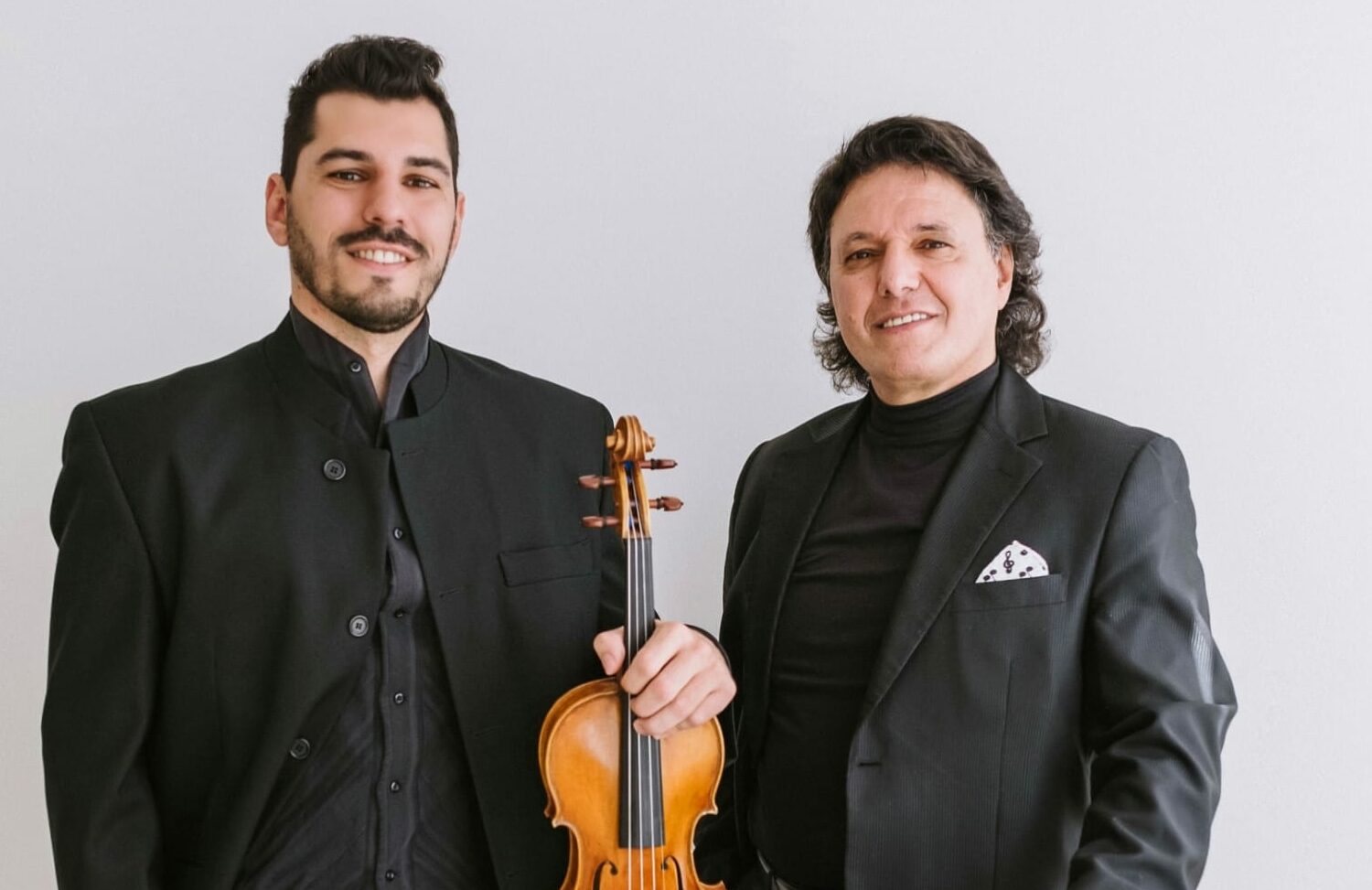
There is a February 2, 2026 that, for UCRI and for the Roman communities, has the taste of a breakthrough: at Carnegie Hall in New York the Concert for the Day of Remembrance / Samudaripen, promoted by the Union of Rome Communities in Italy with the support of the Italian Institute of Culture, UNAR of Palazzo Chigi and some of the main European and international organizations. Gennaro Spinelli, president of UCRI and solo violinist: an interview that crosses memory, identity, stereotypes, history, family. And a clear conviction: culture, and music in particular, can come to the heart before even that to the mind, disregarding prejudices and restoring dignity to a truly collective memory.
President Spinelli, help us to contextualize the New York event and the work done with UCRI?
The event will take place on February 2 at Carnegie Hall in New York, in collaboration with the Italian Institute of Culture, with the largest European and world cultural organizations in Rome – ERIAC, ERGO Network, the IRU, the Roman International Union – and of course with the National Office for Racial Antidiscriminations of Palazzo Chigi: so there will also be the government with us. It’s an appointment related to Memory Day.
Why the date of February 2, and not on January 27, or Memory Day?
On January 27 I will be at the Quirinale da Mattarella, in concert by the President of the Republic. And so we had to set this great event on another date. It will be an event for everyone’s memory.
When he says “memory of all”, what does he mean concretely?
We will naturally remember the memory of the Shoah, the Holocaust of the Jews. There will be the Samudaripen, which is the specific Holocaust for the Roman communities. We will remember the LGBT communities, the aphrodiscendents, people with disabilities, Jehovah’s Witnesses, the deported war: We will bring all minorities back. For us it is extremely important to remember all these days, because memory must be of all, a collective memory.
Why bring this memory to New York and to Carnegie Hall?
Because it will be a world-class event and the Carnegie Hall is one of those places that have an internationally renowned artistic character. We organized the concert in the largest nation in the world, and we chose the focal center of that nation, New York, just to find us all together. There will be Roma and Sinti American communities: Today in America there are many organizations of the Roman community. There will also be the American Rome Council to support the event and initiative: He will gather communities from all over America and take them to Carnegie Hall. We’ll be honored.
As President UCRI and as a musician, what does this project mean to you?
I played in the greatest stages of the world: at La Scala, at San Carlo, in April we will play at the Phoenix of Venice. But returning to New York is always something very exciting. It is the center of the world today, let’s say it. The Pope too, so I played on October 18 in the Vatican, is American. Bringing our culture to the centre of the world is an essential, important, of great impact: it will allow us to remember the Samudaripen, which is too often forgotten.
What is forgotten exactly when it comes to memory?
Too often a generalization is created on Memory Day, or when we talk about memory itself, and we lose the core of the people we go to remember. Everyone rightly remembers the 6 million Jews, but nobody remembers the others. And we want to change step, change course: we want to remember all, because today we can finally talk about everyone. Today, finally, thanks to information, research, scholars, historians – we don’t speak for hearing, we speak scientifically – we have data, we have elements. Today we have information about more than half a million dirt people in the romanès communities thanks to historians and research. More than 100,000 only at Auschwitz. And now we want to tell and hand over a memory.
And here comes the music: why is it so central?
Because music is the greatest cultural emblem of the Roman community. Everyone listens to music often and doesn’t know it’s Roma music. Carnegie Hall will play ethno-symphonic music. It means that we will resume classical music written by the great composers who were inspired by the Roma: the Zigeunerweisen, the Tzigane of Ravel, the Csárdás of Monti, the Hungarian Dances of Brahms. They paid tribute to this great culture, but they did not fully value it. Then we take that music that was brought to the classic way and bring it “at home”, in the Roma way. And let’s play the traditional Roma music by bringing it back to the classic way. We create a great artistic bridge to create a humanitarian and social bridge. This is the great strength: this impact.
And the audience responds..
We sold out at La Scala, at San Carlo, and at Carnegie Hall we already have the numbers to go to the sold out. We are very, very happy.
An important detail: the entrance is free. Why this choice?
The event is offered completely by UCRI, it is fully funded by the Union of Romanès Communities in Italy. We care a lot, because we will finance every ticket, every entrance. We strongly want this: memory must be something accessible to all. When we talk about large theatres, great places of culture, we always talk about very important prices and not everyone if they can afford it. Culture should be open to the world. And then art and culture come to the heart before the mind: This is essential. Passing through art means bypassing preconceptions, stereotypes, and getting directly to the heart of people. When you get to the heart, I assure you that life changes, racism is destroyed and you only see people, human beings. In this case people who play and bring us joy, joy, make us dance, make us laugh and make us cry. And crying is an emotion: We don’t have to hold her, not even on stage. How many times do you see artists moving on stage? Art is also this.
In the concert there will also be homage to other communities.
We’ll be happy with the Jewish communities because that’s right. There will be homage to other minorities because it is right so. We will pass through Roman music as an essential to get to the rest of the world: as union, bridge, will to be heard, remember and know.
Yours is not a counterposition, but it is an integration of Memory.
That’s right. When it comes to memory, if I tell you about “Schindler’s List”, you know the melody. If I tell you about Samudaripen, I want to introduce you to another melody, another music. Here’s what I’m doing in New York: I come to introduce you to another piece, another part of memory, equally sad, equally great. We don’t come to take anything away from anyone: we come to donate. I want to give extra memory, something more. This is the sense of culture. Discrimination often starts right from there, from that “Back to your home”.
She, at that “go back to your home”, responds with a very clear identity.
I always introduce myself like this: I am Gennaro Spinelli, an Italian citizen of Roma ethnicity. Gennaro: a person, with his own decisions and autonomy. Spinelli: a family, a family heritage, a family history. Italian citizen: rights and duties of a sovereign state. An extra culture. In addition to speaking Italian, to celebrate Christmas, I speak an extra language, I have extra customs, extra features. Nothing less Italian: Just something extra. And I am proud to be Italian, indeed proud also to be Abruzzo. We always talk about Abruzzo or arrostics or negative things, but never about the beauty of that place.
When we talk about Roma we think about the nomad fields in Italy, always perceived negatively.
Numbers to the hand is a wrong narrative, the majority of Italian Roma have been present on the territory for over six centuries. Today in Italy the estimates of the Council of Europe speak about 120,000, but making a maximization, about 180,000 Roma. 180.000 out of 60 million. Of these 180.000 people, about 10,000 live in those who are now called “nomadic fields”. But they are not fields and are not nomads: they were created in the 1970s-80s, so for over 50 years those people have been firm. Have you ever seen a nomad in the same place for 50 years? No. They are modern refugee camps: people arrived after the Balkan war that, instead of finding houses and reception, found fences. That is why memory today is extremely important.
So it changes everything. As she often points out, integrating who has been here for six hundred years is a paradox.
I am part of the Roma of ancient settlement, arrived between ’300 and ’400: the first document of the Roma dates back to Bologna in 1422, much before Italy was called Italy, much before Unity. So when they say, “Go back to your house”, I say, this is my home. How do you integrate a people who have been on a territory for over 600 years? I live in the house, I work. There is a social problem that has nothing to do with the beauty of culture. I am Roma not by nationality: Romanian is a nationality, Roma is another thing and is often confused. I am Roma because I speak an extra language, the romanès; because there is a historical and family heritage; because I have extra traditions: the Bučipé as a rite of engagement, the Calipé as a rite of the funeral, the marriage lived in a certain way, the Kris who is an internal court, a court of honor. They are elements that I also told in my book, Rom and Sinti. 10 things you should know, just to make these concepts easy and for everyone. And I care because that stereotype based on ignorance I lived on my skin. People don’t even know what we call ourselves: they still call us “zingaries”.
The term “zingaro” is commonly used with a negative sense, like an insult, but is not a synonym for “rom”.
“Zingaro” is an etheronim: it is the way a people call another people, often in a derogatory manner. Like us in America we are called “mafiosi”, “pizza e mandolino”. But I’m Italian, I’m not pizza and mandolin. We are “rom”, which is an ethnonymity: the way we self-defeat. This makes you understand how much, when it comes to Roma and sinti, the basicity is missing. And all this ignorance brings discrimination: discrimination based on non-knowledge.
She mentions very strong numbers on perception in Italy.
Today there are reports that say that about 83% of Italian citizenship has negative feelings towards Roma and sinti without knowing them. We are the highest rate of discrimination in Europe, with the lowest percentage of presence: 0.25%. And of this 0.25, only 10,000 live in the fields. Just 10,000. It is like judging Italy by going to look at the clochards living on the street and saying: “This is the Italian culture”. No, that’s a problem, not a country’s culture.
In this context, she chooses art as an instrument of “survival” as well as of story.
We found this method: between art, will and survival. Art. Music is study and continuous sacrifice: I’m a diploma in the conservatory, like my sisters and my father. We are not only “graduates”: we are scholars, researchers, people who want to bring beyond this culture by making it known. And to do so we chose art.
How many “Roman music” do we listen without knowing?
Lots. Think of Django Reinhardt, who we will propose to Carnegie Hall: with only two fingers revolutionized European jazz. Think of the Csárdás of Monti, the Hungarian Dances of Brahms. Even musical structures that the science of harmony allows to lead back to that world. Today the flamenco: who goes to Spain and does not feel flamenco? But they never thank Roma. The Roma “exist” only when there is a social problem: caravans, mugging, thefts, and it’s absurd.
She often tells that many Roma and sinti, even professionals, choose to hide.
There are university professors, doctors, engineers, doctors who no longer say they are Roma. Because discrimination leads you to this. And yet I could give you a thousand examples: Elvis Presley, Charlie Chaplin, who in his memoirs says he is feeling shameless, Rita Hayworth – in the analogue Rita Cansino, a Calé of Spain. I could also mention sportsmen and artists: there are so many. But at some point, to make a career, you realize that you no longer have to say that you are Roma because someone bothers.
She has always done the opposite.
All I did was say I was Roma. I’m taking the music to Carnegie Hall. The day before, on the same stage, plays Itzhak Perlman, one of the greatest violinists in history. And I will have the honor to bring my music to that stage. This is something you can’t buy: career and fame don’t give it to you. It is pride. The pride of being yourself. I’ll take a lot of barrels. I constantly fight proactively: I am not a destroyer, I try to build, but it is a continuous comparison. But high-headed, bringing our art to the places of peace and culture of the world.
There is a network of important institutional support around the event.
The Italian Institute of Culture has pointed us a lot, the Italian Consulate has given the patronage, and many parliamentarians have called us both from the European Parliament and from Italy to push this event. They want it in many because it is right, because it is true, because you can and you have to do. Above all, in this historical period in which racism seems to be deceased: on social media you can say anything and no one can tell you anything. And racism takes away opportunities. It takes you home, life, everything.
In this sense, she speaks of a “revaluation of a whole people”.
That’s right. “The Roma conquer Carnegie Hall”: is the revaluation of a whole people. It’s not about Gennaro anymore. I don’t want my name on the covers: I want my people on top of the covers. That is why it is called “Concert for Memory” and not “Gennaro Spinelli in concert”. My name comes later. And on the poster there are my name, that of my father and that of my grandfather: three generations on one manifesto. Here’s the handover.
His grandfather, among other things, was deported: this memory also enters the concert.
Yes. My grandfather was deported to concentration camps, he was a witness to the camps. Unfortunately there is no more. He disappeared a few years ago during the Covid. My name is Gennaro Spinelli like him. It’s a strong argument. But on stage we’ll talk about it. We will also make a lecture-list in the middle of the concert: We will explain what we are going to do, because it is important to give meaning to what we do.
On stage she will be with her father: this is also a symbolic choice.
Yes. I chose to keep it with my father, who is a great musician, university professor. But he’s my father. What you will see is not only a father and a son who play: it is a continuous handing down. He and I are trying to improve: a positive challenge, with a smile. It is the same concept that we bring to our communities: progress and advance despite everything. And musically it is also a metaphor: My father gives me a harmony on which I suddenly, and I do the same for him. We create the basis for the lives of others, mutually.
There will also be words in the concert besides music, then?
There will be words, explanations. There will be poems read in romanès, obviously translated then in English and we hope also in Hebrew language: we have friends who will come and we would like to translate them into Hebrew. Just to give the concept that is of all. And we will read Jewish poems in romanès: we betray, we divide, we gather and we find ourselves constantly. Then we will give “scientific” concepts: music, we will explain why this music is scientifically romanès, what is Roma music, as it is identified. But always between smiles, practical explanations and of course so much, so much music. The concert lasts an hour and a half, but I assure you: it will look like four and you will never want to leave.
You said a phrase that hits: “I don’t come to remove, I come to donate.”.
If I only talked about Roma, I’d do the same wrong they did to us. It’s important. I felt hate, I was sick, I suffered discrimination and I would never do it to someone else. When you put it on your skin, you’d never do it to anyone. And then there are words that hurt. Maybe one says “I don’t say it for discrimination”, but it hurts me. If you use certain words to define homosexuals or aphrodites, you hurt because those people have suffered that word. We have a few words.
From here his “pragmatic” choice of fighting through music.
Yes. I chose the most concrete and right way to fight. I could only play classical music, I could just do Beethoven, because that’s what I studied. But that wouldn’t make sense. I’m not just that. I’m my music. Because Roman music is not a score: It is a character, it is a way of being. And this concert is also the way to represent our culture with the offspring, with handing down.
She also tells a very hard educational principle: “If you’re good it’s not enough, you have to be exceptional.”.
My father always told me: you must be exceptional, if you are good, nothing is worth it, because unfortunately you are Roma. So if you’re good, you have to be great. For this study eight hours a day. That’s why I have a tool that costs like a house. And that’s all I do is think about how to improve.
And the motivation is not individual: she insists on doing it “for others”.
That’s right. When you do it for you there are millions of ways to quit, you’ll find billion apologies. Finding excuses is very easy. When you do it for someone else, for others, there is no big excuse to stop. If you fight for your son, you’ll never find an excuse. I do it for my people, I do it for all my brothers.
One last detail: were you the youngest president in UCRI history?
Yes. I’m in the second term. I became president at 28, the youngest ever. But I am a son of art: I started my first organization at 18, I have been working at Palazzo Chigi since I was 21 years old. And from there I never stopped, always being a musician.
How do you say good-bye to Roma when you leave?
There is a greeting we often say between Roma: Baxtalo sastipé – or, as we say, But baxt ta sastipé – means “with so much health and luck”, so that you can be lucky, that you can take the best possible way. It’s a big, deep wish. It is the way we say goodbye: that you can be strong and lucky in your life and in your choices.
It is the wish that I wish you, on behalf of all the editorial staff of New York. By the way, will UCRI also reserve tickets to our readers?
Yes. We care a lot: we want to donate tickets to New York. They’ll be free. We’re holding a tot of tickets for your newspaper, which should be between 20 and 25. It’s important: they’re not numbered, so the rule “who gets better housing first.” We donate them to the newspaper so that everyone can participate and everyone can come.
L’articolo At Carnegie Hall for Samudaripen: music as a memory bridge comes from IlNewyorkese.
