
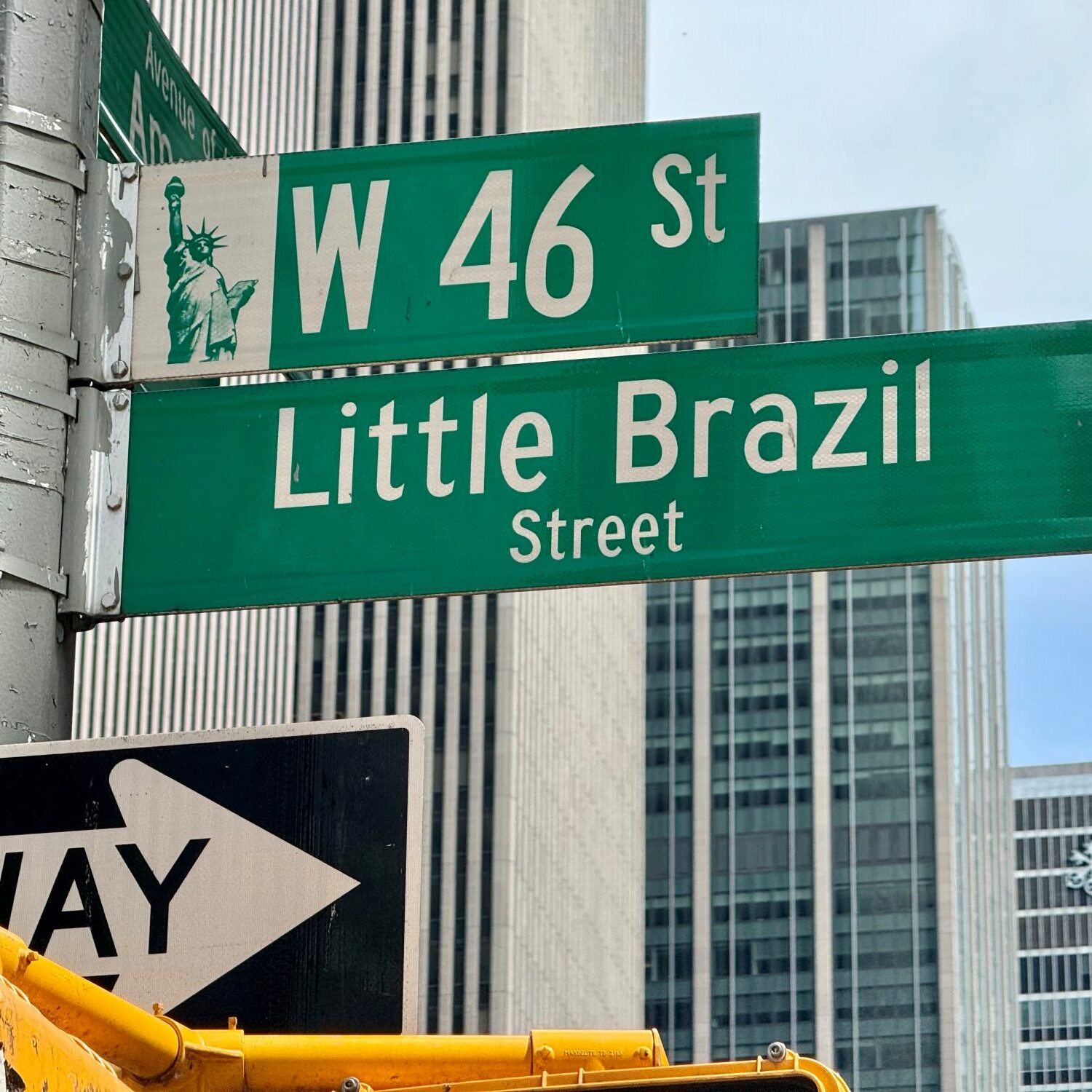
Walking among the skyscrapers of that stretch of Fifth Avenue famous for shopping and New York’s most classic attractions such as Rockefeller Center, the Top of the Rock, and St. Patrick’s Cathedral, the last thing one pays attention to are the street signs. Yet it is by turning your attention upward, to street corners, that you discover unexpected legacies and information. And it is here, along Forty-sixth Street between Fifth and Sixth Avenues that the sign “Little Brazil” towers above us.
New York is, par excellence, the place where the world’s cultures meet, contaminate and reinvent themselves. Among the many communities that enliven the city with colors, music and flavors, today we turn our attention to discovering the Brazilian heritage that channels a unique energy into the city, capable of bringing a touch of Rio de Janeiro even among the gray skyscrapers of Manhattan. As always, to understand what we see today, we must first take a step back through the history of immigration to New York, and this journey today takes us directly to the 1960s. It was during these years, in fact, that the first Brazilian businesses began to open in the heart of Midtown Manhattan, right along that stretch of Forty-sixth Street, which was immediately known by the nickname Little Brazil. It was then a micro-neighborhood that, though small in size, soon became a landmark for Brazilians in the city. In the 1960s and 1970s, this area was home to restaurants, beauty salons, travel agencies, and shops–all Brazilian. It was a meeting place for the nascent community: people spoke Portuguese here and listened to samba. Although the numbers were still small, it was clear that something special was being born: a corner of Brazil in the heart of New York City! It was in the 1980s, however, that Brazilian immigration boomed, fueled by economic crises and political instability at home. Young people, professionals and families were looking for new opportunities in the United States, and New York represented an attractive destination where the Brazilian community could grow away from home. Today, although many of the original businesses have moved away or no longer exist and the Brazilian community has also taken over other neighborhoods in New York and neighboring New Jersey, Little Brazil remains a symbolic place, linked to the community’s memory and identity. It is here that the foundations were laid for the Brazilian presence in New York, a presence that continues to grow and enrich the city’s cultural mosaic.
Over the years, Little Brazil has lost some of its original commercial dimension but has acquired an even deeper value: symbolic and cultural. And it was from here, in the heart of Manhattan, that one of the most spectacular Brazilian celebrations outside Brazil was born: Brazilian Day. It all began in 1984, when João de Matos, a Brazilian immigrant and figurehead in the community, decided to organize a party to celebrate Brazil’s independence, which falls on September 7. The idea was to bring New York Brazilians together for a day of music, food and national pride. It was an immediate and surprising success: thousands of people poured into the streets, turning that first edition into an event that would grow year after year. Over time, Brazilian Day has evolved from a small community celebration to an international mega-festival and is now one of the largest Brazilian events outside Brazil, capable of attracting more than a million people. The event stretches along Sixth Avenue, which is closed to traffic for the occasion, to other parts of the city. Key elements are, of course, music and food. Churrasco, coxinhas, pastel, pão de queijo, and brigadeiros are just some of the typical dishes that can be enjoyed right on the street, among stalls and food trucks. It’s a veritable explosion of music, dance, traditional costumes and street food where Brazilians in New York mingle with residents and visitors who want to immerse themselves, at least for a day, in the vibrant soul of Brazil… without the inconvenience of having to deal with an international airplane flight! In 2025, the date set on the calendar for this event is Sunday, August 31-don’t miss it if you will be in Manhattan! Brazilian Day is more than just an event: it is a symbol of a community that has been able to make its place in one of the world’s most complex cities, keeping its roots alive and sharing them with others. It is also an opportunity for those who do not know Brazil to get closer, through music, food and the collective joy that only Brazilians know how to bring to the streets.
While this is the most visible and spectacular time of the Brazilian presence in the city, during the rest of the year New York also offers other opportunities for authentic Brazilian experiences. From restaurants to concerts, cultural centers to dance classes, the city is full of small and large establishments that keep the connection to Brazil alive.
For food lovers in particular, New York City is a true paradise. Among the best-loved establishments is Berimbau do Brasil, with its two locations in Midtown and the Village, with its convivial atmosphere and traditional dishes: from feijoada to moqueca to the inevitable caipirinha. On the other hand, if you are looking for something more elegant but still authentic, Casa, in the West Village, offers Brazilian comfort food served with a refined touch. And of course, you can’t miss the churrasco: at Churrascaria Plataforma and Fogo de Chao, meats are served nonstop right at the table, in the gaucha tradition. An experience to try at least once, if only for the theatricality of the service!
Appetite satisfied and for a truly intimate dive into Brazilian culture, we must return to what was once the beating heart of Little Brazil. At 17-19 W 45th Street, there is, in fact, a special place, tucked away downtown but known only to those who know how to look: the Buzios Boutique & Brazilian Market. Don’t be fooled by the objectively uninviting entrance, and reach the eighth floor by the cramped elevator, to discover the best selection of typical products, imported directly from Brazil: guaraná, frozen pão de queijo, Garoto chocolates, farofa, and even swimsuits, flags, Havaianas flip-flops, perfumes and cosmetics by Natura. Running it is a very nice girl who sports a smile and accent that leave no doubt about her origins. During my visit to the store, she told me how the store itself once occupied a much larger space with storefronts directly on the street and a very loyal clientele always on the lookout for the flavors and items of home. Today, despite its smaller size, Buzios Market remains a place of connection for the Brazilian community, but also an authentic gateway for those who want to get to know Brazil without leaving Manhattan. Right here I met a Brazilian girl who had come especially from Baltimore to stock up on household goods!
The last stop for those who wish to immerse themselves in Brazilian culture in a deeper way is the Brasil-United States Cultural Center (CCBEU). In addition to offering Portuguese language courses for all levels, it organizes art exhibitions, film screenings, lectures and workshops that allow people to discover lesser-known aspects of Brazil, from its history to popular traditions. The CCBEU is a true cultural bridge between Brazil and the United States, a place where the Brazilian community comes together to keep ties with its roots alive and where enthusiasts can approach it with curiosity and respect. This is where the ranks of all Brazilian events that take place in New York, the city that never sleeps and, in this respect, quite similar to Brazil! For those who love music and dance, there is no shortage of opportunities to get swept up in the rhythm: from samba and forró classes at schools like Samba New York to capoeira events open to the public at Brazilian cultural centers.
In a city like New York, where everything is constantly changing, Brazilian culture has managed not only to take root but to flourish with contagious vitality. From the streets of Midtown to festival stages, from cozy restaurants to cultural centers, Brazil tells its story every day, offering residents and travelers alike a small taste of its sunny spirit and resilience. This also concludes the Brazilian leg of this New York trip. If by now you have felt like experiencing an all-greenoro day among the skyscrapers of Manhattan, all you have to do is mark the addresses above to create a small itinerary that can take you, if only for a day, directly from Rio to New York City!
This article is part of the “Around the World in New York” column, a journey through the world’s cultures without ever leaving the city. Stay with us to discover the next stop that will take us to another corner of the planet, still in the shadow of Manhattan’s skyscrapers!
The article Brazil in New York: a celebration of colors, flavors and community comes from TheNewyorker.
