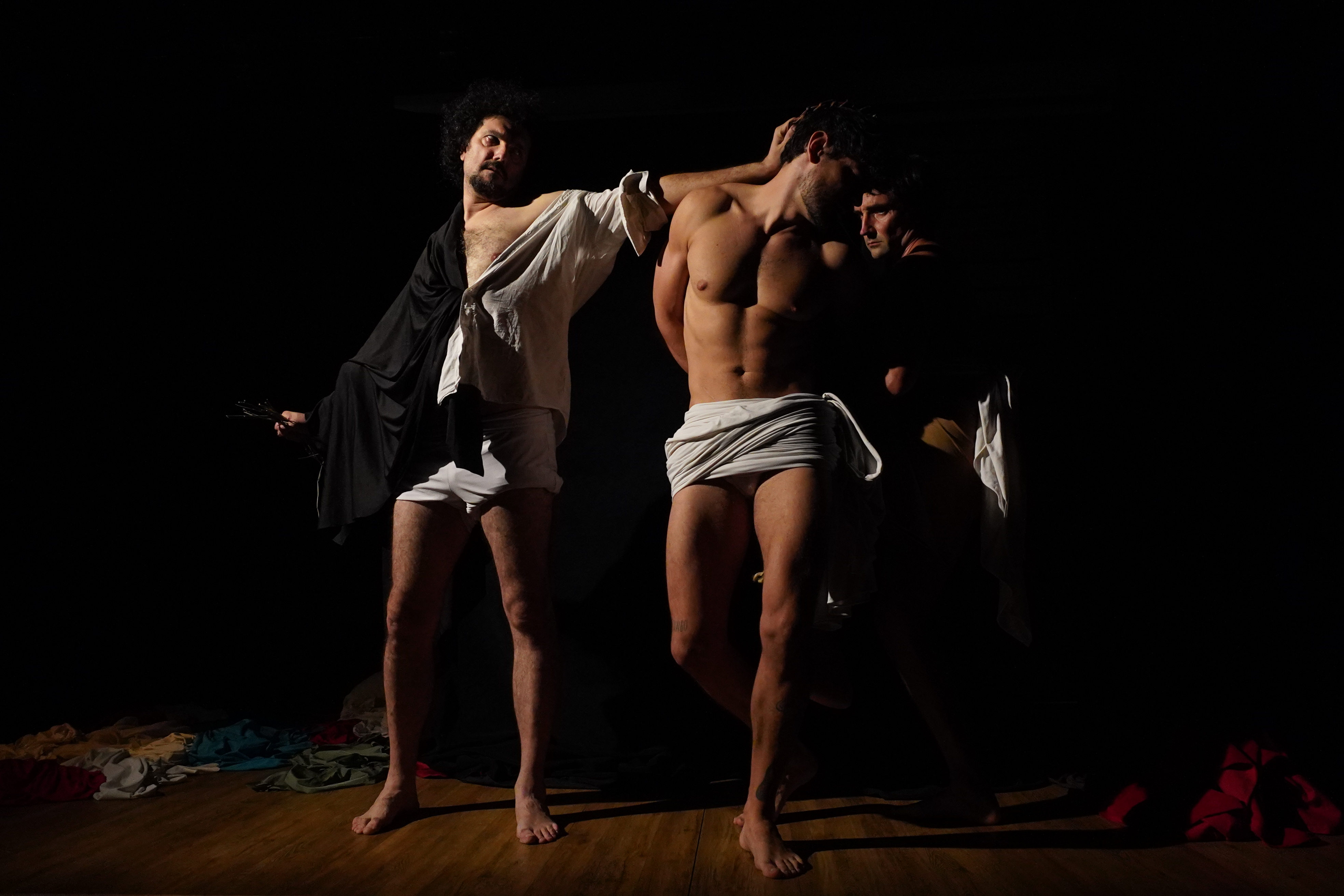
From 18th-century Naples to international theaters, their work blends theater, movement, music, and light, transforming the stage into a living artist’s workshop before the audience’s eyes. Now, after years of touring across Europe and Asia, Teatri 35 is coming to the United States with Chiaro Scuro, a performance inspired by the masterpieces of Caravaggio.
How did your artistic project begin and evolve into the show you’re bringing to America?
Gaetano Coccia: This project started quite a while ago. Our company was founded in 2010, and since then we’ve been developing a project based on the technique of tableaux vivants, a theatrical practice that dates back to the 18th century. We didn’t invent anything new—this form already existed and was particularly popular in Naples at the end of the 19th century. What we did was reinterpret it, giving it a different artistic direction.
Originally, tableaux vivants were static images: actors recreated a painting and remained still for an extended time while the audience admired them as a living artwork. We wanted to transform that stillness into movement—into performance. On stage, the audience doesn’t just see the finished painting; they witness its creation. The actors use fabrics and materials to suggest shapes and colors, and the image comes to life before their eyes. We don’t wear period costumes or pre-made outfits: we build the composition live with drapes and cloth, as if we were the painter’s own palette.
How did the opportunity to bring this show to the United States come about?
Gaetano Coccia: Completely by chance. Lia Adelfi, president of the Dante Alighieri Society of Michigan, is Neapolitan like us and had heard about our company. She reached out to propose bringing our show to the U.S. From that first contact came the idea of including us in the Institute’s November program. So, almost by accident, we ended up organizing this American tour.
This will be your first U.S. tour, right?
Gaetano Coccia: Yes, our first. We’ve traveled extensively, especially in Eastern Europe and more recently in India, but never to the United States. It’s a thrilling moment for us—an important and completely new experience.
Returning to your work, would you say your performance is more an interpretation than a faithful recreation of the paintings?
Gaetano Coccia: Absolutely, it’s an interpretation. We’re never identical to the original—both for technical and artistic reasons. Some poses are physically impossible to hold for long on stage; other times, we simplify the composition to focus on a detail. For instance, in Saint Francis in Ecstasy, the saint is held up by an angel in a complex pose: we preserve the essence of the scene but adapt it to the realities of live performance. Sometimes we also reduce the number of figures to help the audience focus their attention.
How do you develop your performances? Is it a collective process or more director-driven?
Francesco Ottavio De Santis: It’s very much a shared process. As in any creative endeavor, there’s discussion—and sometimes disagreement—but that’s part of the dynamic. We decide together which artist to work on, and everything develops around a musical structure, which is fundamental for us. The music guides the movements, defines timing, the pauses, the moments when the scene freezes into a painting. We don’t script everything on stage—many gestures arise spontaneously—but that spontaneity comes from years of shared understanding. And yes, sometimes we argue, but that’s a sign the creation is alive.
Why did you choose this artistic form, and why Caravaggio in particular?
Francesco Ottavio De Santis: It happened almost by accident. We didn’t set out to create a show of tableaux vivants. It grew out of our work in physical theater—exploring the body, its relationship with music and space. During some stage exercises, working with a few props and pieces of cloth, we began to play with Caravaggio’s images. We were struck by his ability to capture the precise moment when an action is happening—or has just happened. In that sense, Caravaggio was a director before directors existed: his painting is already theater.
The title of your show, Chiaro Scuro, recalls Caravaggio’s signature use of light and shadow. How important is lighting in your performances?
Gaetano Coccia: It’s essential. Caravaggio’s entire visual identity is defined by his use of side lighting, and that’s something we recreate on stage. A single spotlight, set just two meters off-center, can instantly evoke his atmosphere.
We often use a black velvet backdrop to cancel out depth and restore the two-dimensional quality of his paintings. Then there are the colors—red, white, and black—the three dominant tones in his palette. Together, these elements recreate the visual sensation we want the audience to feel. It’s like stepping into Caravaggio’s workshop, where, as legend has it, a beam of light entered from the ceiling to illuminate the scene. Our goal is to bring that same magic to life.
Does your show also explore Caravaggio the man—his troubled life and personality?
Gaetano Coccia: No, we don’t go into his biography. This isn’t a historical or biographical play about the “tormented” artist. We tell Caravaggio’s story through his paintings, not through his life. Of course, those who know his story might recognize certain echoes—like in The Death of the Virgin—but that’s not our focus. We aim to convey the visual and emotional power of his art, not the narrative of his existence.
How would you define your artistic style?
Francesco Ottavio De Santis: Ours is a theater of mimesis, but not of imitation. We don’t recreate a “fake” reality—we create a real effect of truth. We reconstruct what might have happened in Caravaggio’s studio, without tricks or illusions, and that’s what gives the image its emotional impact.
We’re not chasing visual resemblance alone, but the emotional charge Caravaggio embedded in his canvases. We want to bring back the life within those images—the vibration of the creative moment, the tension between light and shadow.
What are your expectations for this American tour?
Gaetano Coccia: We’re very curious and excited. The first performance will be on November 8 at the Marygrove Theater in Detroit, followed by another on November 10 in Indianapolis. We can’t wait to see how American audiences respond to our work.
We’ve toured extensively, but bringing our show to America has a special allure. Every time I’ve been here, I’ve felt a deep enthusiasm for Italian culture, and that makes me think our show will be warmly received. Expectations are high—but in a good way, the kind that gives you energy and pushes you to give your best.