
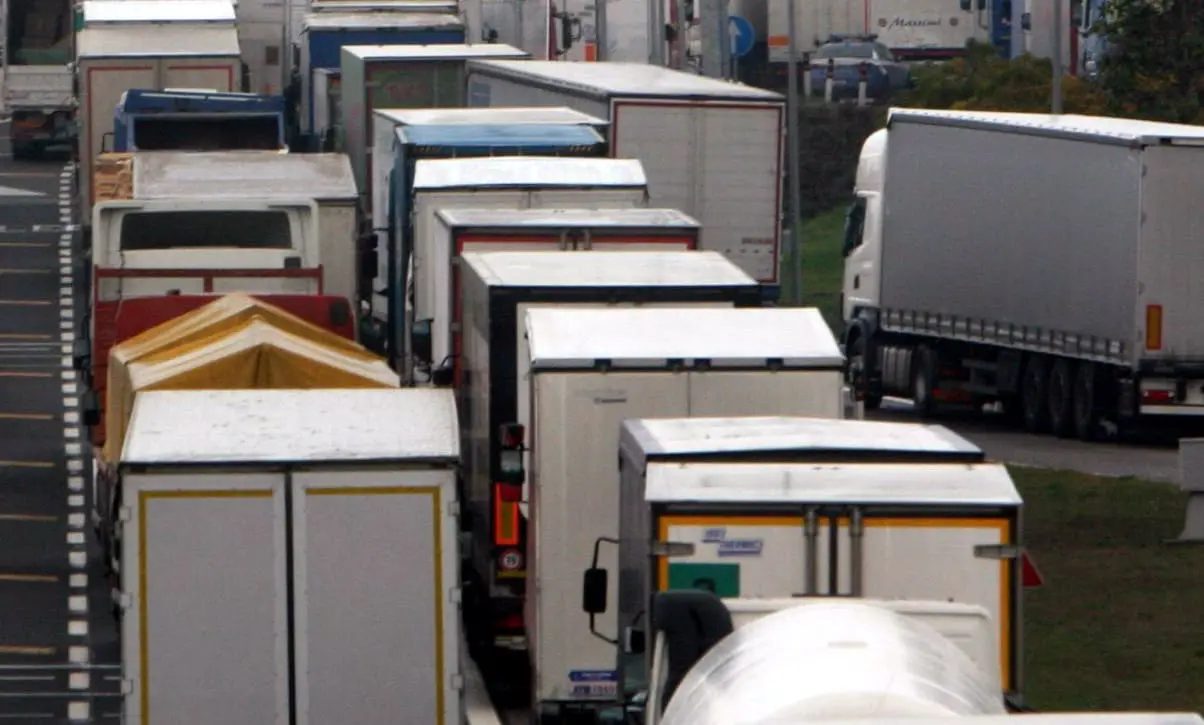
VENICE (ITALPRESS) – The announcement of the stop of the road haulage, arrived yesterday, is only the last alarm bell of an area in distress, where the protest is no longer episodic, but the symptom of a deep and persistent crisis. And in the coming months, the situation could even worsen. According to the estimates of the Study Office of the CGIA, in fact, an enterprise in five risks to close by the end of the year, crushed by an increasingly suffocating liquidity crisis. If the price of diesel should remain constantly above 2 euro per liter until the end of 2026, there is no hope. Many small padroncini will be forced to throw the sponge permanently. The numbers are impietosis: in the face of 67,350 enterprises of the field of the road haulage present in Italy, more than 13.000 of these could be forced to surrender within the end of this year, leaving their vehicles stopped in the squares, as silent carcasses of a field in affanno. It is not just trucks that stop, but an entire system that risks imploding, with chain repercussions on the real economy and the estate of thousands of families. For those who observe the world of logistics from the outside, the increase in the price of the fuel to the pump seems a manageable discomfort: a cost that is “rebalt” simply on the final customer. But for a road haulage company, reality is radically different. It is not just a question of resentment, it is a crisis of financial sustainability.
In an average transport company, the diesel represents about 30% of the total operating costs. Along with the cost of staff, it is the heaviest expense item. When the price of oil undergoes sudden surges, this balance breaks instantly. Unlike other productive sectors, the transporter often operates with long-term contracts or fixed rates negotiated months before. If the fuel increases by 24 percent as it happened from the beginning of the Gulf conflict, this extra cost is absorbed entirely by the conveyor. The price of diesel to the pump in self mode today is averaged 2,135 euros per liter. Despite the cut of excise duties decided by the Meloni government and extended until the next beginning of May, compared to the beginning of the Gulf war the increase of price was 24 percent (+0.415 euros per liter). But if the comparison we do with 31 December last, the relapse was even 30.6 percent (+0.50 euros per liter). Considered that a tank of a heavy medium contains about 500 liters of diesel, today to a transporter to fill up to own Tir costs 1.067 euros, 207 euros more than a month and a half ago and 250 euros more if the comparison is performed with the end of last year. Assuming that the price of today’s diesel represents the average figure of 2026, this year to supply a heavy medium the owner should spend 76,860 euros, almost 17,500 euros more than he spent in 2025.
The difficulties of transporters are not exhausted in the flame of the price of oil; the central node is a political strategy that, in fact, ends up penalizing the category instead of supporting it. The critical reference goes to the measures taken by the Government in recent months. If, on the one hand, the cut of excise duties has been introduced, on the other, the promised tax credit for transport companies has remained: a measure that, to date, exists only on the card and will only affect a small minority (about 22%) of the means of transport goods in circulation on our roads. Paradoxically, just the cut of the excises presented as an immediate relief there turned out to be an authentic boomerang. By law, in fact, the transporters benefit from a refund on excise duties paid on professional diesel. When the Government temporarily reduces the tax for all consumers, the same reduction is deducted from the refund due to the category. In summary: the pump discount neutralizes the specific tax advantage. If we add to this that the market quickly absorbed the cut, vanifying the effect on the final price, the picture is complete: the transporters lose the refund without obtaining a structural drop in costs. A drink in full order. To complicate the scenario is added the attitude of many clients.
Numerous carriers, especially the smallest, are receiving communications from their customers in which the application of the fuel surcharge clause is challenged.
This contractual clause should ensure automatic adjustment of tariffs when the price of oil fluctuates more than 2% compared to the reference values. Yet today’s reality tells a different story: on the one hand there is some client who denies tout court the adjustment and, on the other, those who recognize it only partially, arbitrarily piercing the share corresponding to the cut of the excise introduced by the government. The difficulties of the sector come from afar. In the last 10 years, for example, the total stock of the active enterprises of road haulage present in Italy is diminished of well 19.241 units. If in 2015 they were 86.590, in 2025 they went down to 67.349 (-22.2%). At regional level the most critical situations occurred in Valle d’Aosta with a contraction of 34.1% (in absolute value equal to -29), in the Marches of 33,4 (-1.062), in Lazio of 32.5 (-2.238), in Friuli Venezia Giulia of 30,5 (-449) and in Sardinia of 30,2 (-722). On the other hand, the only region that can count on a positive balance is Trentino Alto Adige with +12,1% (+165). The economic crises that have occurred during this period have contributed to a decisive extent to reducing the level of the enterprises of this sector.
However, an important contribution to this reorganization is also attributable to the high number of aggregations and acquisitions that have occurred in this last decade, in particular, resulting in a strong decursion of the number of mono-vehicular enterprises. A change not entirely negative. In fact. Thanks to the effects of crisis and to these processes of corporate union, the average size of enterprises has increased and, consequently, the level of productivity of the entire logistic system has grown. Also in 2025, the provincial reality where the largest number of enterprises of the field of the road haulage is Naples with 3.984 activities. Follow Milan with 3.102, Rome with 2.854, Turin with 2.153 and Salerno with 1.724. In these five realities we see beyond 20 percent of the total of the active enterprises of road haulage present in Italy that last year touched altogether 67,349 units. Imperia, finally, was the provincial reality that between 2015 and 2025 suffered the heaviest contraction equal to -40.2% (absolute value equal to -90). They follow Rome with -39,4 (-1.854) and Ancona with -39,3 (-354). Among the 102 provinces monitored in this survey, the only ones that in the last decade have undergone an increase have been Caserta with +5.2% (+56), Palermo with +12,9 (+123) and Bolzano with +35.7 (+213).
– photos of repertoire IPA Agency –
(ITALPRESS).
