
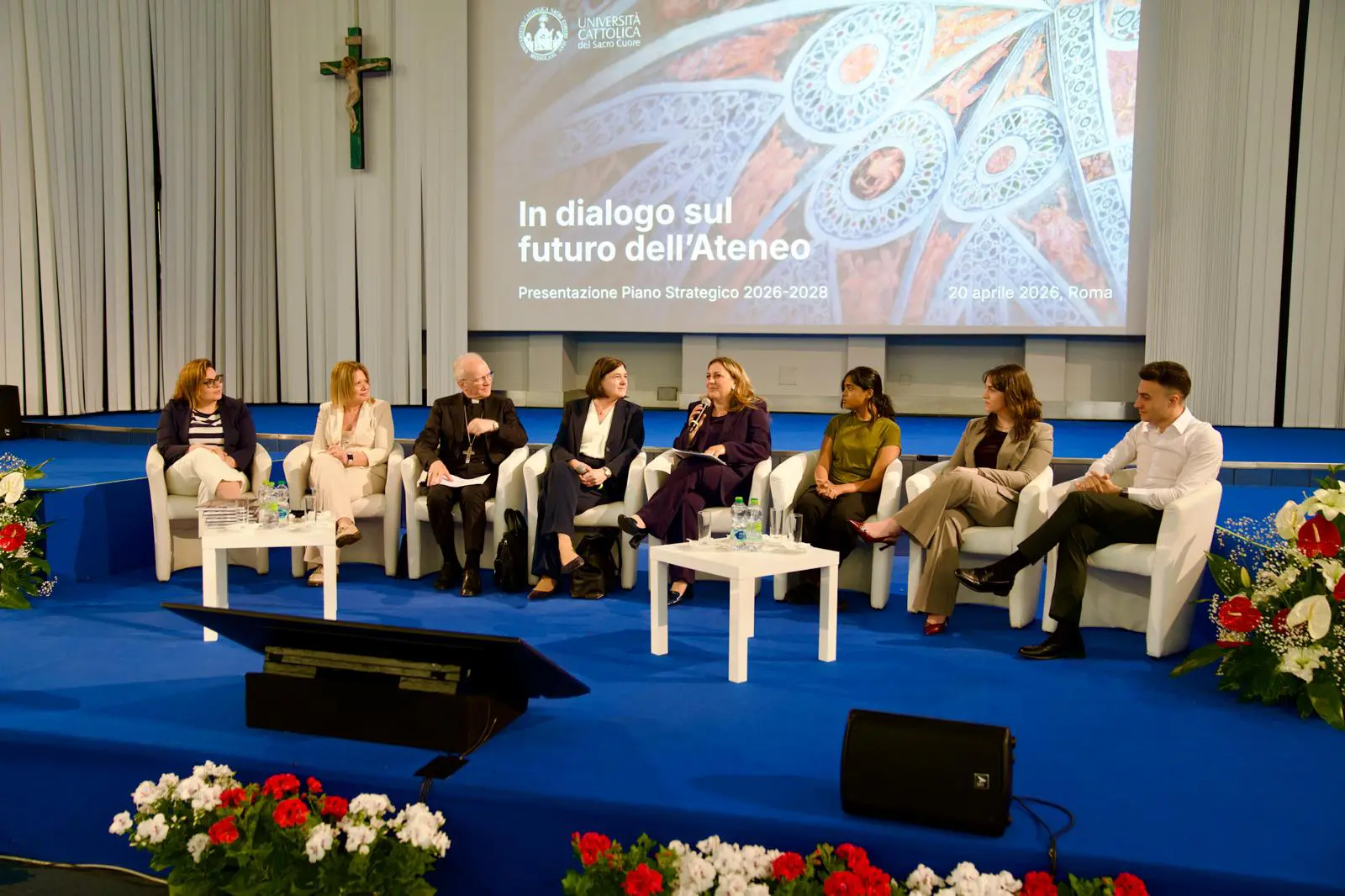
ROMA (ITALPRESS) – A school of integration of knowledge, valorisation of research and young researchers, educational offer of quality, internationalization and Plan Africa, fundraising inspired by identity and institutional principles: these are the five pillars of the Strategic Plan 2026 – 2028 of the Catholic University of the Sacred Heart presented today, in the See of Rome of the University, by Rector Elena Beccalli.
.
The result of a participatory process that involved all the members of the university community, the Plan outlines design that, by creating impact, can leave the mark and fully integrate with teaching, research and third mission activities.
At the presentation, together with the Rector Elena Beccalli, S. E. Mons. Angelo Vincenzo Zani, Archivist and Librarian Emeritus of Santa Romana Chiesa.
“The new Strategic Plan of the Catholic University of the Sacred Heart is first and foremost based on a participatory method, on the active collaboration of the entire university community, on the co-design and listening of the main interlocutors to write together the future of the University for the next three years,” Professor Beccalli began.
“Three addresses guiding our institutional mission – Beccalli continued – enhance the profile of non-profit Catholic universities; foster full integration between the educating community and research university; build a place of experience of knowledge and not only of transmission of knowledge. This means, for example, to activate innovative pedagogical proposals such as service learning, based on the involvement of the student community in active citizenship paths and social participation, or as peer mentorship, to help even on content, knowledge and skills.”.
The Strategic Plan 2026-2028 is divided into five pillars connected: “The first pillar – said Rector Beccalli – concerns the establishment of a school of knowledge integration to enhance the university’s interdisciplinary approach to addressing the great issues of our time from a transversal perspective, avoiding the risk of a fragmentation of skills.”.
“The second pillar is represented by the valorisation of research, research and researchers in order to make the research university profile even more incisive, promoting a favourable research environment capable of attracting and supporting young researchers and young researchers through incentives and awards.”.
“The third pillar is based on a quality training offer that enhances the experience of knowledge in physical and digital spaces, also through a renewal of content and teaching methodologies with particular attention to the tools of artificial intelligence and the development of paths in collaboration with the international digital platform FutureLearn for a training that embraces the entire span of profesional life.”.
The fourth pillar concerns internationalization with “the expansion of the global dimension through accreditation, attention to rankings and further dual degrees in addition to the 112 already active and, together with a more identity-oriented approach inspired by solidarity, aimed at continuing in the implementation of the Africa Plan”.
“The fifth pillar – the Rector concluded – is dedicated to fundraising activities, leveraging on identity and institutional principles with the idea of gift as reciprocity, strengthening relations with alumni and external interlocutors to support strategic design and ensure access to our courses to young people who are worthy but without means.”.
The new Strategic Plan of the Catholic University of the Sacred Heart is the result of a shared process started nine months ago, characterized by 34 thematic workshops, which joined 665 community members, 1.711 responding to the online survey and 54 project proposals presented through the call for ideas.
“The initiative promoted by the Rector from the beginning of his mandate, and shared firmly by his collaborators and teachers, responds to an original and innovative design in the scenario of current academic institutions – said Mgr. Vincenzo Zani in his intervention -. In particular, it has the great value to mark identity, design and mission of the Catholic University in Italy and to place it in the international horizon”, through three fundamental elements. “The first – he continued – is the cultural and geo-political context that is the backdrop to the Strategic Plan. The choice desired by the Rector of tracing the Athenaeum towards the future, giving shape to the idea of better universities for the world, can not but refer to the roots themselves, to the DNA of this institution. And I like to point out that while the implementation of the Strategic Plan is under way, Rector Elena Beccalli has been elected a member of the International Federation of Catholic Universities (FIUC), commissioned by Gemelli, as well as president of its European section, namely the FUCE. This role of our Rector will undoubtedly help to further stimulate the international dimension, scientific research and academic quality of our University, as it is well underlined in the pillars of the Strategic Plan”.
“The second factor that makes the Strategic Plan peculiar is the method followed in its elaboration that covers a great human, cultural and academic value, in an extraordinary workshop of dialogue and exchange that has made everyone protagonists of a university community that questions and becomes aware of its great task to be carried out in a society in profound change. Another factor concerns the contents, distributed in the five pillars in which the Plan is divided, of which I would like to emphasize above all the school of integration of knowledge and the valorization of research”. The school of integration of knowledge, in particular, must have “as a vital goal to reform thought by coordinating cultures and separate knowledge. Interdisciplinaryity is insufficient to remedy superspecialization.” “In this sense, the first two pillars, the integration of knowledge and the quality of research, are a significant bet, the true added value that the Catholic University with courage proposes in the panorama of academic studies today.”.
The story of the process that led to the drafting and sharing of this document was entrusted to Isabella Di Chio, Journalist Rai, TgR Lazio, who compared with two members of the university community, Professor Tiziana Bove, Ordinary of Anestesiology, Dr. Laura Motta of the Office of Research of the See, and students Antonio Pio of Nuzzo (Baberian Medicine and surgery Faculty of Medicine and surgery).
– photo press office Catholic University of the Sacred Heart –
(ITALPRESS).
