
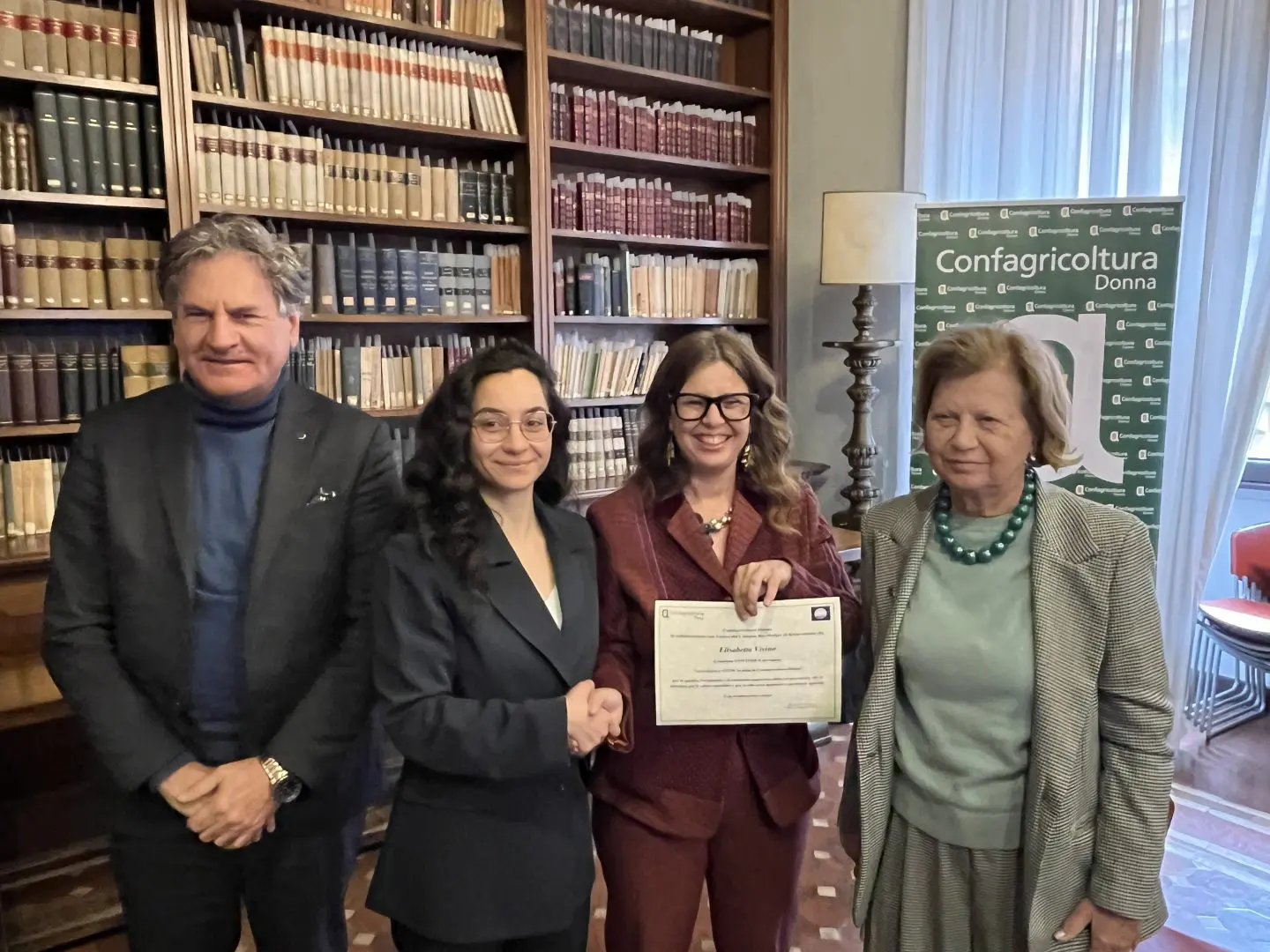
ROMA (ITALPRESS) – The first two awards for students from the Campus Bio-Medico University of Rome and the University of Udine, winners of the bands financed by ConfAgricoltura Donna, have been awarded today. The result that materializes one of the many paths initiated by the Organization and which assumes a particular value because celebrated a few days from March 8, International Women’s Day.
The prize for the student of the Bio-Medic Campus in Rome was awarded to Palazzo della Valle, the national seat of the Confederation. The initiative is part of the project “Agriculture and STEM: the challenge of ConfAgricoltura Donna”, launched in 2025 with several Italian universities to strengthen the female presence in the processes of innovation applied to the agricultural sector and to create a stable link between productive world, university and research.
In this perspective, ConfAgricoltura Donna has activated collaborations with the University Campus Bio-Medico in Rome, the University of Udine, the University of Tuscia, the University of Padua, the University of Perugia and the Istituto Agronomico Mediterraneo in Bari, to promote new talents and propose a replicable model of interaction between university system and agricultural representation, oriented to the construction of a contemporary vision of agriculture. The Athens took advantage of an evaluating committee with a representative of ConfAgricoltura Donna.
The project is part of a particularly dynamic professional context: today almost 32% of Italian farms are led by women, protagonists increasingly active in innovation and sustainability. To support and enhance this evolution, ConfAgricoltura Donna has set up a cash prize of 1,000 euros – intended for a master’s degree in Innovation and Sustainability in Agriculture – awarded through a call that in a short time produced good results: in this first manche there have already been 30 thesis, of which 26 from the University of Udine and 4 from the University Campus Bio-Medico in Rome.
In addition to the quantity, it affects the quality of the works presented: thesis characterized by a strong interdisciplinaryity, able to overcome the traditional vision of agriculture as an isolated sector. Research integrates skills ranging from computer to data management, from engineering to biological, environmental and biomedical sciences. A demonstration of how to innovate in agriculture today means to cross different knowledge and to make the agricultural sector a privileged laboratory for the application of advanced technologies that contribute to food security.
“While many are limited to remembering March 8 with slogans and declarations of circumstance, we choose a different path: we work all year round with concrete commitment, with targeted projects, with initiatives that open real spaces to women in the world of work and civil society – said the president of ConfAgricoltura Donna, Alessandra Oddi Baglioni -. This project is an example of what we believe in: enhancing female talent in the areas of research, innovation and progress in the country. We continue to build opportunities, support paths, enhance women who can change the future.”.
The President recalled that 2026 was declared by the UN International Year of Agricultural Women: “A recognition that emphasizes the central role in global agri-food systems. It is a strong signal: women are not an accessory presence, but a structural component of agricultural production, sustainability and world food security.”.
“ConfAgricoltura has always believed the science applied to the sector and to the value of the contribution of women, both in the scientific field and in the agricultural field – said the general manager of ConfAgricoltura, Roberto Caponi -. The synergy with universities is also fundamental for the future of the agricultural system.”.
Present at the Roman event also the president of the Master’s Degree in Food Sciences and Human Nutrition of the University Campus Bio-Medico in Rome, Laura De Gara: “The participation of the graduates in this award is an element of great value for our University, always strongly oriented to health issues – said in his speech -. The comparison with students and graduates gave us the opportunity to highlight how innovation and the great challenges that today affect agri-food systems, from climate change, to the many aspects of sustainability, are closely linked to human health, which cannot be separated from that of the Planet. This is the integrated perspective of One Health that guides our commitment.”.
Mrs Valentina Grippo, Vice-President of the 7th Commission for Culture, Science and Education, has shown attention to the critical issues related to the involvement of students in STEM training courses.
LE PREMIATE
Elisabetta Vivino: Università Campus Bio-medico di Roma Title: Emerging contaminants in agriculture: impacts of polystyrene nanoplastics on durum wheat The thesis explores an extremely important emerging problem for its possible impact on food safety. It is the result of a study on the effects of nanoplastic contamination on the health of plants and their possible presence in caryocides of durum wheat intended for human consumption. The experimental approach adopted is multidisciplinary, relevant, innovative and high scientific rigor. The results identify metabolic pathways involved in the response of the plant to exposure of nanoplastics as possible sources of molecular traits of interest for new breeding strategies.
Alessia De Giorgi: Università degli studi di Udine Title: Potentiality of use of the flour camouflage for detoxification and bioconversion of substrates contaminated by AFB1 Thesis assesses the use of the flour camouflage (Tenebrio molitor) to reduce aflatoxin B1 (AFB1) in contaminated agricultural raw materials, a growing problem also due to climate change. The larvae raised on bran with different levels of toxin have degraded about 82% of AFB1, accumulating quantities below the limits of law. Only 17% of the toxin remained in the frass, then subjected to detoxification for possible use as a finer. The study confirms the potential of T. molitor in the circular economy.
-Photos press office Conf agriculture-
(ITALPRESS).
