
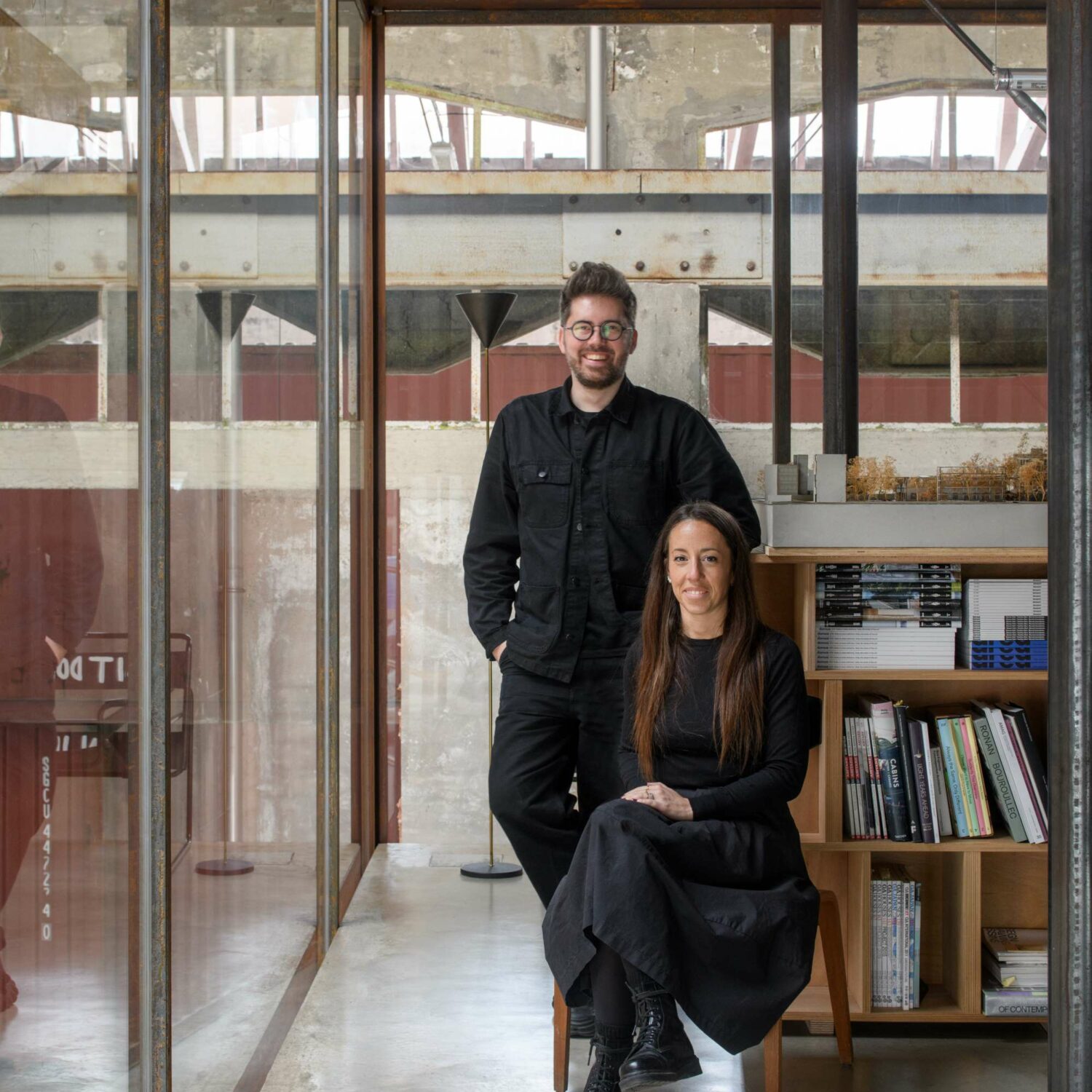
It is not uncommon for an Italian architectural firm to start looking beyond national borders with a mixture of ambition and curiosity. Studio AMAA, for example, was a small firm-in relative terms-until two or three years ago. Since then it has grown along with the business, expanding its reach and finding, even outside of Italy, a physical and mental space to continue designing, even in a context such as the United States. The duo AMAA, composed of Marcello Galiotto and Alessandra Rampazzo, is among those who are trying with conviction, holding together research, practice, and a certain idea of architecture that starts from the province to get very far.
“We had been trying to export our way of thinking about architecture abroad for a long time,” says Marcello. The starting point, in this case, was an invitation to exhibit at the Venice Architecture Biennale, the penultimate one, the one curated by Lesley Lokko. From there a process was triggered: the collaboration with Paola Giaconia and Marco Brizzi, the decision to look around, to look for a city to focus on. Berlin, perhaps. Then, by chance, came New York.
“An opportunity arose to design a small matcha store, Sorate, on Sullivan Street, opened by Italian guys. Sorate, in Venetian, means ‘calm down.’ It’s a small place, but it all started from there.” Shortly thereafter, AMAA picked up a call from BIG, Bjarke Ingels’ studio, which was opening some co-working spaces within its headquarters in Dumbo, Brooklyn. “We decided to give it a try. We were selected, and from there began a journey of going back and forth. Last year we traveled to New York once a month, accompanied by one of our partner collaborators who helps us follow up on projects. Thus a dialogue with the city was born.”
Un ufficio progettato da AMAA | Foto di Mikael Olsson
Their approach is cautious, no enthusiastic outbursts about the American dream. New York is not (yet) a ground for big projects for AMAA, but a base for work and contacts, a place for research. “We come here because it is easier to meet people from all over the world. If you want to see someone from China or Japan or the other side of the globe, you’re much more likely to succeed in New York. Plus, we were looking for a space where we could work without phone calls every ten minutes.”
From a strictly design point of view, however, the differences with Italy remain strong, and the comparison is also still ongoing. “Concrete experience on American projects is still limited,” says Alessandra, “but what we notice, even teaching at Penn, is that the American background is very different from the European one. There is less inclination to conservation, less attention to the existing built environment, a view of materials that differs from ours.”
For AMAA, teaching is as much a pillar as design. And it is also one of the reasons that led them to settle, at least in part, in the United States. “In Italy there is little culture of designing and teaching together. Those who build are often looked upon with suspicion in academia. In the United States this wall is a little lower,” Marcello explains. At Penn, their team consists of architects who design and teach at the same time. “It’s a type of growth that is crucial for us. Also because the interaction with students is a huge source of stimulation.”
“Academic and professional careers, for us, have never been split,” Alessandra adds. “Through the profession we do research, which is what the academy should also do. We don’t see a clear distinction.”
Still, the difficulties are there, especially when it comes to building. “In Italy building is viewed badly, in the academy especially,” Marcello points out. “But also from a professional point of view, our work focuses a lot on adaptive reuse, on recovery. In the United States, this has only recently been talked about. Now it has become fashionable to talk about adaptive reuse, and the first projects of towers that are not demolished, but repurposed, are starting to pop up.”
From their point of view, the lag is obvious. “Here they are way ahead on many things, but way behind on others. Just look at the way they pour concrete,” says Marcello, who recalls a construction site in the Hamptons where American workers were “dumbfounded” by Italian precision. “Even major firms like Herzog & de Meuron, who built the Public Hotel in New York, complain about the execution quality. Despite high budgets, the details are inferior to those in Italy.”
Il Caffè Nazionale di Arzigliano, progettato da AMAA | Foto di Mikael Olsson
But what does it mean, really, to design from Italy? Better: from the province?
The AMAA firm was born in Venice, but has its roots in the province. Arzignano, near Vicenza, is Marcello’s home town, and also the main base of operations. “The province gives you the opportunity to shape the rules. You have direct contact with the municipality, with the technicians. And also with people. In the city, everything is more dispersed. In Veneto, you meet, you decide, you go. No one has time to waste.”
There is also another aspect: that of the diffuse city, which in northeastern Italy takes the form of an urban “sprawl” that extends around waterways, roads, and warehouses. “It is a blank canvas, where you can still write. Historic cities, on the other hand, are already written texts: you can only correct a few words.”
When discussing urban transformation, it comes naturally to ask what role suburbs, so often the focus of architectural and political debate, play today. But for AMAA the question arises in a slightly different way. “We work in the province, not in the suburbs,” Marcello points out. But then a broader reflection opens up: “Renzo Piano did a great job with the G124, and his idea of reactivating small portions of the city through urban interventions is absolutely shareable. At the same time, we need timely redevelopment of buildings. Lacaton & Vassal do this very well: instead of demolishing, they improve what already exists, with intelligent and precise interventions.”
Alessandra adds that “an urban strategy is needed. Even small interventions can have a big impact if they are part of a plan. Isolated opportunities alone do not change the system.”
In the end, when asked if there is anything to “import” from the American experience or to “export” from the Italian one, Marcello is sure. “From Italy I would bring here our sensibility for details, matter, urban grafting. The wow effect prevails here. American architecture is more focused on the object: the tower, the museum, the landmark. The reading of the context is often missing.” What about from America? “There is a freedom there that we don’t have. We are caged by constraints and regulations, yet we have discovered-thanks precisely to the province-that you can work even in gray areas. It does not mean evading the law, but knowing how to interpret it.”
Alessandra closes the circle with a reflection that returns to the value of research: “It is not a question of doing what you want. But of looking for new, freer solutions that go beyond established canons. Without denying the stratification and history of our cities. But trying to raise the bar every time.”
The article Designing from the province, telling from New York comes from TheNewyorker.
