
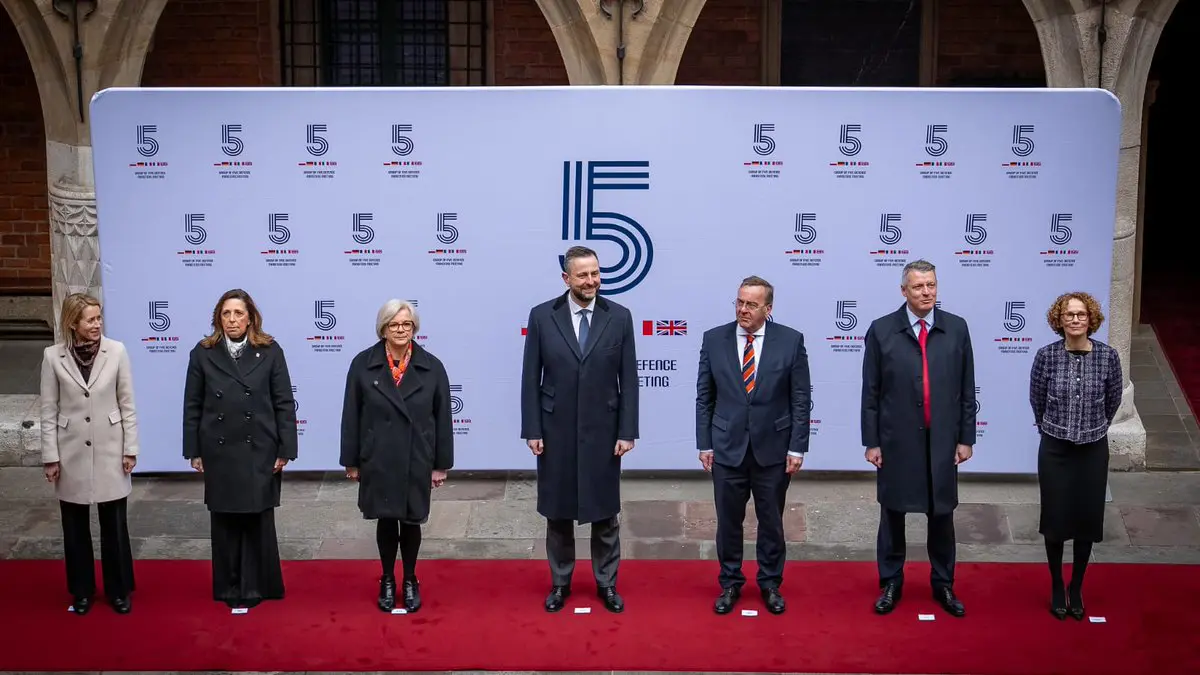
CRACOVIA (POLONIA) (ITALPRESS) – A new ministerial meeting of the countries of the E5 Group took place in Krakow, the coalition composed of France, Germany, Italy, Poland and the United Kingdom, with the participation of the High Representative of the European Union for Foreign Affairs and Security Policy and Deputy Secretary-General of NATO. The meeting, the seventh in this format, also counted the participation of the Minister of Defense of Ukraine, witnessing the centrality that the situation in the country is in the European and transatlantic collective security agenda.
The Secretary of State for Italian Defence, Senator Isabella Rauti, on delegation of Minister Crosetto, represented Italy in the discussions that reiterated the shared responsibility of the main European powers in ensuring the stability of the Euro-Atlantic area and in strengthening the capacity of deterrence and defence within the NATO and EU framework.
A joint declaration was adopted during the work in which ministers defined three strategic priorities. The first concerns the expansion of deterrence and operational readiness, with the aim of increasing the scale and capacity of available forces and consolidating both conventional and multi-level deterrence within the Alliance.
In this sense it has been reiterated that “NATO remains the foundation of collective defence” and that the E5 States are ready to assume “more responsibility for European security”. Among the commitments reiterated there is the implementation of the decisions that emerged from the NATO Summit to the Hague aimed at increasing defence spending and encouraging a “European Nation”, through a strengthening of capacity, coordination and shared responsibility.
A second area of study concerned the prevention and contrast of hybrid threats. The Ministers agreed on the urgency of strengthening early warning and rapid response mechanisms, as well as strengthening institutional and social resilience in the face of pressures and activities that can threaten the internal and external stability of the Allied States, underlining the complementary role NATO and EU must play in this area to ensure coherence and synergy of initiatives. The third and broadest director concerned continued support for Ukraine.
The ministers confirmed that a strong Ukrainian army constitutes “the first security guarantee” and reaffirmed the importance of jointly coordinating assistance through ad hoc mechanisms with NATO and EU. It has also been reaffirmed that any lasting peace agreement must include robust security guarantees for Ukraine to ensure long-term stability in the region.
On the industrial and technological level, the launch of the Low-Cost Effectors and Autonomous Platforms (Leap) initiative was announced, aimed at promoting cooperation in the development and acquisition of low-cost weapon systems and autonomous platforms, including pilotless aircraft vehicles and innovative interception systems.
The aim of the ministers is to improve collective resilience and contribute to the satisfaction of the capacitive requirements required by NATO while reducing delivery times and the production costs of key equipment.
The E5 also expressed its intention to jointly co-ordinate specific initiatives in the Western Balkans to consolidate regional security in a manner consistent with the efforts already under way in the EU and NATO, as well as to promote the Euro-Atlantic integration of the countries concerned, contributing to the stability of a crucial portion of South-East Europe.
The final document of the meeting emphasizes that the strengthening of European defence capacities is not aimed at creating alternative structures to NATO, but rather to consolidate the Alliance’s capacity as a whole, through a greater European contribution in terms of forces, resources and political-military coordination.
The Ministers also expressed support for the removal of regulatory and administrative barriers which hinder industrial cooperation in the defence sector, recognizing that a more dynamic European industrial base is essential for the long-term resilience of collective security.
-Photo accounts X Ministry of Defense
(ITALPRESS).
