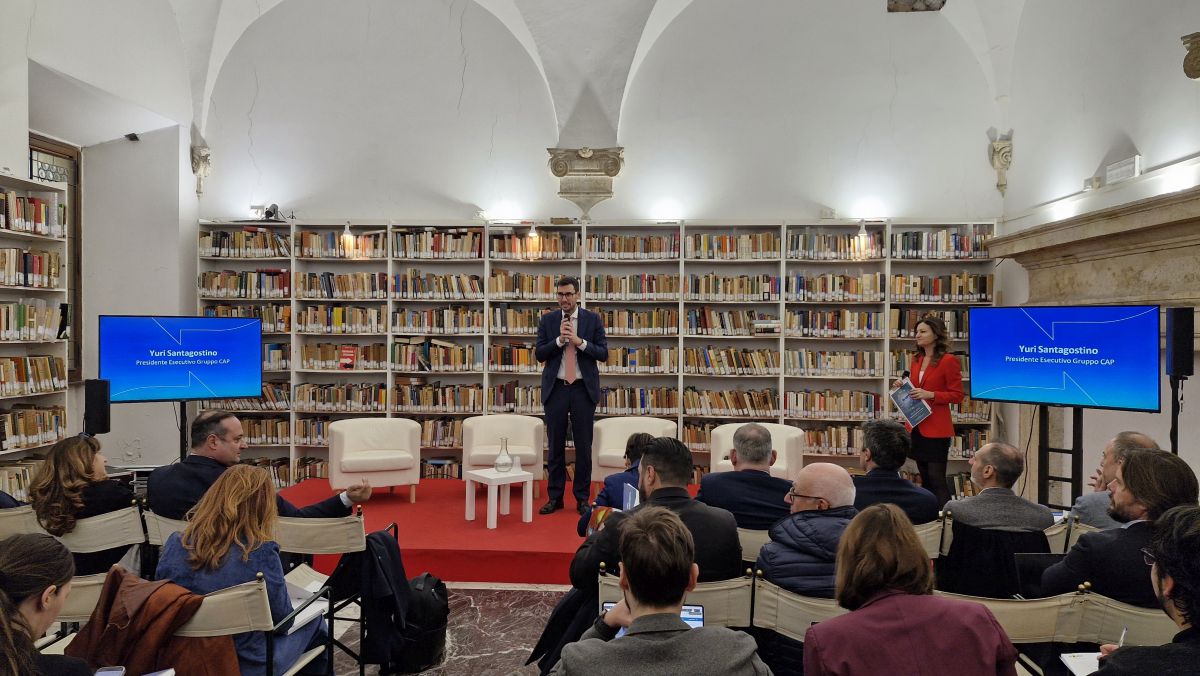
ROMA (ITALPRESS) – Networking industrial skills, research and territorial governance to address in a systematic way the challenges of ecological transition: with this goal is born SHIFT, the platform promoted by Gruppo CAP that brings together industrial, technological operators, research centers and subjects of spatial planning, with the ambition to create a stable place of comparison and joint work, capable of elaborating analysis, visions and proposals useful to accompany the evolution of both legislation and industrial in progress. The project was presented in Rome, at the headquarters of the Luigi Sturzo Institute, during a national event that brought together representatives of the institutions, the production system and the scientific world. ‘SHIFT – says Yuri Santagostino, Executive President of Gruppo CAP – has a peculiar method: to make different actors dialogue at the same table with different interests. The challenges of our time, however, require maximum sharing. Today public services are a fundamental social architrave, also to guarantee community rights. We put together companies, public service managers, private individuals who support companies, consultants, research and university and civil society: an essential element to be as effective as possible and to bring our proposals to a national and European level. From the geopolitical point of view, the situation unfortunately changes every day: we return to talk about energy and energy security. On the climate level, we are also experiencing a crisis that requires new and innovative answers. The birth of SHIFT is increasingly evident in the European and national debate: addressing climate, energy and industrial challenges no longer through sectoral and isolated interventions, but building synergies between different sectors and complementary skills. In this scenario, environmental infrastructure – water, energy, waste and resource recovery – become a strategic asset for the competitiveness and resilience of the territories. ‘For environmental and energy security issues – says Fabrizio Penna, Head of Mission Unit for the NRR of the Ministry of Environment and Energy Security – it is essential to create comparison tables between institutions, businesses, citizens, stakeholders and free professionals. The issues to be addressed are relevant, often delicate and sometimes controversial. We have common objectives to achieve: from decarbonization to the management of a complex geopolitical phase, which directly affects costs for citizens and businesses. We must address the issue of energy price, energy security and independence. Comparison tables such as the one launched today with SHIFT see the Ministry of Environment and Energy Security fully involved. We are interested in bringing our contribution, but above all to listen, to build together effective strategies at European and global level. Water, as well as energy, is not only an environmental theme, but a key factor in the country’s economic and productive system: up to 20% of national GDP is in fact attributable to the availability of water resource. The extended water supply also generates a significant economic value throughout the chain, with a multiplier of 2.8, demonstrating the leverage effect on other productive sectors. SHIFT was born with a clear mission: fostering collaboration between public and private individuals, promoting technological innovation and building new models of integration between environmental services, contributing to the development of scalable solutions for the ecological transition. The activity of the platform develops around three strategic pillars. The first concerns climate change, with particular attention to Nature-Based Solutions, the development of technolaquatech and the energy neutrality paths of environmental infrastructure. The second is dedicated to bioeconomy, with initiatives oriented to reuse and quality of waste water and to the valorization of organic matrices, in a perspective of circular management of resources. The third area concerns the synergy between water and waste, with the aim of developing models of integration between Integrated Water Service, energy systems, district heating networks and waste management systems, promoting more efficient and sustainable management of environmental infrastructure. Through these areas, SHIFT aims to become a permanent space of comparison and co-design, able to put to system industrial experiences, technological innovation and strategic vision of the territories. With the birth of SHIFT, Gruppo CAP confirms its commitment to promoting alliances between industry, research and institutions, with the aim of transforming environmental infrastructure into engines of innovation, sustainability and development for the country. For Carmelina Cicchiello, Head of the Heritage Department, Business Policies, Integrated Cycle of Waste, Infrastructures, Roads, Ports and Airports, Demanio dell’Anci‘the public-private partnership is indispensable to address these challenges and transform criticalities, such as waste management, into opportunities for the territory, while improving environmental management and awareness in the use of resources. Natural resources, in fact, are not unlimited and must be managed responsibly, especially in a country like ours, poor of primè materials. The platform’s operational debut coincides with the presentation of the first Brief Policy, focused on the opportunities for integration between water infrastructure and urban energy systems. The document analyses the potential for thermal energy recovery in waste water, showing how purifiers can become real “energy mining”. The water cycle networks maintain a stable temperature between 10 and 20°C throughout the year: a still unvalued resource that, through industrial heat pumps, can feed the urban district heating networks. Integration between Integrated Water Service and district heating is a concrete example of how environmental infrastructure can evolve from sectoral systems to urban energy platforms. To make these models scalable, SHIFT stresses the need to update the national regulatory framework, overcoming current economic barriers. The Brief Policy proposes the regulatory equivalence between recovered heat and electricity for the purposes of EU environmental targets at 2045, as well as the defiscalization of electricity used for heat recovery. At the same time, recognition of the strategicity of infrastructure integration works is required, together with a simplification of authorised routes: necessary steps to amortize the high costs of laying the networks and ensure the realization of the operations within the deadlines of the PNRR. The solidity of SHIFT lies in its multi-stakeholder nature and the ability to relate different skills along the entire chain of ecological transition. The project involves realities such as Utilitalia, Fondazione Utilitatis and Aqua Public European, together with technological and planning partners such as A2A Calore e Servizi, ALA, Gruppo Allevi, Aquanexa, Bioforcetech, Isle Utilities, Tecno Habitat, LAND, Order of Engineers of Milan, Politecnico di Milano, Rice House, ARS Environment and Active Listening. This plurality of actors allows SHIFT to propose itself as a system enabler, offering the public decision-maker technical analysis and operational proposals for an ecological transition based on an integrated vision of the development of environmental and urban infrastructure. -photo xi2/Italpress-(ITALPRESS).