
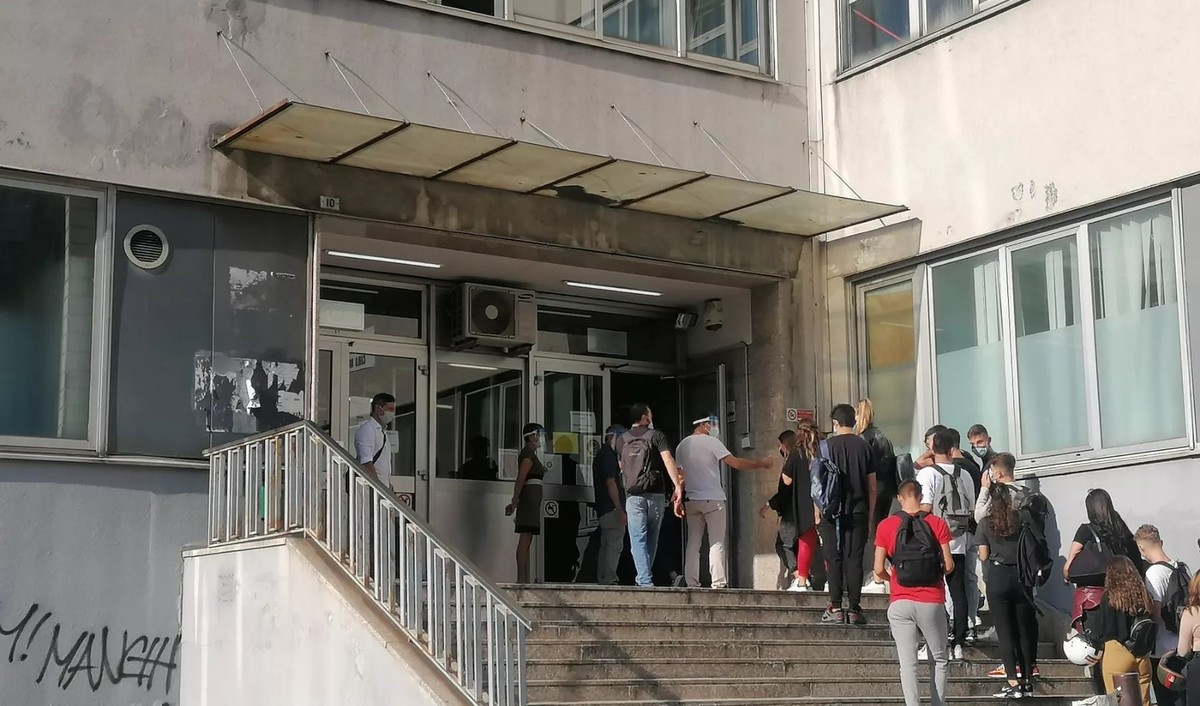
The attack on the principal of the Bergese hotel school in Genoa is not just a news incident, but a worrying sign of the deteriorating relationship between school and family. Education, from a shared foundation, has become a battleground. In a society where social tension and individualism seem to prevail, we need to question the roots of these behaviors and how to rebuild an educational pact that is now deeply torn apart.
Journalist Valentina Evelli wrote an article, published in La Repubblica, in which she recounted the unacceptable gesture suffered by Andrea Ravecca, headmaster of the Sestri Ponente school. According to the reconstruction, the student’s mother “allegedly showed up at school after her son took a note for disciplinary issues.”
During an interview with the principal, she allegedly first verbally and then physically assaulted the school principal who decided to call law enforcement. “At that point the parent allegedly decided to leave the school, and when the principal asked to stop, the woman suddenly turned around, striking Ravecca with a punch to the face.”
The man fell to the ground suffering “shoulder and head trauma” and was transported to the emergency room. “I’m bitter, what happened is a sign of weakness for all of society,” said the principal, stressing the seriousness of the action, not so much for himself, but for “the absolutely uneducational message that was given to the boys.”
This event is part of a context already marked by increasing educational fragility. Increasingly, parents are acting as “unionists of their children,” ready to defend them no matter what, even in the face of evidence of misbehavior.
This “overparenting”-or overparenting, as defined by U.S. psychologists-undermines children’s autonomous growth, de-empowers and weakens them.
The educational alliance between school and family is crumbling. Frequently, parents interfere in teaching, demand to agree on grades with teachers, fix backpacks for high school kids and fuel virtual conflicts in school chats.
To reverse this course, new educational tools are needed. Society must return to offering young people reference figures and supportive environments capable of supporting them in their insecurities. There is an urgent need to promote responsible parenting training courses. Moms and dads must learn to rationalize, reason, reflect instead of acting on impulse.
As shown in my research, contained in the book ‘Children of Apps,’ the pandemic years have exacerbated teenagers’ isolation and identity confusion, pushing them to perceive reality as a video game and to want to win at all costs. Precisely because of this, many of them end up asking their parents for help, expecting them to intervene in every situation.
In this context, the school must become a promoter of paths of education on feelings and citizenship, involving multidisciplinary teams and proposing inclusion and support projects.
All is not lost. We cannot give in to “badtivism” and resignation. Violence cannot and must not overshadow the many positive experiences that animate Italian schools every day. There are teachers, parents, principals and students who continue to believe in the power of education. It is necessary to rebuild, step by step, the dialogue between school and family, encouraging mutual respect and empowerment of each.
What happened to the Bergese principal is a wake-up call that we cannot ignore. This is not an isolated case, but the symptom of a deeper educational crisis, in which the confusion of roles and the absence of boundaries risk compromising the growth of our children. Only through a renewed synergy between school, family and society can we restore meaning and value to the word “educate.” Because educating means, first and foremost, building together.
The article Educational emergency: when parents punch the entire society in the face comes from TheNewyorker.
