
Not always fashion is born in the living rooms; sometimes it appears in the moments when history breaks. However, it never breaks in a clear way but breaks in small pieces, in microstorie. Some of these, fashion wears them without declaring them, sewn in the folds of a fabric or hidden under the back of a jacket or behind the lightness of a print.
The story of Emilio Pucci belongs without hesitation to this second category, to a suspended dimension, in which elegance is never only aesthetic, but the result of a complex and often dramatic historical crossing. Not an apparent elegance, but that in which style is rooted in risk, choice and responsibility.
Before becoming the Prince of prints that would conquer the world, he was a man immersed in the contradictions of Italy in the twentieth century.
Aristocratic Florentine, aviator and ace of the Regia Aeronautica, tireless traveler of the world, direct witness to the crucial events of World War II, Pucci embodies a figure in which personal biography and collective history intertwine deeply.
In Italy crossed by the war, the fall of fascism and the difficult reconstruction of the post-war period, fashion also becomes a language of rebirth, identity and international projection. In this context, the trajectory of Pucci — which from experiences marked by risk, imprisonment and political responsibility approaches the creation of a free, dynamic and surprisingly modern visual imagination — reflects the tensions and aspirations of an entire country.
After the fall of the fascist regime, while Italy is dilated and forced to deal with Nazi occupation, civil war and its political redefinition, Emilio is involved in one of the most delicate and controversial events of that period: the preservation of Ciano diaries.
What has appeared for many decades a marginal episode, is in fact a crucial step in the construction of the Italian historical memory: to guard, protect, to get those documents outside Italy meant to expose themselves to concrete risks, to move in an ambiguous territory, espionage theater, negotiations and constant dangers.
It is here that a Pucci emerges far from every patinata image: a man who acts, takes a position, crosses the war not as a spectator but as a protagonist, paying in person the consequences of his own choices.
This experience, marked by tension, mobility and contact with different worlds, is not confined to personal history, but is reflected — perhaps unexpectedly — even in its creative vision. When, in the post-war period, Emilio enters the world of fashion, he does so bringing with him an imaginary already crossed by movement, travel and encounter with other cultures.
Its fluid lines, vibrant colors, dynamic geometries are not only an aesthetic revolution: they are the expression of a look that has formed well beyond the Italian borders, contaminated by African suggestions, by Mediterranean atmospheres and by influences collected in his travels to Indonesia.
In an Italy that tries to reinvent itself and project itself on the international scene, Pucci contributes to building a new idea of modernity: light, free, cosmopolitan. Fashion thus becomes not an escape from history, but a continuation of it in other forms.
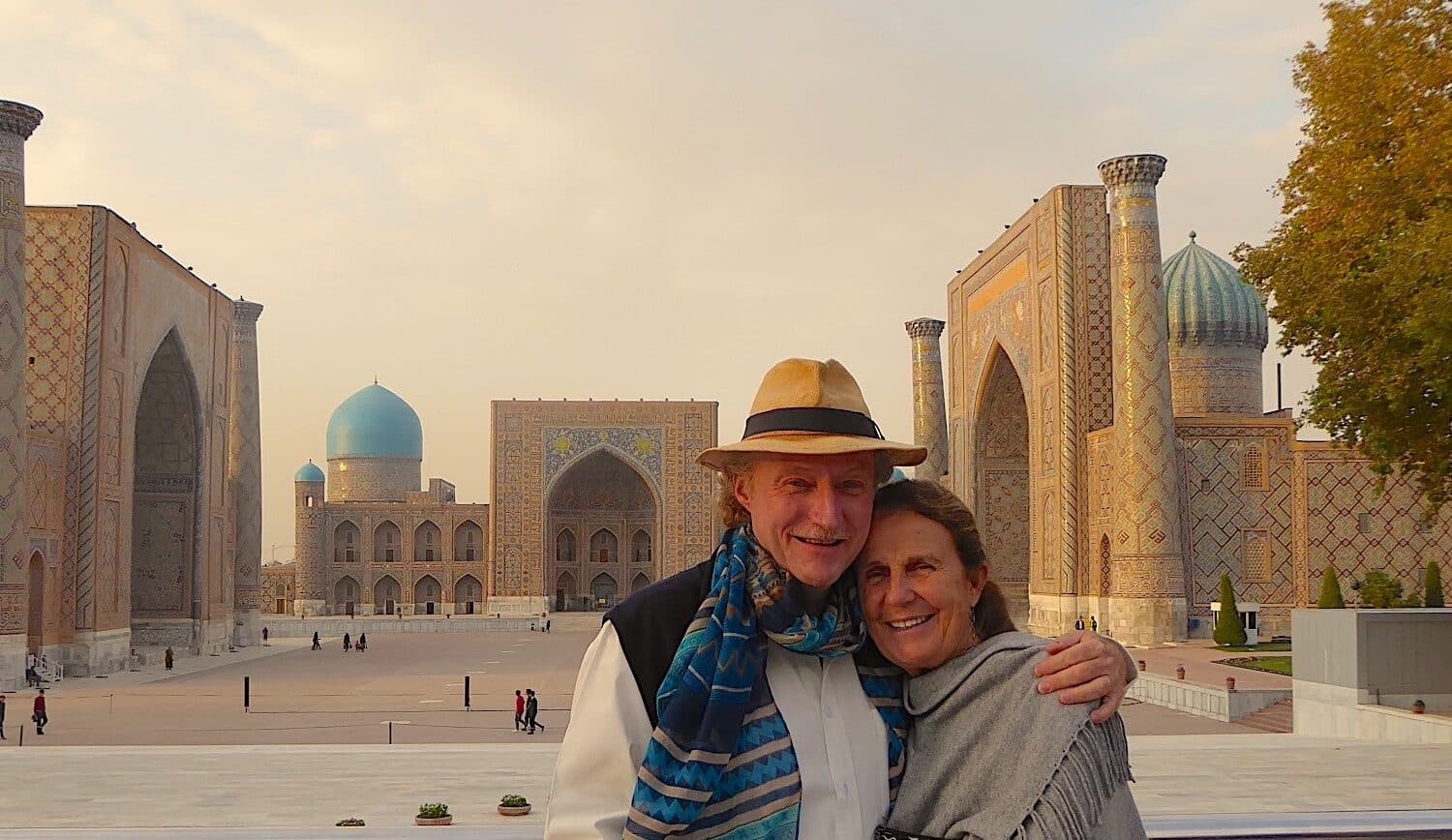
It is precisely in this boundary space between memory and style that fits the work of Terence Ward and Idanna Pucci ( Emilio’s nephew), that in their book they return a figure far from the myopic vision of the stereotype of the designer. Through documents, testimonies and a story that has the rhythm of a novel, emerges a protagonist immersed in the history of his time, able to transform extreme experiences into creative vision.
Her individual courage and artistic creation end surprisingly to coincide.
The interview with the authors thus becomes an opportunity to question how fashion can be read not only as an expression of taste, but as a living trace of an era and its contradictions.
The conversation with the authors had the same density of their survey lasting years. It was not a simple interview, but rather the opening of an archive: a story made of obstacles, deviations and insights that restore all the complexity of their work.
Terence Ward and Idanna Pucci talked about a research far from linear. The sources, first of all: fragmentary, dispersed, sometimes contradictory. Reconstructing the figure of Emilio Pucci has meant moving between difficult documents to find, indirect testimonies and shadow zones of Italian history that still remain a unique narrative.
To this was added a first project, a documentary, which should have told this story and instead never saw the light. A failed attempt that, however, did not close the search — if anything has made it more stubborn.
It is precisely in this resolve that the value of their work is measured. Authors have never stopped: between the United States and Italy have continued to chase tracks, to verify versions, to fill gaps. Public and private archives, family memories, forgotten cards: each element has been tested, in a process that looks more like an investigation than a traditional biography.
What emerges from their voice is the portrait of a path built against dispersion and silence, where writing becomes the point of arrival of a long resistance to memory loss. And it is perhaps this tension — between what has been hidden, forgotten or never told to the end — to give the book its most incisive force.
Pucci was not a partisan, at least not in the purest sense that history has encoded. Yet, reading the authors’ story, this definition suddenly seems unfair.
In the heart of the war and the Resistance, his actions — linked to the protection and transfer of the diaries entrusted to him by Edda Mussolini, wife of Galeazzo Ciano, Minister of Foreign Affairs in those crucial years — assume the contours of a commitment that, although without formal membership, is charged with the same risk and moral urgency.
Explanation, escape, clandestineness: and then capture, torture, stubborn silence. Days in which he does not yield, does not reveal, does not betray.
It is in this ambiguous space, out of the sharpest categories, that the figure of the designer becomes even more interesting. Because the Resistance was not only an organized armed movement that faced Nazis and Republicans, but also a constellation of individual choices, often isolated, which helped to redefine the image of a country overwhelmed by fascism that sought at that exact moment to redeem itself from those years of dishonour.
In this sense, thinking of Pucci as an atypical form of partisan is not a forced operation, but a possible key to reading: the sign of an Italy that, just as it collapses, tries to distinguish itself from what has been, to oppose, to redeem itself.
In the course of the interview, Idanna Pucci recognized this interpretation, recalling how a similar intuition had already emerged in a confrontation between her uncle and journalist and writer Oriana Fallaci.
A passage, therefore, that does not serve so much to legitimize a definition, as to confirm a tension: that between official identity and lived truth, between historical labels and individual trajectories that cross and complicate them.
Reading all of a breath, Emilio Pucci’s absonishing odyssey remains, in the end, a precise feeling: that his story cannot be contained in one narrative. Nor only fashion, nor only war, but an irregular interweaving of experiences that obliges us to review categories and simplifications.
It is perhaps right here the strongest caring of Terence and Idanna’s work: to have returned complexity to a figure that the time had made icon, bringing it back inside the living tensions of his century and remembering that, sometimes, even behind the lightness of a press hides the weight of history.
Because, in some cases, what appears light is nothing but the most sophisticated form of resistance… or Resistance.
L’articolo Elegance on the surface, daring under skin: Emilio Pucci’s double life comes from IlNewyorkese.
