
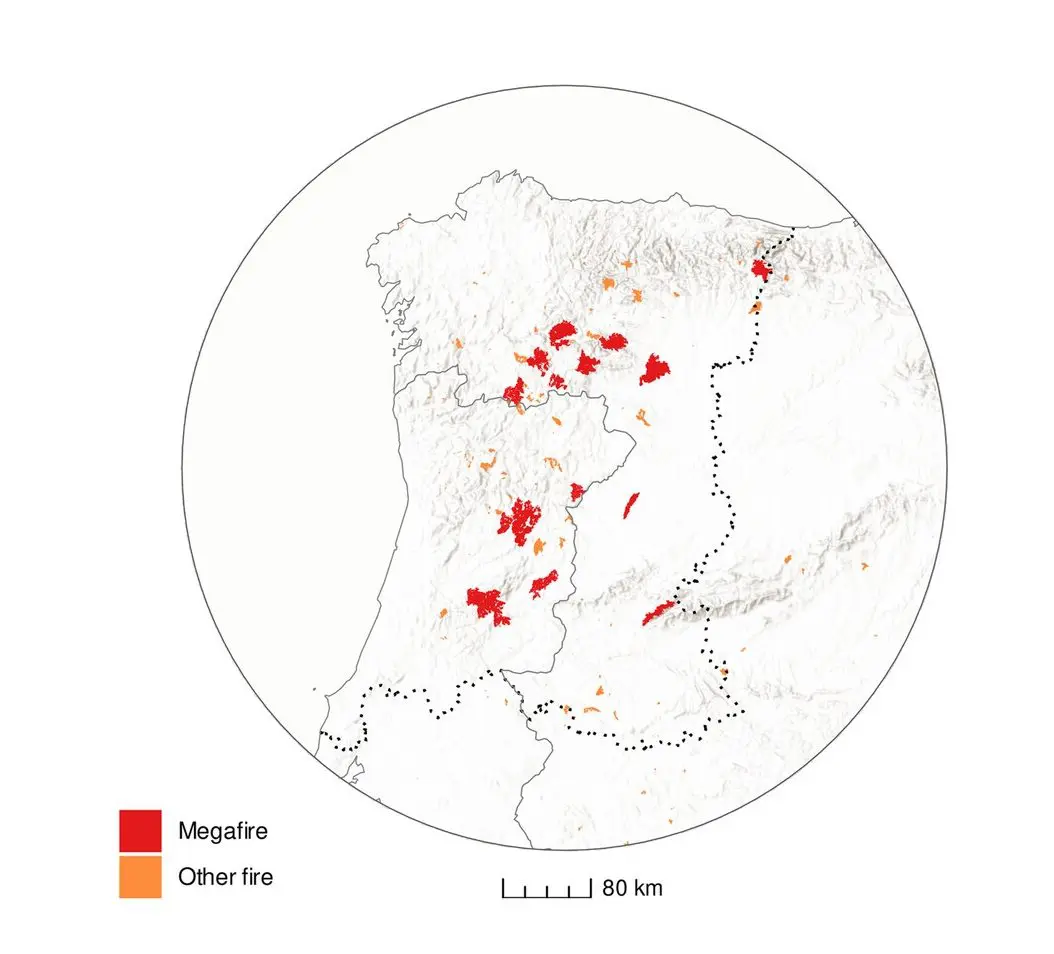
ROMA (ITALPRESS) – The combination of extreme weather conditions and vegetation particularly prepared for combustion was the origin of the historical record of the surface burned during the fires that hit the North West of the Iberian Peninsula in August 2025: it is what has reconstructed an international study in which researchers and researchers from the National Research Council of the Institute of Climate Sciences and the Institute of Climate Sciences have participated.
The study published on Global Change Biology in the format Science behind the news, was led by the Group of Regional Atmospheric Modelling (MAR) of the Spanish University of Murcia, and saw the participation, as well as the Cnr, of institutions from Spain and Belgium. The research shows that fires were not an isolated event, but developed in conjunction with an exceptional heat wave lasting 16 days in south-western Europe, which favored extreme weather conditions for fire propagation. These conditions were reflected in the rise of the Incendium Danger Index, which reached the highest monthly value ever recorded in the North West of the Iberian Peninsula in 1985-2025.
The area affected by fires, while representing 2% of the European territory, has concentrated more than 50% of the total surface covered by fire in Europe until the end of August, including about 541,000 hectares on a total of one million damaged by fire. However, the extreme weather conditions detected, while being a determining factor, do not explain the extent of fires alone. In addition, there has been no evidence of a greater presence and impact of fires on protected areas: the surface burned inside these spaces is, in fact, consistent with their relative extension on the territory. The flames have rather disproportionately affected the areas of stain and shrub, which have burned in percentages much higher than expectations: This imbalance suggests an increase in the extension of this type of vegetation, probably linked to decades of abandonment of the territory, common to the whole European Mediterranean, and an ineffective forest management.
“The results show how climate change is increasing the likelihood of extreme weather conditions favourable to fires, but the final impact also depends strongly on the use of soil and plant fuel structure,” says Marco Turco, an Italian scholar in force at the University of Murcia who coordinated the study. “It is necessary to move from a predominantly reactive fire suppression strategy to proactive prevention, which considers resilience to fires as a national security priority,” says Mara Baudena, the first researcher of the Cnr-Isac in Turin. “An integrated management of the territory, which reduces the fuel load and strengthens the active and conscious presence of local communities, together with satellite monitoring and rapid intervention capacity, are today among the most effective measures to limit future impacts,” concludes Antonello Provenzale, Cnr-Igg research manager.
– CNR press office photos –
(ITALPRESS).
