
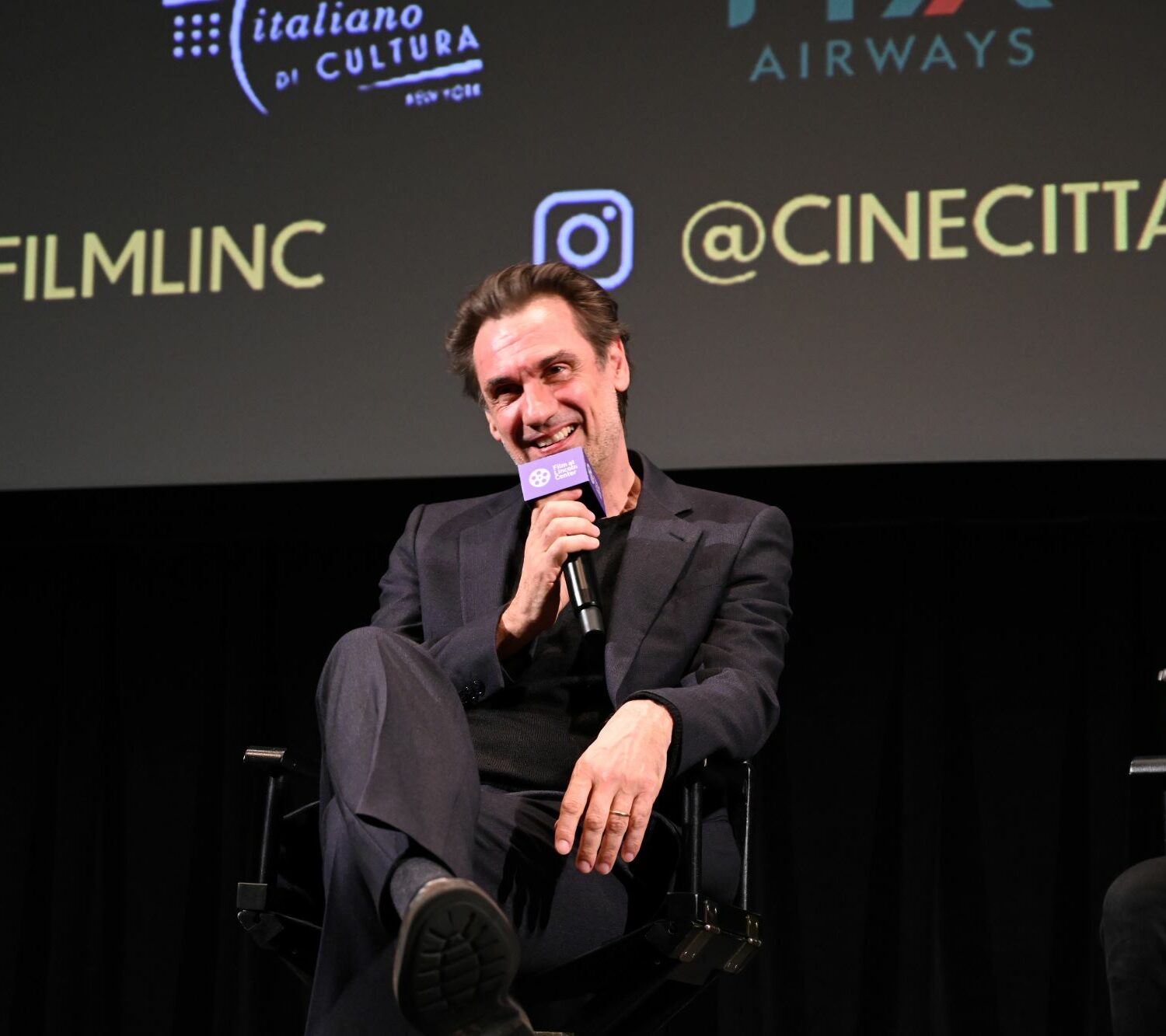
Fabrizio Gifuni is one of the most appreciated actors and theater directors on the Italian scene. In recent years he has established himself as a performer capable of dealing with complex and layered characters, working with directors such as Giuseppe Bertolucci, Marco Bellocchio and Paolo Virzì. Winner of the David di Donatello for best supporting actor for Il capitale umano (2014) and best actor in a leading role for Esterno notte (2023), he now returns to the big screen with Il tempo che ci vuole, an autobiographical film by Francesca Comencini presented out of competition at the 81st Venice International Film Festival. The film tells the personal story of the director and her difficult relationship with her father, the great Luigi Comencini, played by Gifuni himself. We interviewed him for the Newyorker on the occasion of Open Roads: New Italian Cinema, the festival organized in New York by Lincoln Center in collaboration with Istituto Luce Cinecittà, which every year brings to the United States a selection of the most interesting voices of Italian cinema.
The film addresses the deep and often unresolved bond between a father and daughter. How does one enter such a personal story, knowing that one is fleshing out someone else’s memory?
It is a responsibility but also a great privilege. When Francesca proposed the role to me, I immediately felt that it was not just about playing a character, but about entering a very delicate affective zone. I read her words, listened to her silences, and tried to return not so much a “resemblance” to the real Luigi Comencini, but an emotional bond, a truth that could speak even to those who did not know them. I believe that in this sense the film succeeds in coming out, from a private story, to enter a universal horizon, that is, the story that each of us had with our parents. It is a deeply identifying moment, where the viewer feels that that story is also his own, not just that of a great master of cinema.
Caring for the other becomes, almost by reflex, a way to care for oneself as well, to deal with the wounds one cannot process alone. How present is this dimension in the film?
I think the theme of care is deeply rooted in this project, but it is above all a liberating narrative. I think of the relationship between father and daughter that develops over a lifetime: from childhood, with its frailties, to early adulthood. There is a moment in the film when this bond generates a kind of twist, a mirror effect. The same stairs that the child climbed laboriously, sleepily, to go to school unwillingly, become later the stairs that her father can no longer walk, because his body does not support him, because he is ill. I think those are among the most emotionally powerful scenes: in that silent passage, so many people are mirrored. For me, however, it is not just a film about healing; it is mostly about courage. The courage to face unspoken things, to put the pieces of a relationship back together, even when it hurts. To look at a parent no longer as an icon, but as a human being, fragile, imperfect. It is in that recognition that, in my opinion, comes the possibility of true liberation, for both parties.
The absence of chorality is a radical choice. The reduction to just the two voices of the protagonists amplifies the sense of their presence, making the narrative even more powerful…
This lack is one of the film’s most profound qualities, a rare insight that only a director like Francesca Comencini could have: choosing to isolate only two voices, that of a father and a daughter, and to zero out everything else. This subtraction forces the audience to stay there with them, unable to escape elsewhere. It locked us inside that dialogue, inside those rooms, inside that memory. And those two voices resonate for a hundred because every time a memory surfaces, something also resurfaces in the viewer. This is the strength of Francesca’s insight: being able to transform an absence into a space of resonance.
What was the feeling, if there was only one, that accompanied you more than any other in playing this role?
One of the things I tried to pay more attention to was the empathy that characterized Luigi Comencini. Empathy, understood in its most authentic form, means first of all being able to listen to the other person to the core, without prejudice, in a free way. It sounds like a simple gesture, but it is not. The ability to suspend all filters is one of the qualities that guided me in building the person more than the character. It was a fundamental starting point for me. I was deeply struck by reviewing the television program Comencini made for RAI in 1970 that aired in 1978, I bambini e noi. In those six episodes you often see him at work, listening, asking children questions. And it is there that you catch his emotional intelligence, his extraordinary way of taking in the answers, without forcing them, with respect and attention. I have tried to pose with the same emotional intelligence in welcoming this role.
During the making of the film, was there a particularly significant or, on the contrary, particularly difficult moment for the director, especially considering her deep personal and emotional involvement?
Francesca was extraordinary in her ability to maintain a coolness, in the noblest sense of the word, while working. I mean the kind of detachment it takes to remain lucid behind the camera while going through a deeply personal and painful experience. That is not to say that she was not emotionally involved, quite the contrary. She got emotional many times, but she managed to contain that emotion as long as she was on set. This film touched us all deeply. It is one of those projects that creates bonds destined to last forever. The narrative is full of emotionally intense scenes: some dramatic, some light, but all marked by a very high specific weight. It is a film that never backs down in the face of emotion. On the contrary, it is courageous precisely because it confronts them, runs through them. And this also applies to us actors. We are often inclined to want to control everything, and instead the real change, the real growth, happens when you let go of that control. It’s difficult, but every time you face something that you thought you couldn’t sustain, that you thought was too strong, too painful, you come out transformed. I don’t know if necessarily better, but definitely more adult. It is an inevitable passage, and The Time It Takes is also that: a film that takes you inside that passage. A passage for which it takes The Time It Takes.
The article Fabrizio Gifuni recounts the fragility of fathers comes from TheNewyorker.
