
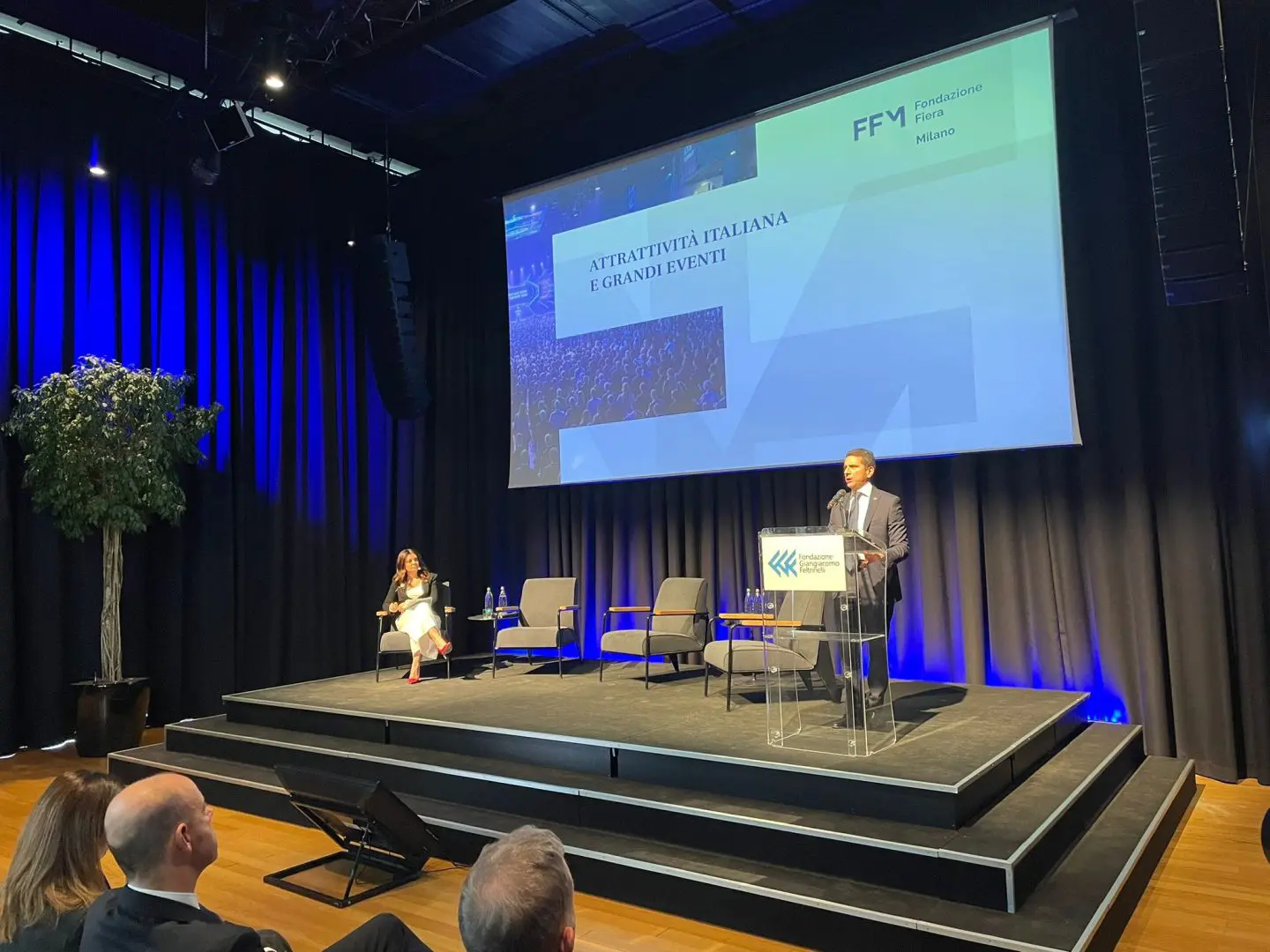
MILAN (ITALPRESS) – The European meeting industry returns to full swing with a clear growth compared to the pre-pandemic years. In 2024, a total of 3,057 large associations or corporate events took place in Europe, with at least one thousand participants, in presence or in hybrid format, with an increase of 7% compared to 2023 and 17% compared to 2019. This is the photograph that emerges from the report “Europe of the great associative and corporate events 2025′′′, realized by the Centro Studi di Fondazione Fiera Milano e ASERI – High School of Economics and International Relations of the Catholic University, which certifies the definitive overcoming of the historical thresholds of the sector and a clear improvement regarding the pre-Pandemia levels.
88% of the events held in 2024 in Europe are concentrated in 15 countries, with Italy ranked third in number of major events hosted, consolidating its leading role in the sector. In 2024, in fact, our country hosted 397 events in 33 cities, equal to 13% of the total European, with an increase of 8% compared to 2023.
The figure places Italy immediately after France and Germany and just before Spain, configuring an increasingly competitive Mediterranean axis in the production and attraction of events with high added value. “The results of the report confirm the strategic role of the meeting industry as a real infrastructure enabling the circulation of knowledge, capital and innovation – said Giovanni Bozzetti, president Fondazione Fiera Milano – Clearly emerge the dynamics of a sector that grows particularly robust in the segment of the most complex and high economic impact events, contributing directly to the development of the territories. In this context, the value of Made in Italy is confirmed as a strategic flywheel of competitiveness: the quality, creativity and reliability of our trade fair-congress system, combined with the characteristics of the territory, the business system and the scientific community, continue to attract leading international events. Appointments such as the Milan Cortina Olympics, now at the doorstep, further strengthen the position of Italy and Milan in the European scenario. In this context, Fondazione Fiera Milano plays a crucial strategic role: it is not limited to creating spaces, but it builds ecosystems capable of connecting institutions, enterprises and research centers.”.
The study, starting from the analysis of the great events realized or in presence or in hybrid format, has also analyzed their characteristics, with focus on time distribution and typologies and sectors. The distribution has a strong seasonality, with peaks in June (14%) and October (15%). The average duration of the events is 2.8 days, which rises to 4 days in August. 44% of the events reported are congresses, in 39% of cases it is conferences and in 6% from conferences organized within fairs.
The congress centres and congress venues host 32% and 30% of the events respectively, while the hotels receive 9%, reaching 71% of the events. Within the congress centres and the fair-congress offices, 28% of the events have a European or global dimension; This share falls to 25% if only the exhibition-congress offices are considered. In terms of content, corporate events focus mainly on technology sectors (31%) and commerce (28%).
Non-corporate events, on the other hand, deal mainly with medical issues (34%) or related to human sciences (16%). On average, only 17% of corporate events have a European or global rotation, while for non-corporate events this incidence is higher, at 26%.
Milan is firmly established among the most important and attractive European cities, placing itself in third place after London and Paris, with 90 events detected and an increase of 6% compared to 2023 (85), with numbers above the European average in particular regarding the class of events with 1500-2500, 31% against 23%. Milan, in particular, demonstrates an extraordinary attraction especially in the financial, managerial and scientific fields, on which it primes compared to other European cities considered: the Lombard capital confirms the first position in the Economics segment, concentrating 21% of the events, with particular reference to financial and insurance issues, organized in the entire cluster; the primacy of attraction, moreover, is recorded for the first time also in the management segment and in the field of Science, thanks to events of great international importance.
Numbers reflecting the role of the city as an international financial hub and a place capable of virtuous synergies, thanks to a combination of academic and productive excellence. Among the first 11 European congress cities is the performance of the Italian capital: in 2024 Rome hosted 57 events, equal to 3% of the events recorded in Europe, positioning itself to 7 place for attractiveness, with data above the average for the class of events with a size 1.oo-1,500 participants (53% on the total of those made in the city, against a European average of 46%).
In detail, Rome ranks 2nd with respect to the Science sector and 3rd in the Medical Science field: an activity linked to concentration in the city of laboratories and research centers such as the National Institute of Nuclear Physics, the National Institute of Astrophysics and the Italian Space Agency.
-Photo xm4/Italpress-
(ITALPRESS).
