
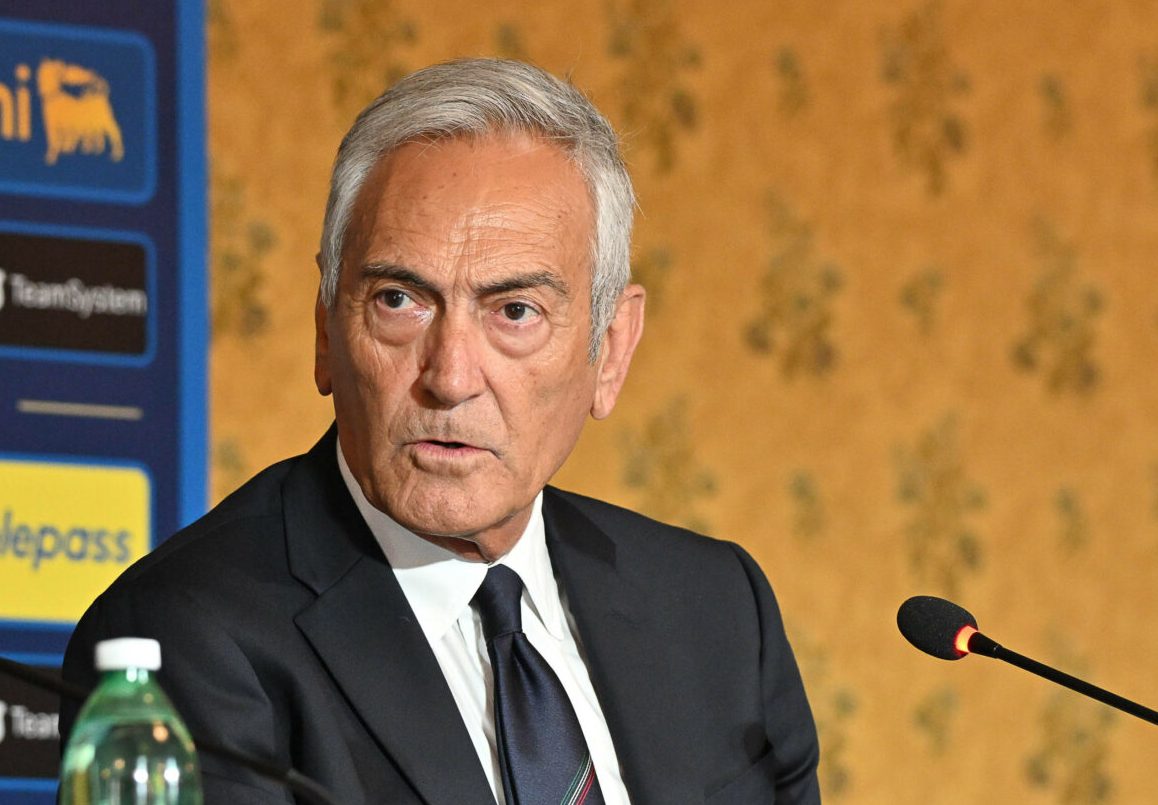
ROMA (ITALPRESS) – “The criticalities of the Italian football system have been well known for years, recalled in many official documents, which differ only for the statistical data in constant worsening, confirming the fact that it is mostly structural deficits.” It is the thought of the resignation president of Figc Gabriele Gravina, who decided to make note of the report prepared in view of the audition before the VII Commission Culture, Science and Education of the Chamber of Deputies, then erased after its step back “as if the problems of the football movement were subsequently resolved”.
“If we want the good of Italian football, as a sports movement as a whole, it is necessary to make clear on the real competences of the Federation, the Leagues (so of clubs) and the institutions – says Gravina – Too many inaccuracies, if not even true falsehood, in fact, fuel the search for guilty at all costs, but above all the spread of wrong convictions. I risk, the latter, that penalizes even more than the first real search for solutions to the problems of our football”.
“In my view, in fact, it is no coincidence that in the subjects of direct and exclusive federal competence (social and environmental sustainability, youth and school projects, training and development programme of the Youth Nationals, just to name a few), there have been remarkable results, contrary to the subjects in which the interests of the components, as well as the autonomous reciprocal, overlap to this point in order to arrive to ingess Gravina the system”.
LA RELAZIONE DI GRAVINA
Few Italians in the field, dispersal of talent, an economically unsustainable system and the huge infrastructure issue, as well as the difficulties of making a common front. These are in summary the criticalities of Italian football at the origin of the “mali” of the National, which for the third time in a row missed the qualification to the World Cup. Gabriele Gravina, president of resignation of Figc, made note of the report that he should present on the occasion of the hearing before the VII Commission Culture, Science and Education of the House, then canceled following his step back. Gravina lists a number of points that can explain the current situation, starting from the low percentage of Italians and young people in the field: said that the A series with an average age of 27 is the eighth oldest tournament in Europe, in the current championship foreigners played 67.9% of total minutes while in Spain we are 39.6% and in France 48.3%. On the other side of the 284 players who played on average at least 30 minutes per game, only 89 – of which 10 goalkeepers – are Italian.
The data also condemns investments in youth sectors (in the Top 50 for ten-year revenues from the sale of “home-formed” players there are only Atalanta and Juve, two of the four clubs with a second team “whose introduction was however long obsteggiated in our system”, recalls Gravina) while the Italian Serie A is the 49th World Championship (out of 50 monitored) for percentage of minutes played by footballers21. The progressive impoverishment of technical quality and the dispersion of young talent in Italian football is also recorded: the results – the best of all – obtained from nationals until the Under 20, whose players then struggle to assert themselves in the first teams. Gravina mentions Spanish footballers who played the European Union U19 2023 (wine from Italy) who “have almost double malnuts in the first division and almost six times greater in European Coppe matches than their Italian counterparts”. As far as economic management is concerned, “the resources generated are not enough to cover costs” and for this reason you prefer to take players abroad, “which often turn out to be cheaper”. In the last 40 years 194 companies have not been admitted to the championships and in the last 13 years 519 penalty points have been imposed.
“Italian professional football still loses more than 730 million euros per year”, with the incidence of the cost of work on the value of production that in the last five years has exceeded 80% in both series B (82%) and in series C (89%). “The area of professionalism is hypertrophic (97 professional clubs have very few countries in the world: Mexico, Turkey, Argentina, Thailand, Saudi Arabia are the only ones with the most professional clubs in Italy”, reads again in the report, which then lives on the infrastructures (“Italy does not figure among the top ten European nations by number of stadiums built/modernized between 2007 and 2024”) and on the “cronic inability to make system: the number of subjects carrying different interests that sit in the Federal Council is higher than that there is”.
If Italian football is in crisis, politics also has its faults. Gravina points its finger against the abolition of the sports bond, which has repeatedly been challenged by the Federation, “for the devastating effects it has produced on the foundations of the Italian football system”, but also against the Mulè reform which gave the Leghe “a sort of “right of understanding” on fundamental issues such as, for example, the definition of the National Licences system for admission to the championships. This resulted in the impossibility of tackling some fundamental reforms to try to correct the first highlighted criticalities”, on all the reform of the championships, with Serie A and Serie B at 18, with reduction of the professional area of the Lega Pro. We are talking about fixing a minimum number of Italian players to be deployed in the field, but it is “impossible to be implemented because it is contrary to the principle of free movement of workers, which applies to football as a professional sport”.
And if on the one hand there was no “system collaboration” for the untouched calendar, which also takes into account the needs of the National”, on the other, unlike what happened for Milan-Cortina, the America’s Cup in Naples or the Mediterranean Games in Taranto, “there were no economic appropriations, not even in anticipation of Euro 2032” with “the investments in new plants, already implemented/advised institutions” Another point underlined by Gravina the fact that “the costs of the passage to the professionalism of women’s football are entirely at the expense of clubs and Federation; vice versa, in Spain, the public contribution for the passage of women’s football to professionalism was almost double (20 mln euros in the three years, against 10,7)”.
LE CONCLUSIONI DELL’EX PRESIDENTE
“For the good of Italian football, the only way to intervene is to do so in a radical way, thanks to a unity of intent that exceeds the boundaries of the convenient and the appropriate. It would be decisive one step forward by all federal members, with the fundamental support of the Government and Parliament.” So Gravina in the conclusions to her relationship. “Because without this convinced and unanimous will to prioritize the common good to the defense of its positioning, with the policy that must create the conditions and facilitate the appropriate tools to act, no individual can determine the true and complete relaunch of the Italian football movement”, emphasizes again Gravina, listing a series of measures that could be of help, such as the right to bet (percentage of jets or wins on football) and the same credit from football.
And again, the restoration, even with possible reformulation, of the “Decreto Crescita”, the abolition of the prohibition of advertising and sponsorships for the operators of bets, introduced with the “Decreto Dignity”, the adoption of measures of support for the realization of new stages and/or the modernization of the existing ones, the recognition to the Sporting Federations of the status of “social enterprise” or, “quantomeno, reintroduction of the norm that is allowed of the norm of the same And again, among the proposals on the table present in the report, “the project of technical relaunch of the Italian youth football (trusted to Maurizio Viscidi), focused on the recovery of the centrality of the technique regarding tactics, the strengthening of the formation of the trainers of youth sector, the attention to the basic non-agonistic activity, the reform of the juvenile championships” and the “project of reform of the championships of Serie A, B, CAT and D, in agreement, to the state understood in the state of the.
– photo IPA Agency –
(ITALPRESS).
