
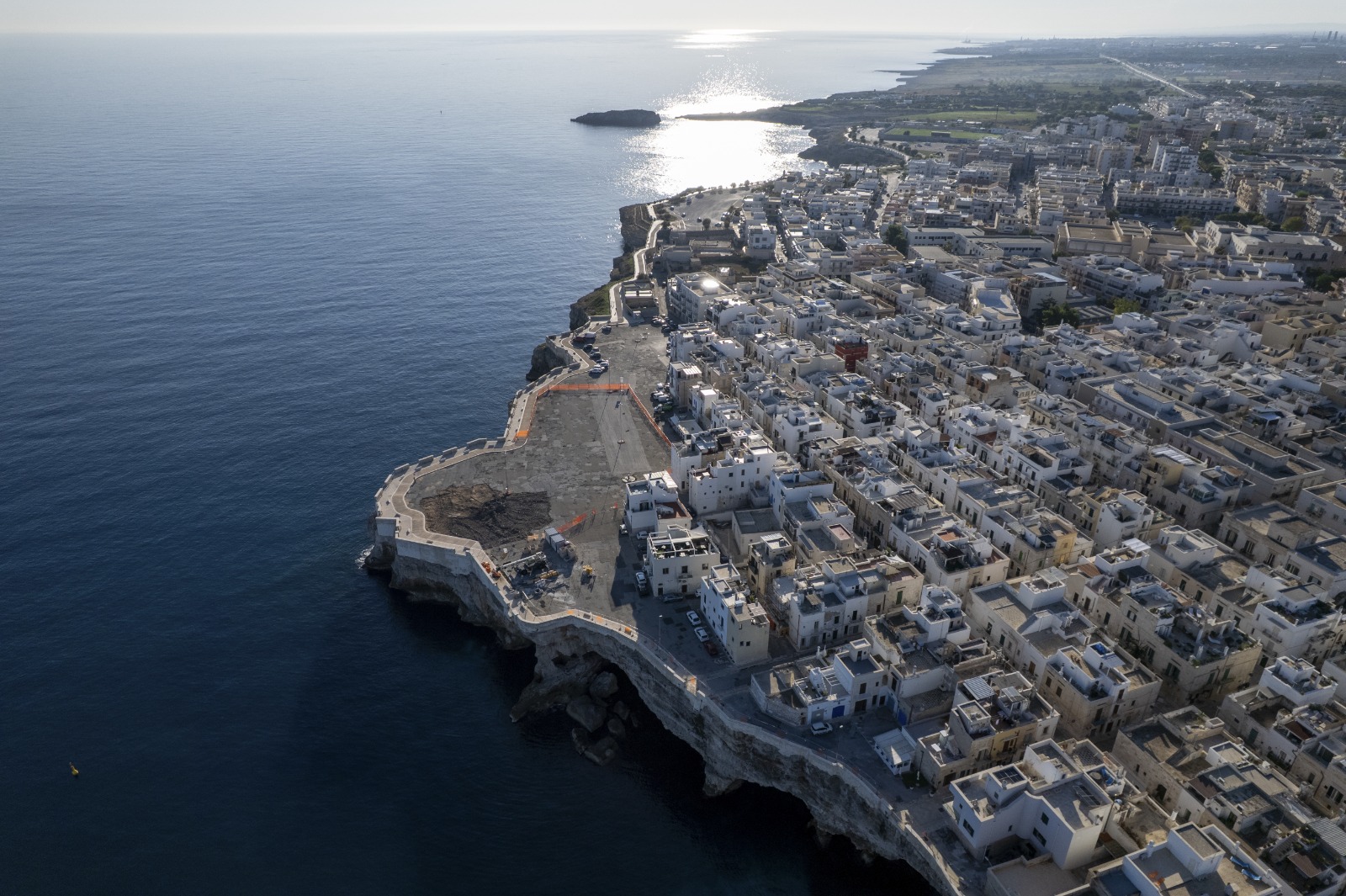
ROMA (ITALPRESS) – For the third consecutive year, Bari primes in the Climate Index of the Sun 24 Hours, the first stage of approach to the survey of the Quality of Life of the Sun 24 Hours. The Apulian capital follows several locations of the Adriatic coast such as Barletta-Andria-Trani (second place, whose data refers to the average performance of the three capoluoghi), Pescara, Ancona and Chieti.
Among the top ten are mostly coastal territories (including Livorno, Trieste and Imperia), but also some cities in height (Pesaro and Urbino, as an average of the values found in both urban centres, and Enna). The climate classification takes pictures of climate well-being and tells what are the capital cities able to offer the best weather conditions to those living on the territory according to the average data collected during the decade 2015-2025.
The result contributes to 15 indicators that measure 15 different climate parameters that impact people’s daily lives. Among the great cities are better placed Bari, Trieste, Venice and Naples, while Milan, Bologna, Florence and Turin are in the second half of the ranking. At the bottom of the ranking is the city of Carbonia (South Sardinia), one of the most affected by extreme hot peaks, the heat index and relative humidity. The Sardinian capital is preceded by Terni, Belluno and Caserta.
Belluno, in particular, is last in three of the fifteen indicators: it has the least number of hours of sunshine per day (average 6.8 against 9,2 of Agrigento, the most sunny); it records the most average number of cold days a year (19.5 in the decade taken into consideration); it is penalized then by relative humidity, with 263 days a year out of climatic comfort, that is under 30% or over 70% of moisture. The Venetian city, however, also boasts the least number of tropical nights, only 15, during which (between midnight and six) there is a temperature greater than 20 degrees.
Terni, instead, is penalized by the worst performance among the capoluoghi for waves of heat and peaks of extreme heat: in the hinterland these phenomena are not mitigated by the marine breeze, that instead rewards cities like Savona, Pescara, Imperia, Genoa, among the first in these indicators.
The great cities are divided into two groups: on the one hand Bari (1^), Trieste (8^), Venice (15^), Naples (24^), Reggio Calabria (29^), Cagliari (33^) and Rome (37^) that meet among the first forty positions of the ranking; on the other Milan (71^), Bologna (72^), Florence (78^) and Turin (90^) in the second half of the ranking. More generally among the last 30 places, so where the worst weather conditions are found, you will meet all cities in the North (especially located in the Po Valley) except six corners of the South and five of the Centre. In Turin, then, we find the worst air circulation, with 162 stagnant air periods per year (at least 4 days with rainfall ” 1 mm daily).
The primates of Enna emerge, which, thanks to its altitude, records the lowest heat index and the best air circulation, and cities like Cagliari or Catania where no more cold days are detected (under 3 degrees perceived temperature) per year.
The study also shows a clear trend of climate heating: in the last 15 years the average temperature in Italy has increased by 1,8°C, with higher increases in the North (+2.3°C). In 2025 there were 17 waves of heat, 14 peaks of extreme heat and about 80 tropical nights. Rains are increasingly concentrated in intense events, while drought periods grow and cold days decrease.
To warm up in a more marked way is the North of the Country where the thermometer climbed on average of 2,3 degrees between 2015 and 2025, while in the capoluoghi of the Centre Italy was 1,9° C, in those of the Mezzogiorno of 1,3° C. Enna primates emerge that, thanks to its altitude, records the lowest index of heat and the best circulation of the air, and of the city like Cagliari or.
Extremely warmer: events linked to high temperatures rise, there are 17 waves of annual heat (+5.5 compared to 2010), 14 peaks of extreme heat and about 80 tropical nights, in strong increase. More violent but less frequent rains: rainy days decrease but intense rainfall increases, with episodes concentrated in a few hours. More drought: increased the consecutive drought periods, arrived at 12% of the yearly days without rain (picks up to 19% in some cities of the South). Milder winters: cold days collapse and heat zero grows, signal of the progressive reduction of snow at low altitude.
-Photo IPA Agency-
(ITALPRESS).
