
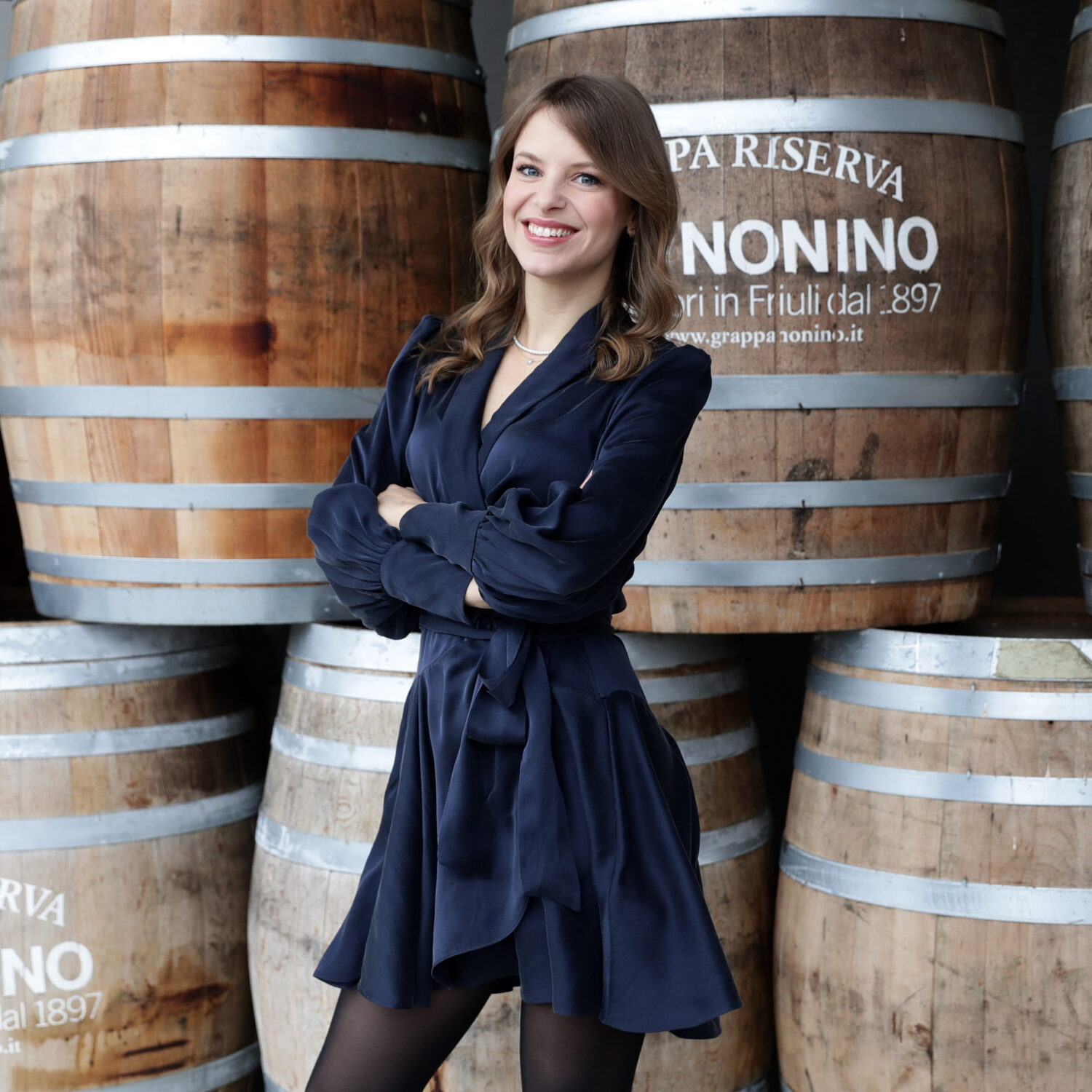
Francesca Nonino introduces herself immediately as follows, “I am the sixth generation of my family, distillers in Friuli since 1897.” The voice is passionate and quick, an enthusiasm that you can immediately tell is not manufactured, and that never stops growing as you speak.
“We are known around the world for revolutionizing the way grappa is produced and offered,” he says. A revolution that started from a very simple, but also very disruptive idea: treating with respect the pomace, the raw material from which grappa is made, which until then was considered waste.
“Grappa was seen as a poor product, made from waste. They called it ‘firewater,’ it burned everything: even hunger. My grandparents, Giannola and Benito Nonino, thought that selecting a single grape variety, instead of distilling the pomace mixed together, could make the consumer understand that grappa could be the soul of the grape in the glass, the very essence of the grape variety.”
It happened in 1973. On December 1 of that year, they distilled a single-varietal grappa for the first time: from grapes of Picolit, a very rare grape variety from Friuli. From there, says Francesca, “Everything changed: it was shown that grappa could be a fine, complex, elegant distillate. Today everyone makes single-varietal grappa, but back then it seemed crazy.”
Madness it really seemed. When Giannola Nonino went to the winemakers to ask them to keep the Picolit pomace separate, the response was, “Madam, you are crazy. We will never take the time to do that.” And in fact, no one did in those days. The pomace was a waste, period.
But Giannola Nonino did not give up. “She went to their homes, talked to their wives, and thanks to cooperation among women she was able to achieve what she had been denied.” The grappa revolution, Francesca says, was a women’s revolution.
That story, she has known all her life. “As a child I used to go to the distillery with my grandfather. I didn’t participate, of course, but I observed. And most of all I would listen. And I could hear in our story universal, inspirational values. I understood that the love of one’s craft could turn working into a real life mission capable of attracting and involving everyone around you.”
She says that even then she thought that one day she would like to be able to be an integral part of her family’s history, “That one day, if I had children or grandchildren, I would be able to say: I contributed too.”
After Picolit, the Noninos also began distilling Schioppettino. “And there they discovered that Schioppettino, Pignolo, and Tazzelenghe were grape varieties that had become illegal. In joining the European Community they had not been declared among the wine varieties of our region, and because of that they were in danger of disappearing.”
To save them, they invented the Nonino Prize. “At first it was a cash prize for winemakers who planted those varieties. Then, in 1977, they managed to get them recognized and authorized.” And from there the prize became a cultural institution, anticipating six Nobel Prizes over the years. “All this,” he says, laughing, “with the goal of making the best grappa in the world.
When I ask her what her role is in the company today, she says she is in charge of digital communication: social, website, and the U.S. market with her Aunt Elizabeth. And she does it with an approach that has nothing museum-like about it.
“There are no old products, only boring narratives,” he says. “My generation did not know about grappa, but not because it was a bad product. Simply, no one told them about it in the right way.” According to her, many companies have continued to communicate from the top down, when it is necessary to speak directly to the consumer and make them the real protagonist of the experience with the brand. “You have to engage. And do it in seconds. You have to be clear, effective, and also fun.”
Francesca says the modern consumer is much more knowledgeable. “He wants to know what he drinks, where it comes from, how it was made. If you can tell it in the right key, you win him over.”
Meanwhile, grappa has also begun to move. Especially abroad. “In Italy, grappa is drunk neat, as a digestive. Abroad, however, it is also used in cocktails. And it works. Since 2007, thanks to my Aunt Antonella, we have made more and more bartenders fall in love with grappa in mixing.”
In the United States, he says, the opposite happens compared to Italy. “There you start to learn about mixed grappa, in cocktails. And then you go on to taste it pure. It’s an opposite path, but very effective.” There are bartenders, he says, who have made grappa the starting point for experimenting with new mixes. “It’s as if each cocktail becomes the telling of two stories: that of the bartender and that of the distillate.”
In the coming days Francesca will leave for a long trip to the United States. She will stay for two months, based in New York but constantly on the move. “The first month is already full: San Francisco, Boston, Detroit, Columbus, Cleveland, Philadelphia … then we’ll see. Definitely Miami as well.”
He says he has been working in the U.S. market for eight years. “And that in the last four or five I’ve really realized how much of a difference it makes. We don’t have the budgets of multinational companies. We can’t pay to be on menus. Our investment is traveling, meeting, telling stories.”
And it works. “When you speak with passion, that comes. It’s a universal language. I happened to go back to venues five years later and still find people who remembered me, who had chosen our products. It’s a matter of human connection. Of shared passions.”
Last time, he says, he attended a dinner at a Japanese restaurant where they had marinated salmon in Merlot schnapps. “Something I never expected. And it’s wonderful to see grappa finding new interpretations, even far from home.”
Finally, I ask her what she thinks is the best strategy to enhance such a traditional product in a city like New York.
He thinks about it for a moment, then says, “I read a phrase that stuck with me: you have to make people fall in love with you first, and then your product.”
“In my opinion,” he continues, “you need an excellent product, of course. But also the desire to get involved, to share passion. In a city like New York you are one among a hundred thousand. The competition is enormous. If you don’t have advertising budgets, you have to build real relationships. Those that arise from a real affinity, from shared values.”
“Maybe you won’t be everywhere,” he says with a laugh. “But you will build relationships that last. Of course hopefully forever, for now I can tell you they’ve lasted at least eight years.”
The article Francesca Nonino: “The grappa revolution came from women” comes from TheNewyorker.
