
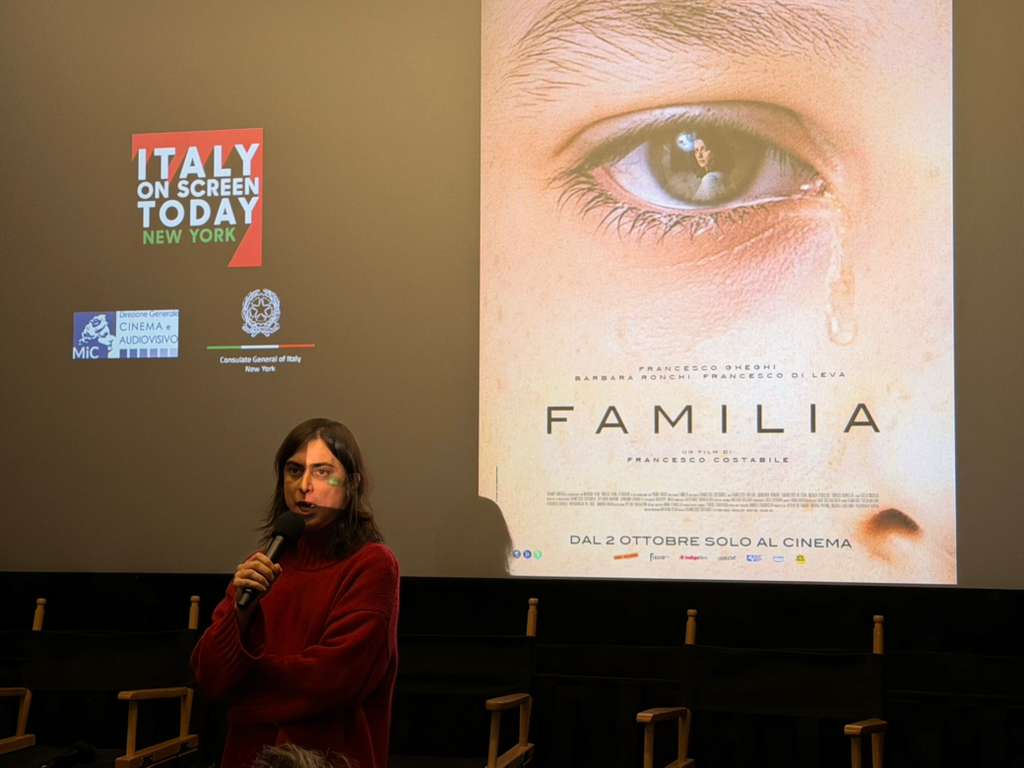
Francesco Costabile returns to cinemas with Familia, a film that explores the moment when a personal story stops being “only” private and becomes a collective issue. The film, adapted from the autobiography Non sarà sempre così by Luigi Celeste — who in 2008 killed his father while defending his mother, and was sentenced to nine years in prison — has been selected to represent Italy at the 2026 Oscars in the Best International Feature Film category. We interviewed him in New York during the Italy on Screen Today festival.
When do you think a story stops being private and becomes a universal theme that concerns everyone?
I think all stories are both private and public at the same time. Our lives, if truly lived, always have a public dimension. Of course, some stories — like Luigi Celeste’s, so tragic and dramatic — take on a broader meaning, because Luigi’s story reflects the experiences of many children who suffered abuse during their childhood. And Luigi had the courage and strength to come forward, first through a book and then through a film. This matters because the way such stories are usually told, even in crime reporting, is flat, superficial, cold. Very cold. Instead, the narrative of someone who has lived these events firsthand is empathetic, personal, and at the same time universal.
From the early screenings you’ve already done in the United States, what reaction from American audiences surprised you the most?
As I was saying, in Italy I’m used to speaking with audiences — people, young and older — who are already familiar with this topic because it’s widely discussed there. Here, less so. There’s an urgency and desire to talk about it, but they’re not as accustomed to engaging in conversations about gender-based violence. That’s the major difference.
If you had to speak to an American and tell them why this film is important, what would you say?
For an American, as for anyone else, this film matters because it offers an experience. Cinema, to me, is an experiential art form: it allows us to live something. Through this film, you can confront violence, experience it from the inside, and gain awareness. This is especially important when discussing psychological violence — understanding that sometimes we are victims without realizing it. Many people have approached me saying that the film opened their eyes to past experiences that, in different ways, echoed this story.
When you began directing, did you ever imagine you might end up at the Oscars?
No! I never imagined it — I dreamed about it, of course — but when I received the news a few months ago, it was completely unexpected. And it was wonderful, because I was thrown into this world without expectations, which actually helps me enjoy it… You know, it’s only my second film, and I had many major competitors, so no, I truly never thought about it.