
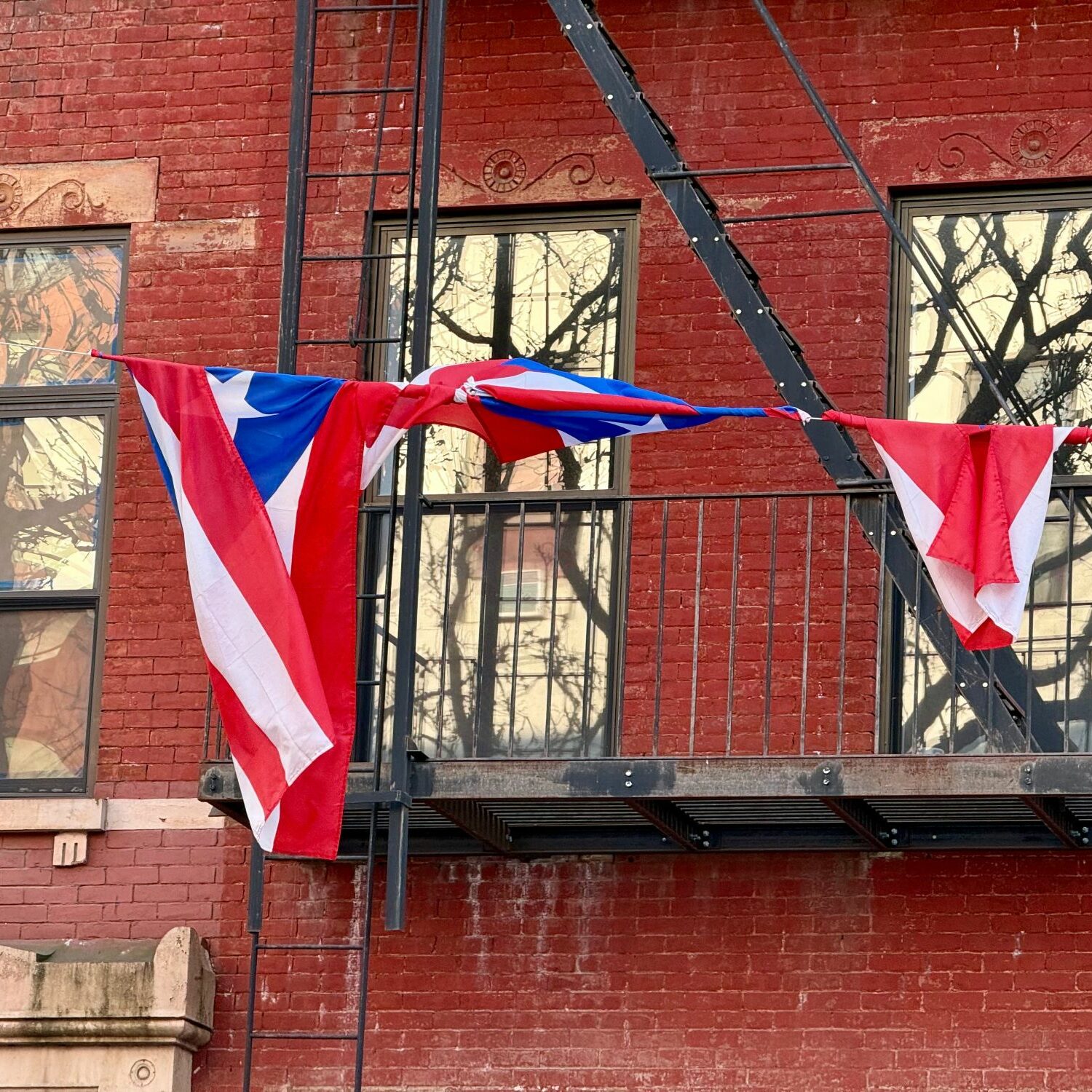
Is there perhaps a stage of the “World Day in New York” most necessary to explore compared to East Harlem, the Latin Quarter par excellence, after the historic night of the Super Bowl recently ended? If even the passion for football wasn’t at the top of our list, we definitely had a way to breathe the powerful oxygen vent Bad Bunny took to the field during his half-time show. Who’s Bad Bunny? And above all, what does it represent today for America and for New York?
Bad Bunny, the art name of Benito Antonio Martínez Ocasio, is a Puerto Rican artist born in 1994 in Vega Baja, not far from the north coast of Puerto Rico. In a few years he became one of the most listened musicians in the world, bringing reggaeton and latin trap to the top of the global rankings without ever abandoning the Spanish language. His albums won Grammy and Latin Grammy, and his presence in major American mainstream events marks a precise cultural figure: Latin music is no longer “niche”, but an integral part of the US pop identity. For today’s America Bad Bunny and his music represent a Latin generation that does not ask for translation to exist in the American public space. His choice of singing mainly in Spanish, even on the most symbolic poles like the Super Bowl, tells a country where hispanic identity is increasingly central. In the United States, more than 60 million people of Latin origin live today, and the Puerto Rican community, an American town since 1917, has historically played a key role in this transformation. And that’s where New York comes on stage. Because if Puerto Rico is the island, New York has been its second home for over a century. Neighborhoods such as East Harlem, also known as El Barrio have become, since the twentieth century, one of the main points of arrival of Puerto Rican migration and is precisely among these roads that the Nuyorican identity was born: a cultural bridge between the island and the city, between memory of traditions and reinvention in a new and in some ways hostile context. Understanding what Bad Bunny represents today also means understanding this story. And to do so, we have to start right from here: from the Latin barrio of East Harlem.
To really understand the central role that the Puerto Rican community has had in the history of New York, it is necessary to go back more than a century until the Jones-Shafroth Act of 1917 that granted American citizenship to Puerto Ricans. Puerto Rico was already an American territory since 1898 when, on the eve of the US entry into World War I, Washington strengthened its control over the island, formally integrating it into the federal political system. From that moment on, those who left the island to move to New York did not cross an international border, but moved within the United States. Yet, in practice, integration was far from simple. The first significant arrivals in the USA date back to the early decades of the twentieth century, but the real turning point came in the second post-war period when, between the 1940s and 1960s, hundreds of thousands of Puerto Ricans settled in New York attracted by the greatest opportunities of work. East Harlem became the main landing point and what had been a stronghold of Italian immigration gradually became El Barrio, one of the most vital centres of the Puerto Rican diaspora. In this context, in the 1960s and 1970s the Nuyorican movement was born, made of poetry, music, theatre and activism. Around the landmarks of El Barrio and others like the Nuyorican Poets Café, founded in 1973 on the Lower East Side, writers and artists gave voice to a bilingual and urban identity, recounting racism, marginality, pride and belonging through powerful narratives that help us to read the present. Because before arriving at the global stages, the cultural trajectory we celebrate today with Bad Bunny has its roots here, among popular houses, murals, streets and churches of East Harlem.
I recommend the discovery of this neighborhood starting from a symbolic place: El Barrio Museum, overlooking Fifth Avenue, in front of Central Park at the height of the hundred and fourteenth street. The museum was founded in 1969 on the initiative of Puerto Rican educators and artists who asked to see their culture represented in the institutions of the city in an authoritative space that was not simply a folkloric appendix. It was at the beginning of a community project designed for the children of the neighborhood but today El Museo del Barrio is one of the main institutions dedicated to Latin art in the United States. The rooms of the museum tell the story of Latin American, Caribbean and Latin art through a permanent collection of over 8,500 works that embraces over 800 years of history through painting, sculptures, photographs, fabrics and temporary installations that reflect the diversity of diaspora cultures. In addition to planning exhibitions celebrating a never-beaten cultural pride and the importance of the origins, the museum organises projections, conferences and community events dedicated to the many and varied voices of Latin American art.
Coming out of the museum and continuing eastward, the streets immediately animate the bright colours of the murals, a true form of identity communication for the Puerto Rican community of East Harlem. These works tell stories of migration, struggle and pride, celebrate poets, leaders and symbol figures, and turn the walls into real open-air books. Inside the Jackie Robinson Educational Complex, along East 106th Street between Park Avenue and Lexington Avenue, Graffiti Hall of Fame immediately captures the look. Born in the 1980s as a space for street artists and hip-hop enthusiasts, it is today an open-air gallery where murals are constantly evolving and tell stories of urban resistance and identity, making the community feel alive. The Calle de Pedro Pietri, instead, celebrates the poet and playwright symbol of the Nuyorican movement, while the famous mural dedicated to Julia de Burgos on East 106th Street recalls the strength and voice of Puerto Rican women in literature. Not far away is the monumental “The Spirit of East Harlem”, at the corner of Lexington and East 104th Street, which stands with figures and symbols representing the community itself in a single large collective portrait that is easily ascribed among the most iconic murals of all New York. Here it is worth stopping a moment and let yourself be carried back in time until the 1970s. The representation portrays the residents of the neighborhood of that time, including the owner of a toy shop and George Espada, who sang in a band of soul music, presented in vivid scenes between the windows of the building. The work has resisted atmospheric agents, fire and various vandalism attacks. Every time she was threatened, the inhabitants of the neighborhood joined to preserve it and so intend to do in the future.
It is worth at this point to continue north until 116th Street, the historic heart of El Barrio where the Puerto Rican and Latin identity is still breathing in general, born here with the first migration waves of the 40s and 50s and guarded today by associations and cultural centers that continue to support the community and the new generations. Among the Spanish signs and shops of 116th Street, bodegas emerge as small but fundamental points of reference. It is not only food shops but real meeting places, where news is exchanged, advice is given and small moments of neighborhood life are celebrated. Open 24 hours a day, they are true symbols of continuity that know customers by name, maintain traditional recipes and tell stories of families who have been working in the same place for decades, woven commerce and social relationships.
In addition to art and bodegas, a distinctive feature of life in East Harlem is music, which invades the streets and on summer days resonates with open windows and car windows. Salsa, bomb, plena and jazz intertwine with everyday life, giving rhythm and voice to the stories of the neighborhood. The sauce, in particular, played a central role in building and maintaining the identity of the Puerto Rican community in New York, becoming an instrument of sociality, cultural expression and collective pride. Today this tradition continues to live in events like the Salsa Saturdays at the Marqueta in East Harlem, where musicians and dancers meet to celebrate Latin culture directly in the streets of the neighborhood. And outside the Barrio, places like the Toñita’s Caribbean Social Club in Williamsburg, the reference point of the Latin community of Brooklyn, keep alive the Puerto Rican scene of the city, offering evenings that recall the energy and conviviality of the old times. The culminating moment of this vitality is, finally, the National Puerto Rican Day Parade, which takes place on the first Sunday of June along the Fifth Avenue and transforms Manhattan into an explosion of flags, costumes, music and dance: an opportunity where pride, culture and contribution of Puerto Ricans in New York and the United States are celebrated by hundreds of thousands of people.
And just the music brings us back to the beginning of this article to celebrate the figure of Bad Bunny as a symbol of presence, pride and visibility. His music goes beyond the immersive rhythm and becomes a declaration of belonging. In the piece “NUEVAYoL”, title made with the Puerto Rican expression for New York, Bad Bunny explores the complex relationship between island and diaspora, telling stories of migration, nostalgia and resistance, and celebrating the ability to bring home wherever you go. Just as El Barrio keeps his soul among murals, bodegas, Latin voices and rhythms, so Bad Bunny’s art gives voice to millions of South American people living and working in the US metropolises. In a historical moment in which restrictive immigration and anti-Latin rhetoric deeply mark the American political climate, East Harlem and Bad Bunny’s voice clearly state that the Latin presence is not a threat to be contained, but a structural reality of contemporary America. With the invitation to savour the streets of East Harlem with curiosity and critical attitude, I will give you an appointment next month for a new stage of our “world rally in New York”.
L’articolo From El Barrio to Super Bowl: The New York of Bad Bunny comes from IlNewyorkese.
