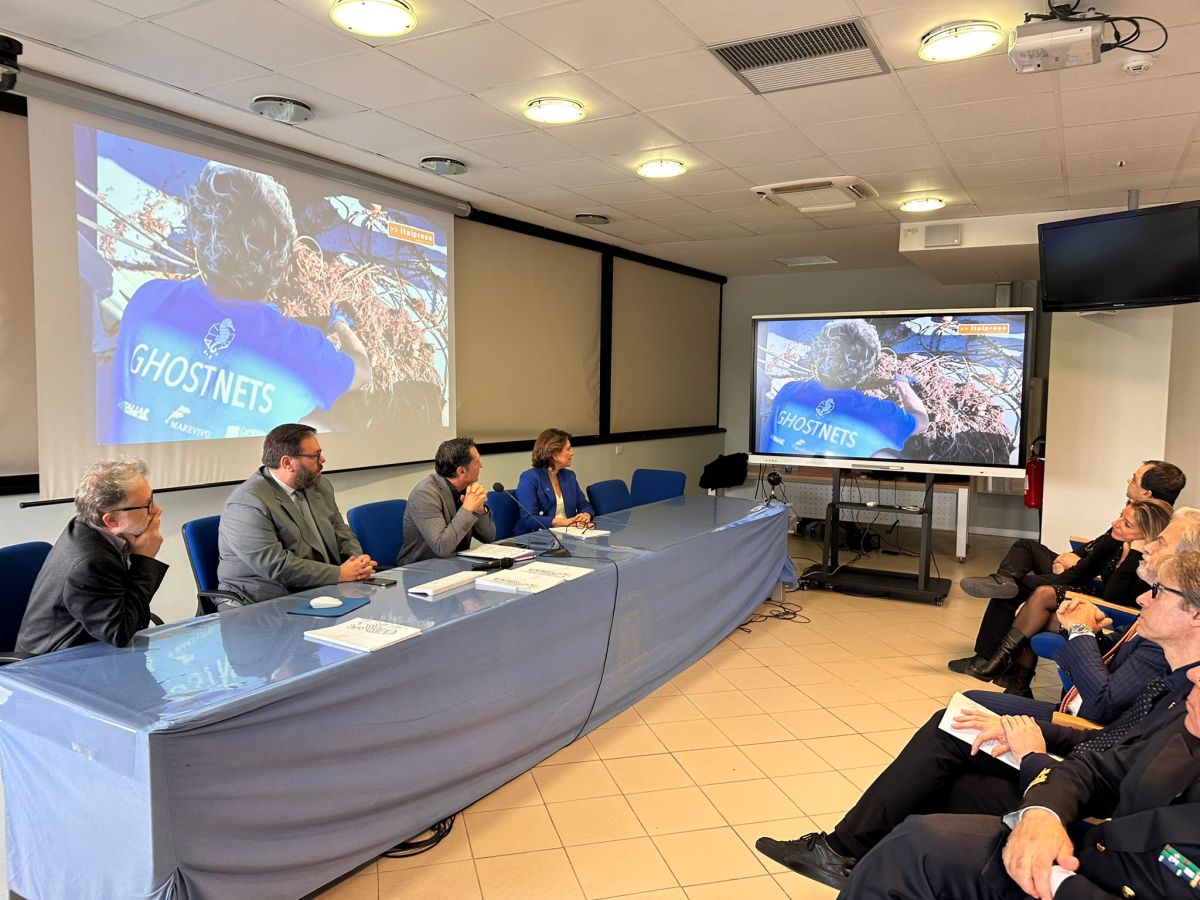
ROMA (ITALPRESS) – Ghost networks that no longer suffocate the seabeds, but generate energy: it is the new perspective opened by Green Plasma, the technology able to treat up to 100 kg of marine plastic not recyclable per day, transforming it into syngas, a fuel gas rich in hydrogen used to generate electricity, directly in the ports and in the collection areas. The system, experimented within the project PNRR MER – Ghost Nets, coordinated by ISPRA, using the fishing nets abandoned at sea and recovered, was presented in Ancona and offers an innovative way to manage marine waste more difficult to deal with. The technology was illustrated during the conference “Green Plasma for the disposal of ghost networks”, hosted by the Polytechnic University of Marche, and presented on Friday 28 November on the day of the “Mediterranean Day”, an event that draws attention to the fragility of the sea and the urgency of more sustainable solutions. The trial was carried out by Fondazione Marevivo, Castalia, CoNISMa, in collaboration with the Polytechnic University of Marche and the company IRIS. Every year well 12 million tons of plastic – the equivalent of a garbage truck poured into water per minute – end in the oceans, irreparably damaging the marine ecosystem. Fishing equipment such as nets, peaks, nets, shafts, ropes and polystyrene boxes, dispersed or abandoned at sea, accumulate on the surface and on the seabeds, intended not to degrade. ISPRA data show that 86.5% of the waste found in the marine environment is connected to fishing activities. For these highly degraded materials, there are no effective recycling chains other than landfill disposal. Over the first two years, the project MER – Ghost Nets, has already allowed to map 157 hectares of seabed, restore 25, remove over 400 abandoned fishing gear – equal to 11 tons of plastic and metal materials – and free vulnerable habitats populated by corals, gorgonies, curls, crustaceans and numerous protected species. The activities will continue in 2026, consolidating recovery operations and offering additional opportunities to apply Green Plasma technology in real operating contexts. Within the framework of the intervention, Fondazione Marevivo, Castalia and CoNISMa- in collaboration with the Polytechnic University of Marche and IRIS – have promoted the experimentation of the system, evaluating the ability to offer an alternative to traditional disposal. Green Plasma allows waste to be “cleaned” directly on site, reducing costs and environmental impact from landfill transport. “Green Plasma testing is a significant advance in the management of ghost networks – ISPRA researchers say. – These are highly degraded materials that make their recycling impossible through traditional chains. Proving that they can be converted into an energy gas directly into the recovery sites means introducing a more environmentally sustainable and more efficient treatment method on the operating level. The Green Plasma model is replicable above all in the harbour areas assigned to the bestowal of the fishing gears abandoned and fully consistent with the objectives of the PNRR and with the requirements of protection of the Mediterranean”.“The Green Plasma is a valid device as it allows not to activate all the logistics of the transport in landfill and to reduce the air pollution that would derive it – emphasizes Raffaella Giugni, Secretary General Marevivo.- The Ghost Nets project has allowed us to recover almost 11,000 kg of abandoned fishing gear, preventing them from continuing to damage the sea. We chose a centralized management of waste at the Labromare plant in Livorno, partner of Castalia, guaranteeing a homogeneous and traceable treatment – says Stefano Chianese, Project Manager RTI Ghost Nets. – Logistics optimization has reduced by 54% the kilometers of transport, minimizing costs and environmental impact. The networks were started to recover according to circular economic principles, enhancing plastics and metals. It is a concrete result that demonstrates how cooperation and innovation can really protect marine ecosystems.” “The removal of ghost networks is a complex and delicate operation, requiring an accurate assessment of the conditions of the foundation and the communities present before, during and after the intervention – says Carlo Cerrano of the Department of Life and Environment Sciences (DISVA), Polytechnic University of Marche, representing CoNISMa. – Prolonged permanence of tools at sea favors the settlement and concretization of organisms, with the risk of damaging protected species or of particular value during recovery. For this reason, CoNISMa researchers have followed each phase of the process directly in the field, ensuring the highest level of caution and constant scientific control during recovery operations. In Ancona, some gorgonies were removed during the removal of networks and are now kept in aquariums waiting to be relocated.” “The Green Plasma represents a concrete example of how research and experimentation can contribute to the management of a very complex environmental problem – says Francesco Regoli, Delegate to Research for the Polytechnic University of Marche. – We know well the consequences of pollution from plastics at sea, the importance of cleaning operations of the seabeds and the difficulty of finding suitable solutions for waste collected. The results of the trial highlighted the effectiveness of Green Plasma technology in enhancing critical refusal such as fishing nets in a gas rich in calorific power, and lowering the mass of rejection by more than 90%. In addition to technology, Green Plasma also introduces a new paradigm: not only is a refusal transformed into a resource, but also a virtuous model is created in which the possibility of observing energy production directly in the gathering places encourages responsible behaviour, reduces the need for storage and transport and contributes to raising awareness of citizens, operators and companies on the importance of reducing this type of pollution”. -photo press office Marevivo – (ITALPRESS).