
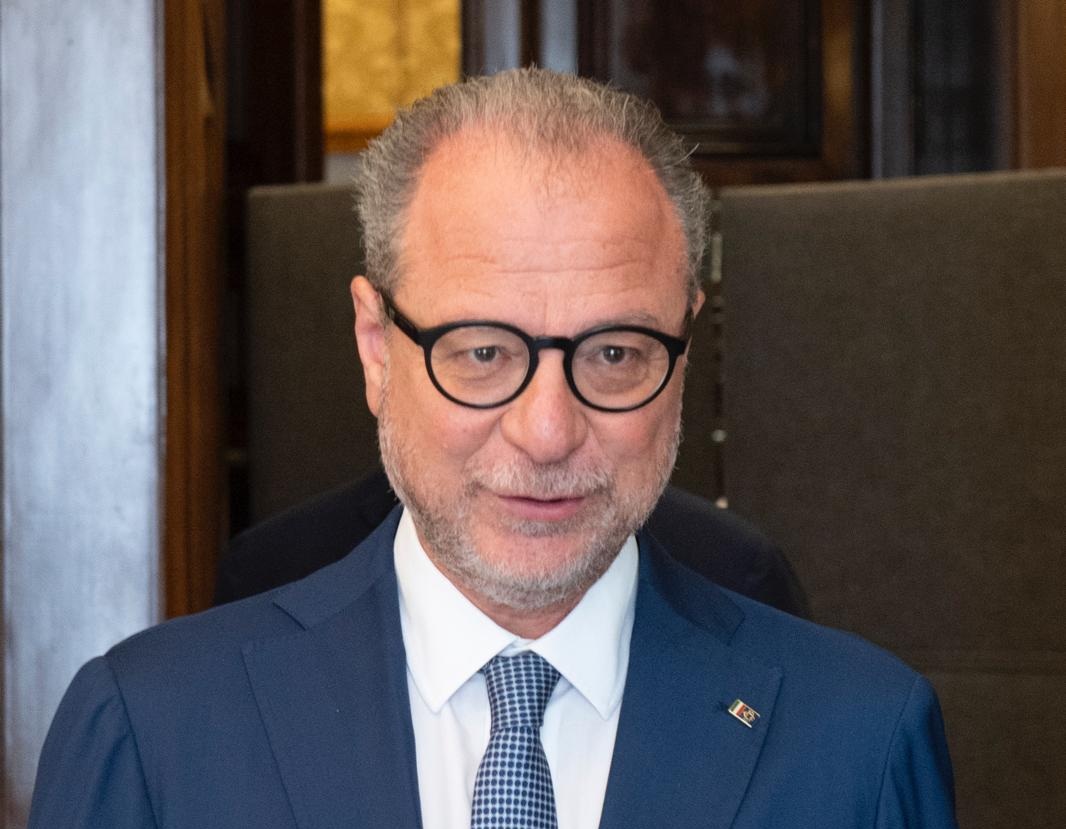
Journalist, editor, parliamentarian. Giorgio Mulè is a figure who embodies the very idea of bridging different worlds. In this intense and personal conversation with Claudio Brachino for the Portraits podcast of ilNewyorkese, Mulè retraces the stages of his education, from his beginnings at the Italian-American Progress in New York to his commitment to Italian communities around the world, to the recent trade tensions between the United States and Italy. A profound dialogue that interweaves politics, culture and memory, showing how Italian identity can transcend all geographic boundaries.
Giorgio Mulè’s American adventure began very early, when he was only nineteen, with an unexpected phone call that catapulted him from Palermo to New York. “I was a scholarship winner at the Giornale di Sicilia, but at some point a colleague at the paper, who had moved to America, called because he needed young people of good will to relaunch Il Progresso Italoamericano. Not even two weeks later, with a visa valid for three months, I was on a Pan Am flight to New York. It was still Pan Am time,” he recounts. It was the beginning of an experience destined to leave an indelible impression. “That was an experience that marked me for life, both professionally and humanly. I owe New York and Italian Americans much of who I am today.” Working at the Italian American Progress taught him not only the craft of journalism, but also the value of community and shared memory.
Mulè reflects on a key concept in contemporary Italian life abroad: Italian identity. A broader category than Italian citizen, it includes descendants, sympathizers and anyone who recognizes themselves in Italy’s cultural values. “It is a lineage. A lineage that is based not only on the possession of a passport, but on the ability to pass on values and ideals that are proper to Italy,” he explains. And he cites the example of Salvatore Palella, a young Italian-American entrepreneur who bought Catania Calcio: “A gesture that perfectly embodies the spirit of the American give back: giving something back to one’s homeland, not out of interest, but out of cultural love. Like him there are many. And this is a fundamental aspect. The Foreign Ministry has launched the Roots Tourism project, aimed precisely at Italians abroad and their descendants. The idea is to return to their places of origin, often small villages under five thousand inhabitants, thus rediscovering the ancestral link with their homeland.”
From his current institutional role, Mulè lucidly observes the relationship between Italian politics and Italian communities in the United States. A relationship that he says has not been properly valued: “Often this community is perceived as marginal, uninteresting. And instead it is a community that votes, that is also decisive for Italy: let’s remember that we elect deputies and senators abroad, even from North America. The New York and East Coast communities are central.
That is why, for years now, I have been gladly participating in institutional and cultural events held in the United States, not only on Columbus Day. The Columbus Foundation, the Italian clubs in New Jersey, in New York, etc.” Mulè emphasizes how the Italian presence on the American East Coast is still an extraordinarily valuable resource. And he also proposes practical solutions to strengthen the link, such as expanding direct flights from Palermo and Naples to New York. “This is also a way to bring the two sides of the Atlantic closer together.”
Finally, a comment on the recent trade tensions between the United States and Europe, and the duties that threaten to affect Italy as well. Mulè has no doubts: “Duties are not good for us. Neither to Italy, nor to Europe, nor – above all – to the United States.” And he clarifies, “The bond between Italy and America goes beyond governments: it is not a matter of Meloni or Draghi, nor of Trump or Obama. It is a deep bond, which cannot be reduced to a commercial dynamic.” The risk, according to Mulè, is that it is American consumers who pay the highest price: “If the United States hinders trade with Italy, it is obvious that we have to divert our exports to other markets. Exports with the U.S. are worth 64 billion, including 8 billion for agribusiness alone. We have to defend these productions. And it will be the Americans, in the end, who will pay more: Grillo, Inzolia, Primitivo, these are wines that cannot be produced in America. They will increase prices, they will increase inflation. And this will also affect their public debt.”
The cultural aspect, for Mulé, is perhaps the most emblematic. “Before, we had the cardboard suitcase. Today we Italians are the ones producing the suitcases that Americans use,” he says proudly. An evolution that symbolizes the reversal of roles in the migratory dream. But behind this success remains a debt of gratitude to the American soldiers-often of Italian descent-who contributed to the birth of the Republic. “They came from Wyoming, Wisconsin, New Jersey…maybe they only knew Naples or pizza, but they died to give birth to our democracy. Just as unforgettable are the Italian Americans who defended America, from the Twin Towers onward. Today the American dream has been turned upside down: it is we Italians who make Americans dream. Ferrari, Maserati, Lamborghini. Fashion, catering, wine, truffles… Italy has become the dream for those who once represented the dream. And this is wonderful.”
In closing, Giorgio Mulè reveals the most valuable lesson America has left him: “Learn, earn and give back. Learn, earn, give back. It is a principle that I try to apply every day, in my role and in my life.” And when asked about the Strait Bridge, a symbol of his most heartfelt battles, he replies with the same logic: “I don’t consider it a symbol or a monument, but a work that can really change the history of the 21st century.” He adds, “Building bridges, not walls: this is the real mission we should pursue, always. Even with America.”
The article Giorgio Mulè: “From Italics to the Strait Bridge, Italy is a dream that goes on” comes from TheNewyorkese.
