
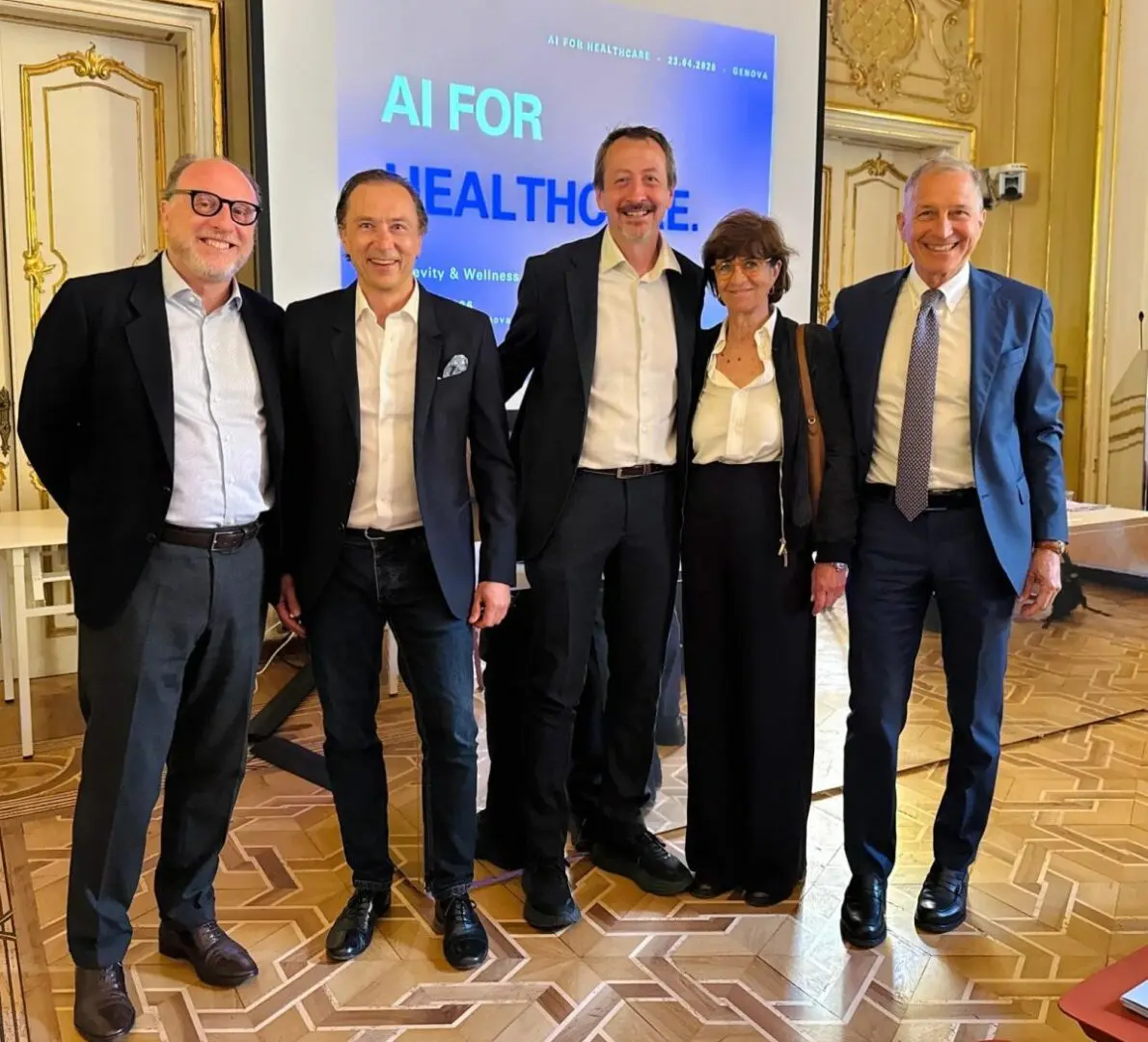
GENOVA (ITALPRESS) – The international conference organized by Fusion AI Labs is held today in Genoa ‘AI for Healthcare – Longevity & Wellness’, a centre of excellence that promotes applied research and industrial experimentation on artificial intelligence.
The event is part of the European ‘Apply AI’ and ‘AI’ strategies in Sciencè, promoted by the European Commission to speed up the transition from research to concrete implementation: the first focused on the adoption of health systems, the second on the strengthening of scientific infrastructure.
Europe faces an unprecedented health challenge. An increasingly older population is exerting significant pressure on public health systems, increasing costs and requiring innovative solutions. Although artificial intelligence has demonstrated an extraordinary potential in areas such as diagnostics, clinical decision support, the discovery of new drugs and preventive medicine, up to 80% of AI health projects fail to go beyond the pilot phase. This is not a failure of technology, but of its adoption: this gap is the central theme of the event.
The conference was born from a specific scientific path to which the founders of Fusion AI Labs participated: the AIDA project, a European research initiative funded by the Horizon programme, which explores the use of artificial intelligence for the prevention of stomach cancer. The results achieved so far are encouraging and indicate increasingly effective prospects for early prevention. “Almost that building a restricted scientific conference around a single project, we made a wider choice: using AIDA as a lens of observation, i.e. a concrete and based demonstration of what an AI applied responsibly can achieve, and open the debate to the broader view of what artificial intelligence is already doing and could do in health and longevity” – says Stefano Sedola, research manager and Fusion Lab training programs.
The event brings together a wide ecosystem of public and private actors: European and national institutions, international organisations, research centres, universities, technological companies, healthcare and pharmaceutical companies. Participants include representatives of the European Parliament, organisations such as UNESCO and World Bank, as well as major global companies and centres of excellence such as Imperial College, Karolinska and Charitè.
The conference is structured in a path that accompanies participants from reflection to practical applications. The morning plenary session is dedicated to the general context and prospects of AI in health, with high international interventions; the afternoon session includes two vertical panels, respectively Artificial intelligence for longevity and well-being and Artificial Intelligence in the health sector – from research to clinical practice.
Renato Botti, Managing Director of the Giannina Gaslini Institute, will open the work, following the introduction of Andrea Pescino – CEO of Fusion AI Labs, which outlines the crucial step from innovation to concrete impact: “Europe has an extraordinary opportunity and also a responsibility. The health sector is under structural pressure: in Italy we have 64 nurses every 10,000 inhabitants, against a European average of 80, and only 1.5 nurses per doctor compared to 2.2 of the rest of Europe. 30% of European doctors are over 55 years old.
It is not a crisis that is resolved only by assuming more personal, but a crisis that requires a paradigm shift in the way we organize, support and upgrade the whole system.
Applied research on artificial intelligence in healthcare cannot be limited to clinical applications, however extraordinary. Think about how much it is worth speeding up operational processes, octimto improve the management of departments, improve the quality of interaction between structures and patients. Every hour saved in an administrative process is an hour returned to the care. Every system that best supports a nurse or a doctor in daily load management reduces burnout and increases the quality of care. This is where Fusion AI Labs wants to contribute: transform research into real impact, build bridges between scientific excellence, industry and healthcare systems, and demonstrate that doing applied research responsible in this sector is not only possible, it is urgent. For Italy. For Europe”.
Antonio Gatti – Global Lead Pharma Life Sciences Microsoft, addresses the Medical Superintelligence theme: “Speaking about superintelligence medical as simple diagnostic improvement underestimates what is happening. Frontier models hold longitudinal reasoning, integrate multimodal data – homicides, imaging, clinical records, real-world evidence – orchestrate instruments, maintain memory. For the first time it is possible to think of AI as an infrastructure of the sanitary and pharmaceutical pipeline, not as a single application. Yet up to 80% of health AI projects do not exceed the pilot phase: not by limits of technology, but by how it meets the system – data, flows, regulation, trust. Quality jump is not on the model, it is on the context. From the discovery of new therapeutic targets to the design of clinical trials, from patient stratification to precision medicine: in a Europe with fewer doctors, less nurses and older than a decade ago, medical superintelligence is not a technological option but a sustainability lever for the entire life sciences supply chain. The question is not whether to adopt it, but as: responsibly, on scale, oriented to the real impact”.
Kiril Veselkov, Associate Professor in Computational Medicine and Oncological Informatics – Imperial College and Antonello Scalmato, CTO of Fusion AI Labs, present advanced applications of generative AI in early diagnosis of gastric cancer conducted with the European research project AIDA: “With AIDA we want to change the paradigm of gastric cancer: do not intervene late, but identify patients at risk when the disease is still in pre-symptomatic phase. Artificial intelligence allows us to integrate and analyze large amounts of data to support precocious diagnosis, personalized therapeutic strategies and more effective prevention.”
Fulvio Mastrogiovanni, an associate professor at the University of Genoa, continues with an insight into the integration between AI and robotics in the healthcare sector. The intervention explores the transition from purely digital artificial intelligence to systems that interact physically with the real world: Embodied AI. “The first part clarifies what “incarnation” really means – Mastrogiovanni explains – not simply models that process data, but agents that perceive, act and learn through a body. Recalling recent research published on Science on the role of tact and advanced sensing systems, the intervention highlights how AI capabilities should be rethinked when switching from digital environments to the physical world, where uncertainty, security and human interaction become central.”
The second part of the intervention instead presents a structured overview of applications in the real world along an evolutionary spectrum: from pick-and-place systems and from robotic manipulation to assisted robotics, up to advanced areas such as robotic surgery, intelligent prostheses and company systems.
Ricard Martinez Director of the Chair of Privacy and Digital Transformation of the University of Valencia, in his speech dedicated to the theme of trust and responsible use of artificial intelligence says: “The European Health Data Area (EHDS) is based on two pillars: the GDPR as a legal reference and the use of anonymous data in safe environments. However, both are critical: anonymization is increasingly difficult to guarantee according to privacy authorities, while security standardization is required to complex processes at European level. In addition, some key choices are left to individual Member States, with the risk of creating fragmented regulations that could compromise the interoperability and effectiveness of the system at European level.”
The morning session ends with a space on the skills of the future: “Today the collaboration between enterprises and institutions is decisive. If, on the one hand, companies carry concrete cases of use, real needs and speed of execution, on the other hand, institutions carry method, research, training and creation of talent – explains Riccardo Ocleppo, founder and director of OPIT, Open Institute of Technology – This is where I thought OPIT should be placed: the projects developed by our students demonstrate it, such as the hackathon, which led to the creation of an AIM assistant to support the deficiencies It is a clear example of what is needed today: not fine technology itself, but skills capable of combining research, social impact and real needs of people.”
The presence of Mr Brando Benifei (the EU law regulator on artificial intelligence), as part of the afternoon panel, gives the present a direct testimony on the application of AI in science and the importance of the adoption of AI in Europe: “Today the real challenge of artificial intelligence in health is to translate its potential, but to translate it into concrete and widespread applications: too many projects remain blocked at the pilot phase. This is where the European model makes a difference. With the AI Act and the European Health Data Space, the European Union has chosen a trust-based approach: clear and proportionate rules that make innovation safe, reliable and focused on the person. In a global context marked by deregulation, we must reiterate that there is no true innovation without trust. The challenge we face is twofold: on the one hand, accelerate the adoption of artificial intelligence in health systems, bridge the gap between laboratory and clinical practice; on the other, preserve and strengthen a European model that guarantees fairness, transparency and access for all. This is how Europe can lead the digital transformation of health.”
Two thematic panels deepen the main development areas: the first dedicated to AI for longevity and well-being, with a focus on preventive medicine and healthy aging; the second analyzes the transition from research to clinical practice through concrete experiences, success cases and sustainable implementation models.
Paula Petrone, head of the Digital Health Unit at the Barcelona Supercomputing Center (BSC), guides the development of AI-based solutions for early disease diagnosis, risk assessment and customized treatments, using multimodal health data, including medical images, wearable devices and electronic medical records. Here is a passage of his intervention: “A new study highlights a health paradox in Europe: you live longer, but not necessarily better. In the last twenty years life expectancy has increased significantly, while the years lived in good health have remained stable, expanding the gap between longevity and well-being.
Stefano Sedola, head of research and training programs of Fusion AI Labs concludes: “The panels are designed to explore artificial intelligence as a real opportunity. The most important contributions are those that show what already works, what is becoming possible and come could appear a future shaped by a responsible AI in healthcare. This does not mean avoiding complexity or pretending that barriers do not exist, rather starting from opportunities and considering obstacles as solveable problems. Today’s audience, composed of highly involved figures, is here to be inspired and informed, not to receive warnings.”
– photo press Fusion AI Labs-
(ITALPRESS).
