
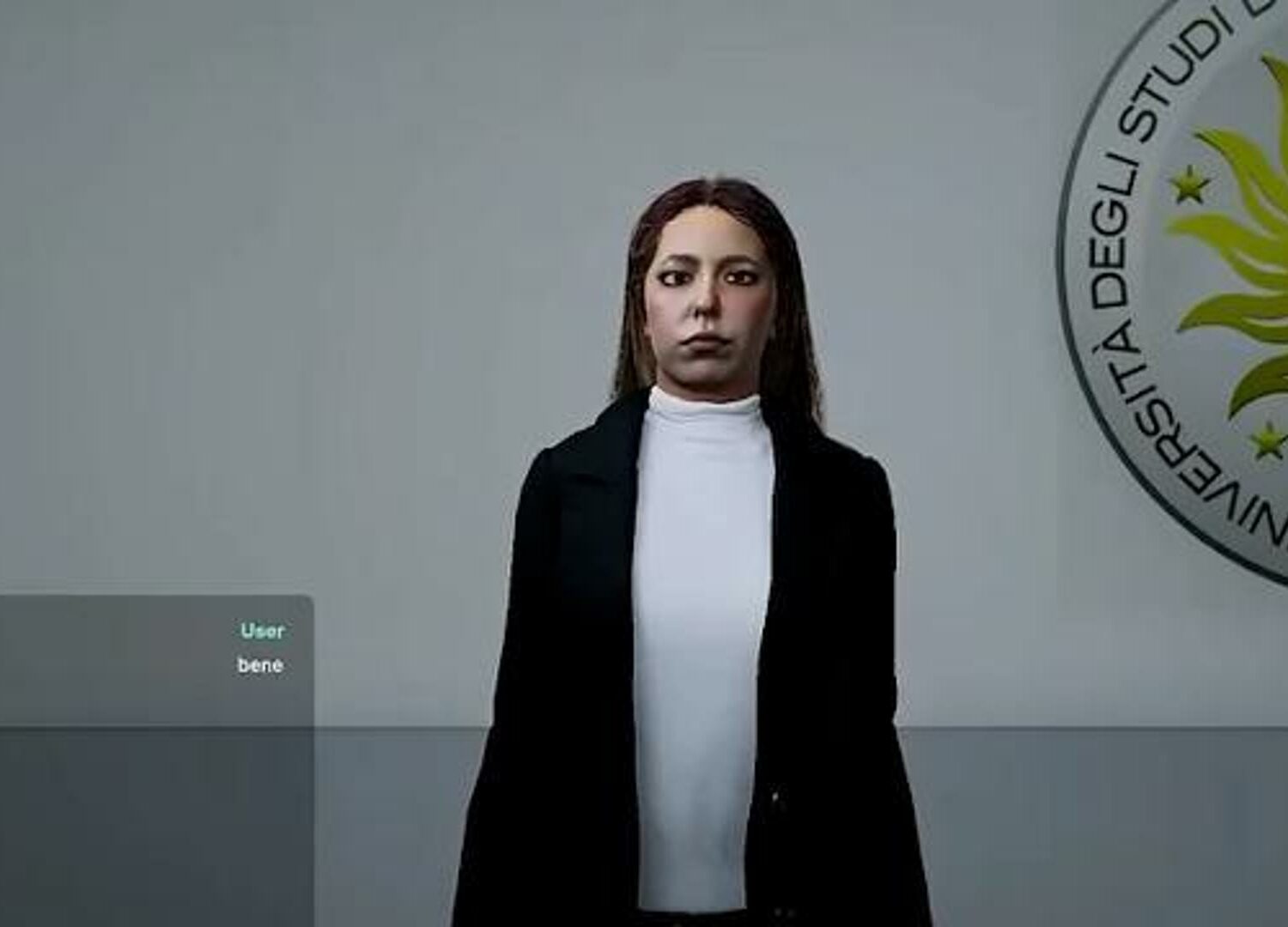
In the heart of Italy, in a classroom at the University of Cassino and Lazio Meridionale, an event took place that marks a significant turning point in the national educational landscape: for the first time, a female student discussed her dissertation through an avatar generated with the help of artificial intelligence.
The case of Veronica Nicoletti, class of 1998, represents not only a technological innovation, but also an opportunity to reflect, from a sociological point of view, on the profound changes that education is going through. It is an episode that invites a reconsideration of the concepts of presence, identity, relationship and learning in the context of the contemporary university.
According to a report by RaiNews.it, “with her thesis ‘Educating Artificial Intelligence, Educating Artificial Intelligence: mitigating Bias,’ Veronica Nicoletti is among the first students in Italy to support a dissertation with the help of an avatar, with a 110 with honors.” An achievement that is the result of an experimental project that “puts artificial intelligence at the service of schools,” making possible unprecedented collaboration between humans and machines in educational settings.
The avatar, RaiNews.co.uk continues to tell us, was created “thanks to a back story path created with the use of Artificial Intelligence,” and Veronica explains, “We educated him in the thesis discussion, including my entire study plan, and the basic directions for the thesis discussion itself. It is also a project aimed at future generations who I hope will be inspired.” So this is not just a technological demonstration, but an explicit intention to redefine educational processes with a view to greater accessibility and personalization.
During the discussion, Veronica’s avatar took the floor in the university’s Great Hall, answering the committee’s questions in real time. As the article reports, “the thesis was discussed entirely by the Veronica avatar, who introduced herself to the committee and those present, answering their questions live. The newly minted doctor of education merely assisted her avatar.”
The direct involvement of the faculty was crucial. RaiNews.it specifies that the project was overseen “by professors Simone Di Gennaro, Alfredo Di Tore, and Professor Monia Di Domenico, who over the past four months have worked side by side with Artificial Intelligence to create an avatar that corresponds as closely as possible to reality.” Veronica added, “We provided the avatar with all my main characteristics, both character and physical, to fit my persona. I had to choose the outfit for this day based on how my character was processed by the AI.”
But the experience was not limited to academic performance. After the avatar’s speech, Veronica spoke “with her own personal evaluations also on the path taken thanks to Artificial Intelligence,” showing how the relationship between human and technology can remain complementary, and not a substitute.
The recent graduate’s dream goes beyond the university: “I would like students to be able to have a personal avatar for their studies who knows them and knows how to enhance their learning and knowledge.”
In an increasingly digitized social context, the figure of the avatar represents not only a technical support, but an extension of identity and thought. Its presence is no longer only physical, but also symbolic; the identity of the student is multiplied through technological mediation; the teacher-learner relationship is reconfigured in hybrid environments, between real and virtual.
There is, however, also an ethical knot not to be overlooked: the use of artificial intelligence in education carries risks related to the reproduction of bias, the dehumanization of educational processes, and the possible loss of critical sense. The very title of Veronica’s thesis-“Educating Artificial Intelligence, Educating Artificial Intelligence”-points to a double direction: training students to understand AI, but also training AI to be a fair and knowledgeable tool.
The Cassino experience is not simply a technological “experiment.” It is an emblematic example that highlights the need to rethink education as an open cultural process in which the interaction between human and machine can become a means of growth, learning and inclusion.
The article If Artificial Intelligence discusses a thesis: the case of Veronica Nicoletti comes from TheNewyorker.
