
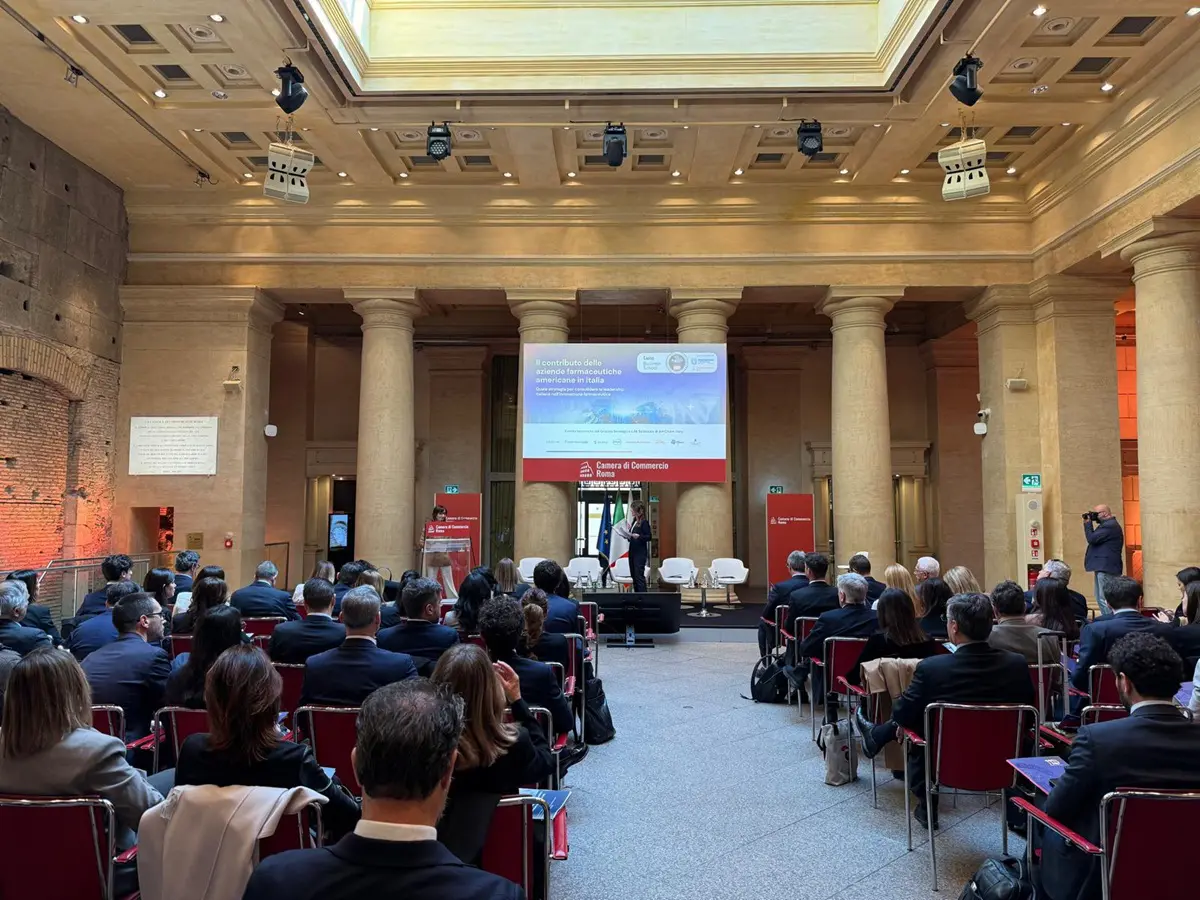
ROMA (ITALPRESS) – US pharmaceutical companies play an important role in Italian production and science, contributing to clinical research, innovation and development of the entire industry: it is the photograph that emerges from the research carried out by Luiss Business School and promoted by the American Chamber of Commerce in Italy. In 2024 the value of the production of pharmaceutical companies in US capital exceeded 9,2 billion euros, equal to 17% of the entire national pharmaceutical sector. The value of production has grown by almost 25% in 2015-2024, with an increase in employment of about 20% in the same time horizon: in 2024 US pharmaceutical companies have employed 16% of the total industry employees in Italy. The economic impact generated on the territory is estimated at around 6.3 billion euros, with a total employment impact (direct, indirect and induced) of almost 22,600 employees. For at least a decade, globally, investments in Research & Development in the pharmaceutical and biotechnological sector have increased. Europe remains the protagonist, but is losing ground: the gap has increased strongly compared to the United States, which remain at the top of the ranking, and investments in China are growing at an annual rate of approximately five times higher than the European one. In 2023 the European Union increased R&S spending by 1.6%. China 8.7%. In the EU, Italy has always been an important country for the production and clinical research of large American and international pharmaceutical groups. The survey conducted by Luiss Business School on a sample of seven major US companies confirms the leading role of U.S. pharmaceuticals in clinical research in our country: in 2024 almost 180 million investments were carried out, sponsored about half of the clinical studies carried out in Italy and recorded over 1,000 scientific collaborations in Italy. Relevating also the contribution in the field of innovative drugs: about 25% of the drugs evaluated as innovative by AIFA are sample companies. For 43% of the sample interviewed, investments in clinical research are growing and only for 14% decreased compared to past years. In addition, future forecasts are even more solid: none of the firms considered expects a contraction and 57% are expected to expand.
However, for the same sample, the growth of investments in Italy will remain below that provided in other major EU countries, due to the continuing of regulatory and administrative obstacles and the inadequate recognition of the value generated by research. 57% of the sample interviewed by Luiss Business School researchers considers Italy an advantageous location, thanks to the availability of productive technologies and resources with high quality skills. With regard to research, 71% of the sample emphasizes the presence of structural criticalities that limit the attraction of the country, while recognizing high-level scientific skills. In depths with the management of the companies interviewed showed a double contrast between positive and negative factors for clinical research carried out by the large American groups. The limit identified as more relevant is the regulatory complexity and excessive bureaucracy and the consequent strong inefficiencies especially in the organization and start of studies. The second dualism sees the scientific excellence and high reputation of many medical research facilities and its human capital in contrast to the considerable difficulty of the same to involve sufficient medical and support personnel. “The data shows an extremely dynamic and important sector in the country. The potential of further growth is significant, but the ability to attract new investments must necessarily be based on an organic and coordinated national strategy that involves regulation, infrastructure, skills, data and incentives. Only in this way will we be able to bridge the gap with the countries that are rapidly advancing and value a fundamental sector for the competitiveness of Italy”, explains Matteo Caroli, Associate Dean for Sustainability and Impact of Luiss Business School.
For Simone Crolla, CEO of American Chamber of Commerce in Italy, “the American multinationals in this country have a leading role, but this does not mean that they occupy all the space: they create a chain of value towards Italian suppliers and Italian skills that then photograph an important reality, that is that of excellence”. In this report, “together with Luiss Business School, we wanted to tell the world of institutions what are not only the future challenges and the needs of the innovation sector in the pharmaceutical industry, but above all to photograph the winning relationship between Italy and the United States, which collaborate so much in promoting innovation policies in the pharmaceutical field. There is a photograph of the value that must be – even at this moment of geopolitical complexity – known to the world of stakeholders, there are recommendations to help the legislator understand what are the bottlenecks that, if faced, could cause further American and Italian investments in America to see light. The issue of payback, for example, is a very well-known theme from the institutions and which is also facing thanks to these contributions of the Chamber of Commerce, to try to find a composition that is fair and respectful of what are the needs both of the public and of the private investor”, he concludes. For Aaron Pugliesi of AmCham “the Italian health system is one of the best in the world, but to maintain this primacy it is necessary that the synergy between public-private remains strong and follows the emerging challenges. From research to care, through new therapies, institutions and companies must find solutions that allow to maintain, or better yet, increase private investments. As highlighted in the Luiss Business School report, US capital companies are a strategic axis to meet the challenges of our country and are ready to contribute with skills, proposals and large investments. From the report emerge among the priorities simplified legislation, increased fiscal certainty and faster administrative times.”.
– photo xi2/Italpress –
(ITALPRESS).
