
February is the month of the Fashion Week and is just New York, part of the “Big Four”, to kick off the four weeks of fashion; to follow London, Milan and Paris. Between a taxi and another, models and celebrities are photographed wrapped in iconic dresses, transforming sidewalks and streets into style scenarios.
But when and how did the New York fashion week start? We had already talked about it in a September article, but we go more specifically.
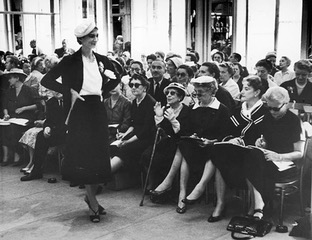
Its roots fell back in 1943, when Eleanor Lambert, an influential fashion publicist, conceived the first “Press Week”. The move was striking: in a very special context (we remember that the Second World War made American buyers very unlikely the idea of a trip to Paris) tried to shake international attention from France to relaunch America. Since the 1950s, the event was named “Press Week of New York”, until, only in 1993, it was recognized as “New York Fashion Week”.
Eleanor Lambert played a very important role in the cultural and institutional development of the sector. He was the creator of the CFDA (Council of Fashion Designers of America) in 1962, the first press director of the Whitney Museum, established the Coty Fashion Critics Award, created in 1948 the Met Gala and the International Best Dressed List (where for the first time in history was given a score to the looks worn by the various celebrities), also participated in the foundation of the MoMA.
The US State Department, between the 1950s and 1960s, urged her to support the spread of American fashion abroad. It was also the introduction of the Fashion Calendar, conceived by Ruth Finley to put order in the chaos determined by the overlaps of the various fashion events. The project was born on the occasion of a simple conversation between friends, who complained precisely about the concomitance of two important parades, that of Saks Fifth Avenue and that of Bergdorf Goodman. From that intuition a centralized weekly calendar was formed, which listed all the fashion events of the city. The Fashion Calendar, printed in pink and with red cover, soon became an icon, considered “the bible” of the New York Fashion Week. It was acquired by the CFDA in 2014 for its strategic importance in the fashion industry
Among the historic locations of NYFW, in 1994 it was decided to organize it at Bryant Park, then move it in 2010 to the Lincoln Center for the Performing Arts.
Those who like me work in the fashion industry know that it is a beautiful but difficult job, it requires dynamism, narrow times, creativity, innovation, sacrifice, meticulousness. It is a “machine” always in operation.
Every time I look at a parade I think about the infinity of people working for months and months before, during and after the event: creative directors, public relations agencies, art, models, journalists, photographers, make-up artist, hairstylists… it would not be enough to list them all. An immense job for 15, maximum 20 minutes of parade. In those few but very precious minutes is shown the essence of the brand, the infinite hours of preparation, the collaboration between different teams, in which everyone tries to do his best for the final result. And when the spotlight is finally lit and the music starts, the tension is transformed into emotion. All the commitment is rewarded by the applause and smiles of the public.
It is no coincidence that the collective imagination has crystallized this complexity in the film story of “The Devil Dresses Prada”: behind the glamour of Fashion Week there is a huge system marked by tight times and hard work, where every decision has a symbolic and economic weight. The figure of Miranda Priestly, inspired by the legendary director of Vogue Anna Wintour, becomes so emblematic of a power capable of orienting trends and narratives. A fictional representation, of course, but not too far from the reality of a sector that cannot afford slowdowns.
A system that in all its complexity, between dazzling lights and chaotic backstage, continues to renew season after season.
Because in the end fashion, just like New York, never sleeps.
L’articolo In the spotlight of the New York Fashion Week: the origins of an event that has changed the history of fashion proviene da IlNewyorkese.
