
ROMA (ITALPRESS) – A new study dedicated to the island of Vulcano introduces an approach that, thanks to artificial intelligence and the integration of satellite data with measures acquired on the ground, can allow to improve the monitoring of the hydrothermal system, that is the set of water, steam and gas present in the underground.
The research, coordinated by the National Institute of Geophysics and Vulcanology (INGV) in collaboration with the Department of Mathematics and Informatics of the University of Catania, was carried out in the framework of the SAFARI project (An Artificial Intelligence-based StrAtegy For volcAno hazaRd monItoring from space) funded by the Application Dynamic Planet program, and was published in the scientific journal Remoteng Society and Environment.
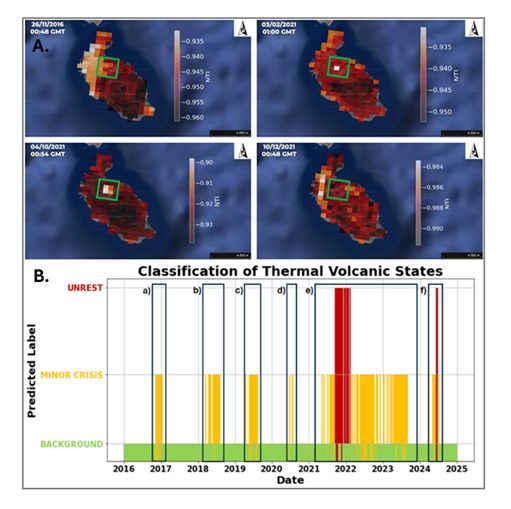
“The study analysed the data collected between 2016 and 2024, combining temperature information and environmental conditions derived from the VIIRS and Sentinel-2 satellites with the temperature of the fumaroles recorded by the INGV monitoring network in the area of the La Fossa Crater,” explains Francesco Spina, researcher INGV and researcher.
The use of a semi-supervised learning model made it possible to accurately distinguish the different conditions of activity of the hydrothermal system: background, minor crisis and unrest.
“In particular – Gaetana Ganci, researcher INGV and co-author of the study continues – the use of a semi-supervised model based on generative neural networks (SGAN) has allowed to exceed the limited availability of labeled data, due to the rarity of crisis stages. The model, in fact, can learn effectively both with a few data labeled and with a large amount of data not labeled.”.
Generative neural networks (SGAN), in fact, are systems able to recognize different situations even with few examples already classified, taking advantage of the information contained in the unmarked data.
The results show how artificial intelligence applied to satellite data can support volcano monitoring, allowing to analyze over time surface temperature variations and identify changes related to the activity of the hydrothermal system, opening the way to more advanced surveillance systems and early identification of instability signals.
– press office photos INGV –
(ITALPRESS).
