
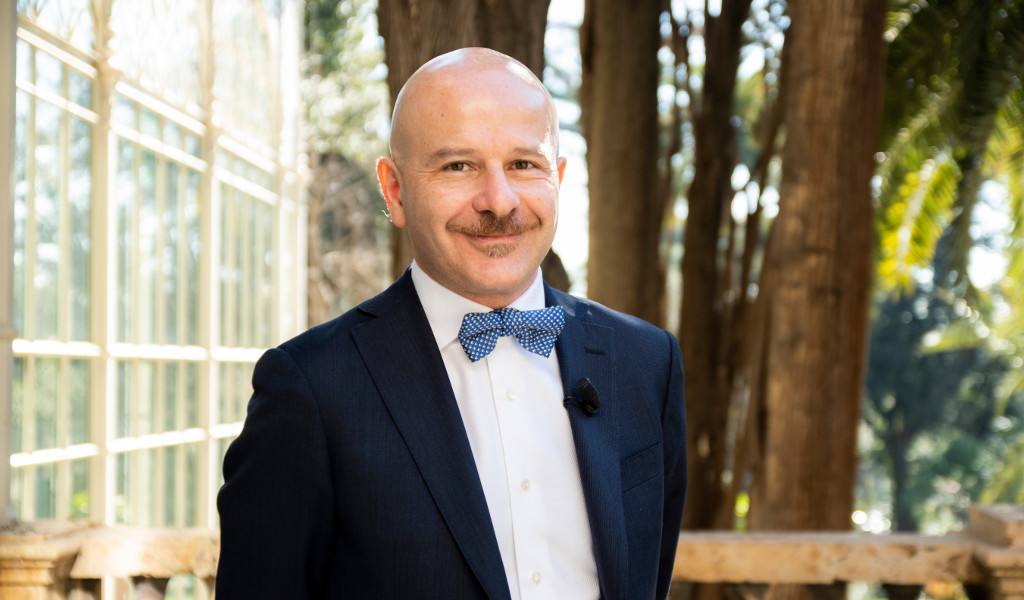
Andrea Prencipe, economist, scholar of organization and innovation, and former dean of Luiss, was a guest on the Portraits podcast, hosted by Claudio Brachino for theNewyorker.
Prencipe has always been an advocate of interdisciplinarity and, despite a background in science, has always shown a strong focus on the humanities: “My studies on innovation, as well as my experience as rector, have convinced me more and more of the need for an approach that knows how to cross disciplinary boundaries. Mind you: this does not mean forgetting specializations, which remain fundamental to scientific, technological and economic progress. But the humanistic contribution is equally essential. When I was pro-rector, almost ten years ago, I introduced at Luiss the first course that put together management and artificial intelligence, in a university of social sciences. At the time, artificial intelligence was not yet a hot topic; in fact, there was a lot of resistance. But that insight has led today to the creation of a department dedicated specifically to artificial intelligence. In parallel, I introduced compulsory teachings from the humanities area: Italian literature, music history, general philosophy, archaeology. Because humanities studies develop overview, critical thinking, the ability to interpret complexity. And not only that: studies in cognitive psychology show that they also help develop empathy, a fundamental skill in today’s working world.”
For Prencipe, the introduction of the humanities into educational pathways also serves to empower students to be critical of artificial intelligence: “I’ll tell you a concrete experience: in my organizational design course, I reintroduced the oral and pen-and-paper exam, but also an AI-assisted exam with a structured methodology. Students had to follow precise instructions, justify their choices, compare responses from ChatGPT, Gemini, Copilot, and hand in the interaction log. At the end, when I asked which exam was the most difficult, they all said: the one with artificial intelligence. Because we forced them to think, not to passively accept. And that’s the real point of innovation: it’s not so much doing the prompt, but being able to frame the problem.”
During the interview, the former Luis dean outlined a vision of innovation that rejects any technical reductionism. “Innovation is change that generates value,” Prencipe explained, pointing out that this change can be technological, but also social, cultural or organizational. “Value, likewise, is not only economic: it can take many different forms.”
In the past, innovation was identified with technological change, Prencipe points out that today we know that it is actually primarily a socio-anthropological phenomenon. “Every industrial revolution has changed the way we are, the way we do, the way we organize ourselves: think of electricity, the steam engine, the Internet, and today artificial intelligence. But beware: we are the ones who create the technologies, and we must learn to adopt them, not passively adapt. I am reminded of Gianni Rodari, who wrote a beautiful fairy tale, The Homework Machine. A little man was selling this machine not for money, but asking for the children’s brains in return. A powerful metaphor: if we abandon our cognitive processes, we risk losing touch with reality. We fly away, but we also become prisoners. That’s why we need a humanistic approach to technological change.”
In this regard, Prencipe shares the position of philosopher Luciano Floridi, who calls on the generation born in the analog world and turned digital to “remain analog human beings”: “In the next essay, which I am writing with Massimo Sideri, we emphasize the importance of preserving what Calvino called ‘the jealously human traits’: attention, memory, essence, imagination, boundaries.”
Finally, Prencipe reflected on the need to reform the Italian university system, taking an example from the American one, which is capable of differentiating missions and pathways: “In the United States there are community colleges, research universities, state and private universities, each with its own mission. This makes it possible to respond to different labor markets.”
Finally, an appeal to small and medium-sized enterprises as well: “We need more courage to recruit graduates, make room for young people trained abroad, and encourage smart generational transitions. This is the only way to truly innovate the productive fabric. And the South, which is often underestimated, can surprise with virtuous models.”
The article Innovation according to Andrea Prencipe: “Let’s not abandon thinking to machines” comes from TheNewyorker.
