
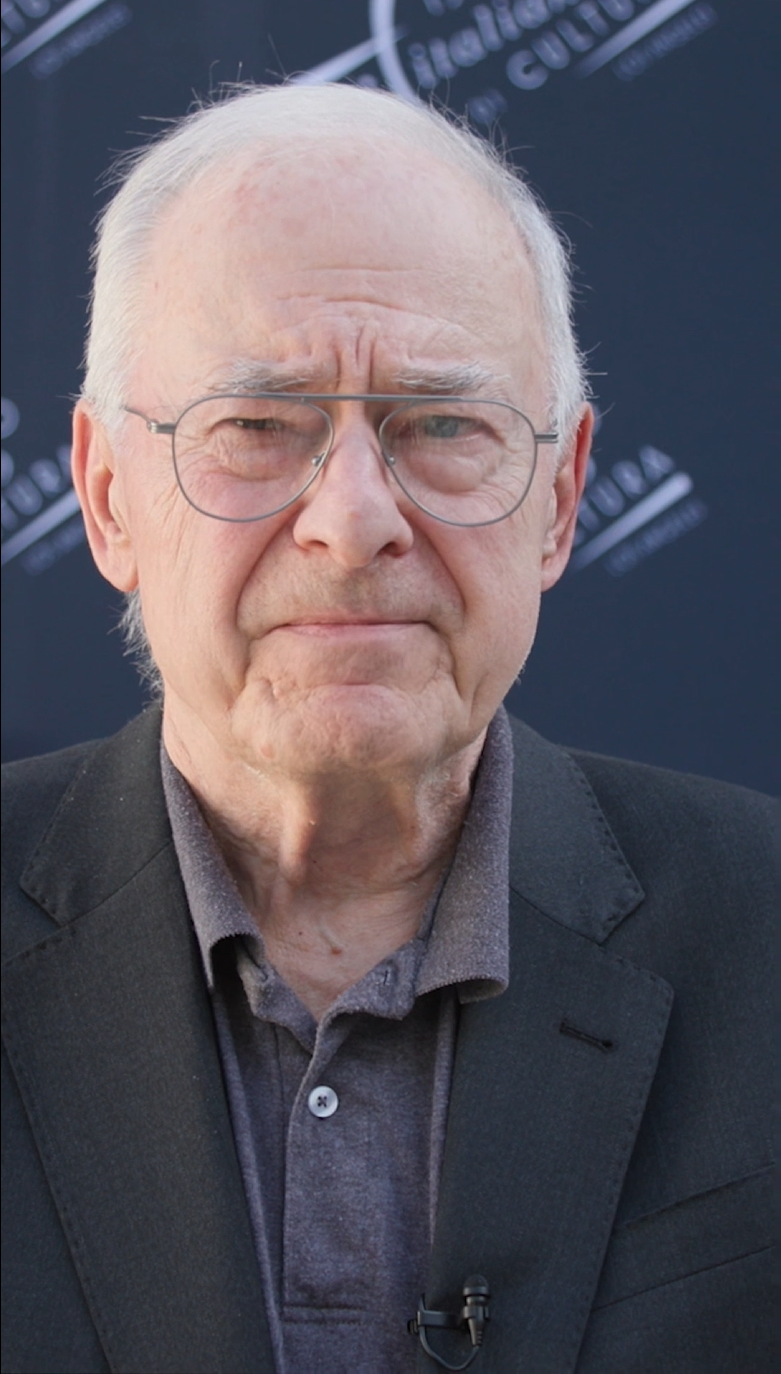
One of the world’s most celebrated cinematographers, Dante Spinotti has worked with directors such as Michael Mann and Barry Levinson, contributing to such international film masterpieces as Heat, L.A. Confidential and The Insider. Born in Italy, Spinotti is considered an absolute master of light and visual composition. We interviewed him in Los Angeles, on the occasion of the screening of the film Posso Entrare, directed by Trudie Styler and presented at the Italian Cultural Institute, at the initiative of director Emanuela Amendola, with the support of Consul General Raffaella Valentini, followed by a conversation moderated by Dante Spinotti himself together with Valentina Martelli.
Let’s start with the film Can I Come In. What was it like to shoot it? How did the project and your relationship with Trudie Styler come about?
The relationship with Trudie goes back a long way. We had worked together 35 or 40 years ago when she was starring in a film that we shot in Cinecittà and also partly in Los Angeles. We always kept in touch and a few years ago we did Freak Show. When this project about Naples came up, which fascinated me deeply because I know that city well, she called me. I served in the military in Naples, filmed there for RAI and also worked on Luciano De Crescenzo’s Così parlò Bellavista, a very important film for Naples.
In addition, the meeting with the producers was very nice, knowledgeable and nice people. It was an extraordinary experience, also because it developed over a whole year, going through all the seasons. Truly remarkable.
What were you inspired by for the photography in the film?
Getting around Naples naturally leads you to be inspired by the character of its inhabitants. Neapolitans open up, they tell you their souls, they don’t hold back. That was the heart of the film; Trudie wanted to tell the people of Naples, but also the stories of the immigrants.
I still remember when I arrived and said to the production, “Tomorrow at 3 a.m. we’re going on the boat, I’ll bring my camera.” Today technology allows you to work lightly, with small but very powerful photographic tools. We shot a beautiful sunrise with some fog over Vesuvius. The goal was to capture not only the beauty of the landscape, but also the spirit of the city and its people.
What is your relationship with new technologies and artificial intelligence in film?
New technologies have always fascinated me. I’ve always loved the ability to see the result right away because of digital. Artificial intelligence is part of this evolution, it’s a step up from the visual effects we were already using for a long time.
I think AI should be embraced and understood; it can help us expand creativity. Of course, AI works by processing what has already existed, while the human mind can imagine what is not yet there, as the great masters of cinema do. Here is the most profound difference: human beings look to the future, AI reworks the past.
You started very young, today there is a lot of competition in the world of photography. What is your key to standing out?
Today technology makes many things accessible, and seeing the result immediately has simplified certain aspects of our work. But the creative input remains irreplaceable. You have to really understand the story the director wants to tell. If you really understand it, you can propose ideas, change perspective, offer something more.
Have you ever had to change a director’s point of view?
Yes, the last film I made with De Niro, Nights, directed by Barry Levinson, was a beautiful example of collaboration. Levinson gave me total visual freedom-I could write with the camera. Of course, if something didn’t work he would say so, but he trusted my way of storytelling.
Was there a time in your career when you felt you had made it?
That moment comes, paradoxically, when you approach retirement. I am not retired, but I have reached a point where I no longer need to work for a living. And then you relax, have more fun, choose projects that you are passionate about. You can be more creative, meet new people, tell different stories. It is the most interesting time, because there is no longer the anxiety of having to prove something.
What about a time when you thought about quitting?
Giving up, never. There are hard times, yes. It’s tiring work: impossible schedules, constant travel, time zones thrown off. But you have to hang in there, stay “on the piece,” as they say. That’s what I always tell the guys: don’t give up. The difficulties are there, but you overcome them.
The article Interview with Dante Spinotti, film photography legend comes from TheNewyorker.
