
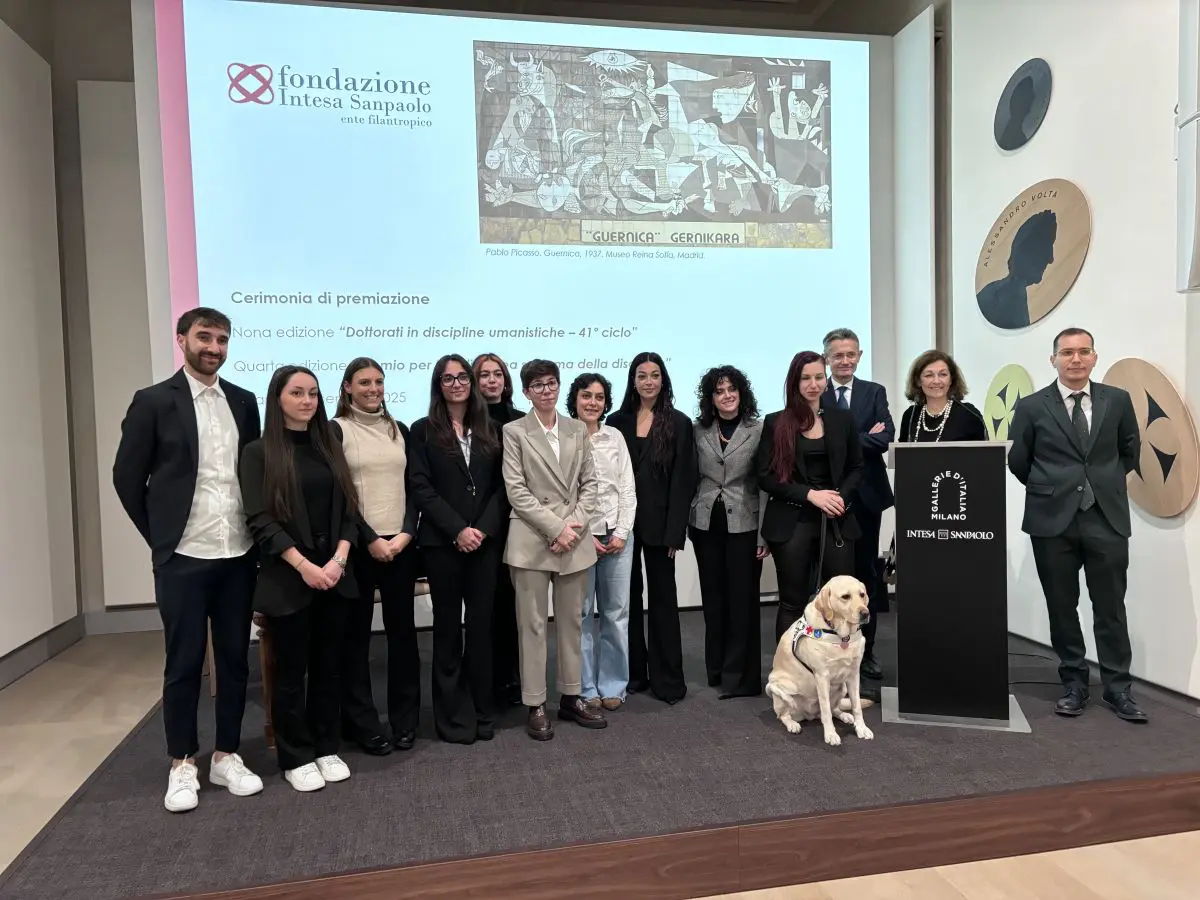
MILANO (ITALPRESS) – The Fondazione Intesa Sanpaolo Ente Filantropico has delivered to the Gallerie d’Italia in Piazza della Scala in Milan, in the usual annual event dedicated to universities, scholarships that for nine years have been awarded for doctoral projects in humanities disciplines. This edition, which confirmed the total amount of 375 thousand euros, has awarded the Universities of Chieti-Pescara, Basilicata, Verona, Palermo and Foggia. Scholarships provide research courses lasting three years aimed at enhancing, promoting and disseminating knowledge of the Italian cultural heritage, with particular attention to the topical issues such as the social inclusion of disadvantaged subjects, the new scenarios of formation, the protection and/or valorisation of the historical, artistic and cultural heritage, the languages of topicality.
“It is an important moment for us in the life of the foundation. Over the last few years we have also added the Bachelor’s Degrees on Disabilities, we do not forget that the protection of the right to study for people with more need is one of the fundamental assets of the foundation. And we are particularly pleased, among other things, to do this ceremony and give these prizes on the international day of the rights of the disabled”, commented Roberto Cereda, President of the Fondazione Intesa Sanpaolo ente filantropico.
Over the years, the Foundation’s commitment has been remarkable: since its birth in 2008, over €35.8 million has been deliberated in favour of the people of Intesa Sanpaolo in condition of difficulties, university scholarships for disadvantaged young people, support for institutions and projects dedicated to solidarity with the needy and in favor of canteens and dormers. Of these, approximately 11 million euros were granted for the right to study and for high training.
In the course of 2025 interventions relating to institutional activity for more than 3.5 million euros, of which about 600 thousand euros intended for employees, pensioners and their relatives in situation of disadvantage; more than 800 thousand euros for university scholarships and doctoral projects and more than 2.1 million euros for solidarity interventions – such as canteens and dorms – and projects for the most in need.
Another reason for appreciation is the national coverage of the projects implemented by the Foundation, which involve universities from all over the country. “We are deliberately covered all of Italy and are very happy about it – added Cereda – we thank, among other things, all the universities that have worked together with us for years, follow us and give us all the support to be able to put on the ground in an increasingly qualitative way these initiatives. We therefore have a territorial representation a bit of the whole country: for us it is another important element to have the presence of all the geographical areas of the country precisely because of this sense of complete and total support that the foundation aims to give”.
On the day dedicated to the rights of persons with disabilities, six awards have been awarded for master’s thesis of experimental research for the improvement of the living conditions of persons with disabilities, in particular if related to work, work placement, digitization as a compensatory tool, for a total value of 18 thousand euros, confirming the crucial role of knowledge in promoting inclusion, awareness and participation. The winning projects of this third edition come from the Universities of Rome “La Sapienza”, Modena and Reggio Emilia, Padua, Catania and Urbino “Carlo Bo” and have taken into consideration methodological and application studies on the theme of disability in different areas, including communication, employment inclusion, Biomedical and Biotechnological Sciences, Science of Education. The initiative was also confirmed for the next year.
For their part, the winning projects of scholarships for doctorates in humanistic disciplines, as well as referring to topics of particular interest, have resulted in the theme of dissonance, understood as tension between values and behaviors, between identity and representations, between social expectations and real lived. An element that unites the projects of the doctorates to the awards assigned to the master’s thesis on the theme of disability.
Among the awards awarded is Vanessa Casu, master doctor in Communication Sciences at the University La Sapienza in Rome with a thesis entitled “The narrative of disability in the media: between mainstream representations and self-representations”.
Not only with his dissertation, but through his own life experience he tried to show how a physical disability may not be such an insurmountable obstacle.
“Receiving this award on this day makes absolutely the difference and for me it was doublely important being myself a disabled girl who wins a disability thesis award – she says. I do many things in my life: I graduated with praise, I am a multi-instrumentalist and practical kickboxing singer at a competitive level. But before I became who I am today, much of what I had thought before becoming a person with disabilities was not true: all the information I had understood about disability, especially in the world of blindness, were wrong.”
According to Casu, this happens because “when we try to inform ourselves on the internet or on the media about this phenomenon, we often encounter in movies where the blind is stereotyped” and represented as the person “who wonders how he will do alone, always accompanied, never autonomous, limited… And in the end you end up assuming almost the likeness of what you are learning about that unknown world.”
“Then I decided to do my thesis on this: I analyzed how traditional media evolved towards new (TV series, Amazon Prime, Netflix, new platforms) and how self-representation was so important. Seeing the same disable that shows you his life is to really change things, because in that case you can no longer imagine why you are really seeing him while expressing and from there really understand what is the life of a person with disabilities, which is then what I am doing to today. The message I launch today is that you can decide whether to make your disability a limit or simply a different condition. If you want, you can do it. you can find your way of studying and doing everything you want in life.”.
– Photo xh7/Italpress –
(ITALPRESS).
