
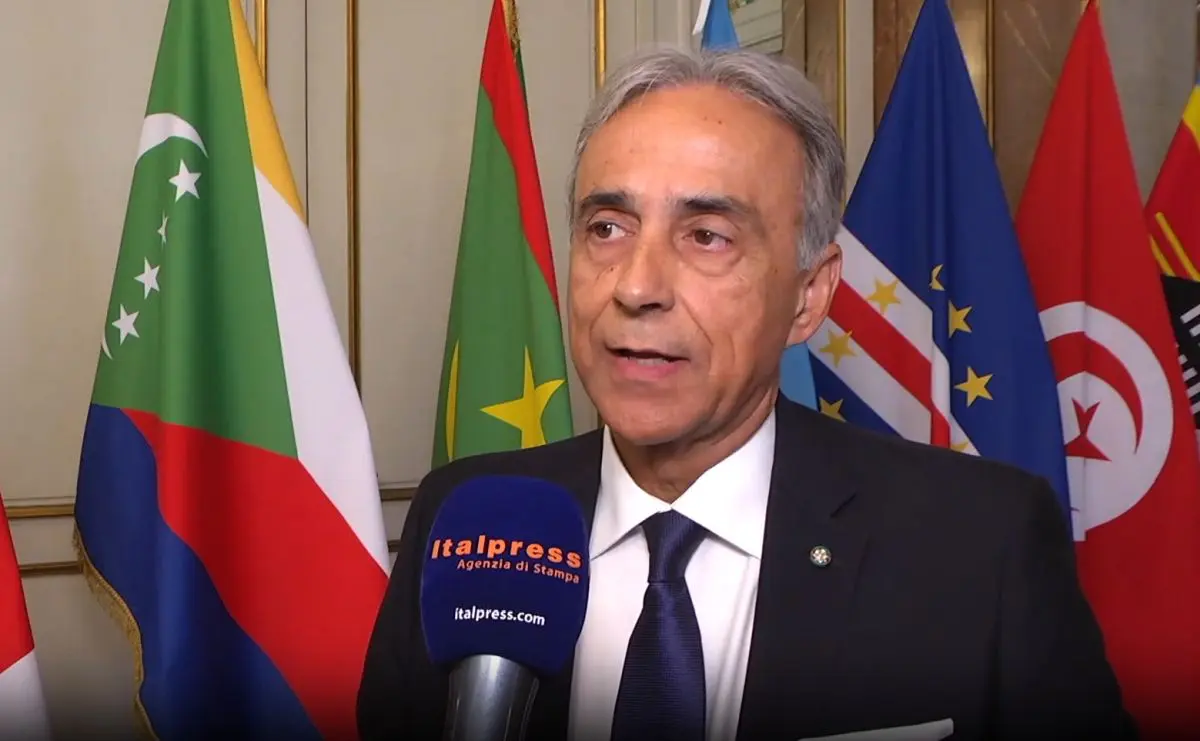
ROMA (ITALPRESS) – After such an imposing military deployment, “Trump could not afford an ambiguous outcome: he had to leave with a result, either diplomatic or military. Since negotiations did not produce an agreement consistent with American demands, the military option remained the only politically feasible way.” It is the opinion of Ambassador Ettore Francesco Sequi, former secretary general of the Farnesina, interviewed by the Italpress agency.
According to the diplomat, the failure of negotiations was not random. “There were two structural problems. The first was time. Trump is not a president of strategic patience; Iran instead sought to gain margins and lengthen negotiation, where Washington wanted a quick decision. The lack of time synchronization has made the break inevitable,” he observed.
The second structural problem was, according to Sequi, the same nature of the agreement. “The United States, supported and inspired by Israel, wanted a comprehensive understanding: nuclear, ballistic missiles, support for regional proxies, with limited concessions on sanctions. For Iran this was too much. Nuclear is the long-term strategic deterrence; missiles are today the only real tactical deterrence left; the network of proxies, though weakened, constitutes the strategic depth, that is the ability to move the conflict away from the Iranian territory,” said Sequi, according to which the greater urgency for Tehran was the removal of sanctions, “which weigh in a catastrophic way” on the economic and social estate. “It was more flexible on nuclear power but excluding missiles and regional network. The incompatibility between a total agreement requested by Washington and a limited one wanted by Tehran made the inevitable clash,” he added.
The consequences of the attack on Iran are now on three floors, according to the diplomat: Iran, Israel and the Gulf. “For Iran the priority is to survive strategically. It must demonstrate retaliation capacity to avoid deterrence, but at the same time avoid an escalation out of control that jeopardizes the regime. If he perceives that the real objective is the change of regime, Tehran will aim at a prolonged war that mobilizes all resources: proxy, pressure on the American bases in the Gulf, regional destabilization, discarding of trade flows through Harm and the Bab el Mandeb Strait, ballistic response to cause damage in Israel and a military cost to the enemy,” Sequi noted.
“For Israel the dimension is existential. Iran and Israel are mutually perceived as long-term strategic enemies. To Tel Aviv the goal is not only to reduce the nuclear or missile threat, but to weaken structurally, and possibly to drop, a regime considered a permanent threat to its safety. The problem is now not to strike, but to absorb the response and prevent the conflict from becoming a regional federation”, he continued. “For the Gulf the situation is extremely delicate. Their main resource is stability. In particular, Saudi Arabia needs stability to achieve Vision 2030, which requires investment, market confidence, regional predictability. A prolonged crisis in the Gulf increases systemic risk: insurance premiums, logistical costs, energy volatility, political instability. It is not necessary to close Hormuz to produce instability; it is enough to make permanent risk,” the diplomat said, according to which “the true variable” is now the duration. “If a short crisis remains, it is coercion. If it becomes a prolonged regional friction, accompanied by an attempt to change the regime in Iran, it is a transformation of the Middle East balance,” Sequi concluded.
– Photo Italpress –
(ITALPRESS).
