
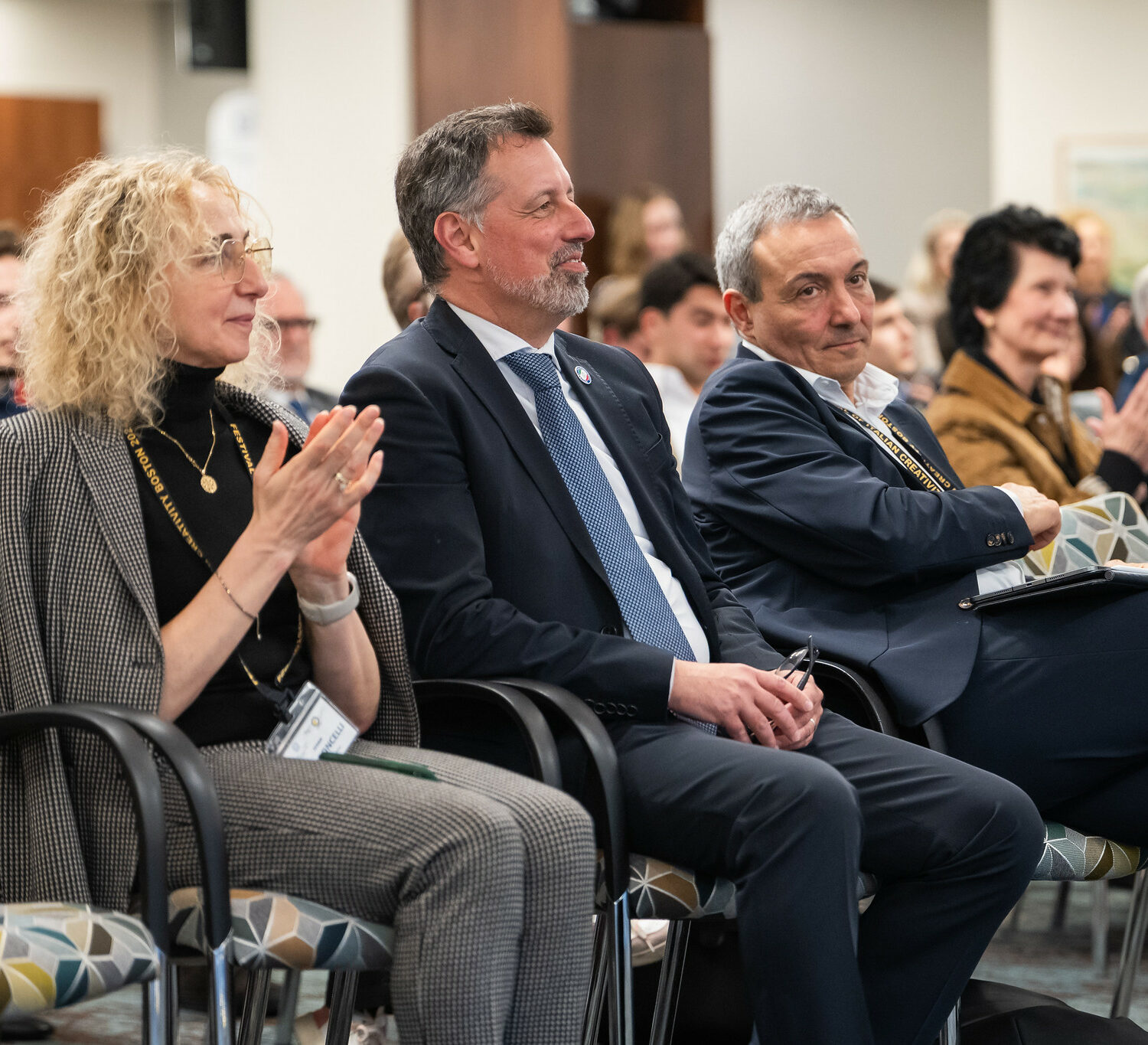
The fifteenth of April is not an ordinary date, it is the birthday of Leonardo da Vinci, and it is no coincidence that the Italian government has chosen it to establish the Day of Made in Italy, celebrated by law from 2023 with the aim of protecting, promoting and projecting in the world the excellence of creativity, industry and Italian culture. After celebrating the 15th of April the day of research with a series of panel experts on the most crucial topics of research, the next day, on the 16th of April, Boston again spoke. In the third and final appointment of STB Days – Science, Technology and Business Days – the Italian Consulate General organized the Innovation Day, conceived on the Day of Made in Italy: a marathon of ideas, startups, investors and visions on the future of the transatlantic relationship between Italy and America.
STB Days are an original format, launched three years ago by the General Consulate itself and today a real good practice for promoting bilateral scientific cooperation. The formula is simple in its ambition: do not talk about innovation, but enable it. To gather for three days an extraordinary community of innovators, entrepreneurs, researchers, investors and institutional partners from both sides of the Atlantic, in a city – Boston – which is one of the most advanced global hubs for research and technology, and which houses an Italian academic, scientific and entrepreneurial community of international importance.
The first panel of the day, the heart of Innovation Day, was created in collaboration with 42N – acronym that indicates the degrees of northern latitude connecting Boston to Rome – a network of entrepreneurs, managers and professors who offer their time as volunteers to promote the meeting between the two ecosystems. To open it Arnaldo Minuti, Consul General of Italy in Boston, and Paolo Gaudenzi, Councillor for Science and Technology of the General Consulate and Professor Ordinary (on leave) of Constructions and Aerospace Structures at Sapienza in Rome.
Gaudenzi is a figure that deserves a presentation. Aerospace engineer with a cum laude degree in Wisdom in 1984, is today one of the most cited Italian researchers in the field of intelligent structures and spatial systems, and is on the list published by Stanford University of top 2% of world researchers: over 4,400 academic quotations, collaborations with ESA, NASA, Thales Alenia Space, AVIO, research projects for the Italian Space Agency and the European Union. He taught at Columbia University in New York, at TU Delft, at ETH Zurich. He was a contact point for Wisdom with the American Embassy in Rome for relations in the spatial disciplines of Wisdom
“Innovation is not in isolation. It comes with people, when ideas circulate and different perspectives meet. Today is one of those moments. »
Arnaldo Minuti, Console Generale d’Italia a Boston
The panel, moderated by Roberto Dolci founder of 42 N, opens with a number that stops the room: sixty-eight percent. It is the percentage of new products in the fashion and footwear industry that fails on the market. Only in footwear, this results in three hundred billion dollars of turnover lost each year. It is not a problem of quality or design, but of process: product briefs are still built on obsolete data, belly intuitions and spreadsheets disconnected between sales, marketing and design departments.
To face one of the most expensive problems of Made in Italy is Ada IQ, the startup that also brings us a solution: an artificial intelligence engine called Smart Brief. What it does is to integrate real-time consumer search signals, competitive intelligence and design reasoning in a single platform, allowing teams to evaluate and improve a product before it comes to the market. The team led by prof. Paolo Ciuccarelli from Northeastern university in Boston boasts eighty years of combined experience in developing enterprise consumer products and software, with roots in Salesforce Commerce Cloud.
On the cybersecurity front, ai.Esra, Italian startup with twenty-five technical professionals, reverses the traditional paradigm: instead of trusting corporate statements, creates a digital gem updated in real time, able to identify invisible vulnerabilities. Result: reduced analysis times of 70%.
Most cyber risk assessments are based on interviews with business managers, but often those responsible do not know exactly what they have in their network: there are devices, processes and vulnerabilities – ghost observers – no one is aware of. You can’t trust what the customer tells you if the customer doesn’t know the truth.
The solution of ai.Esra is a digital twin of the organization, updated in real time, built without having to install anything on individual business devices. Documented result: seventy percent reduction of the time of assessment and savings of one hundred thousand dollars already at first use, for a customer with eleven thousand devices. The cyber risk scoring platform market is worth almost four billion dollars in 2025, with annual growth of 20%.
The most dense moment theoretically comes from Washington D.C., in video connection. Giacinto Paolo Saggese, PhD in Electrical and Computer Engineering from the University of Illinois, former Nvidia, former Google, professor of machine learning at the University of Maryland, is at his third startup. His company, Causify, works on an AI branch that remains surprisingly niche despite its fundamental importance: the AI causal, that is the ability of a system to reason on cause, effect and time, not only on correlations.
The distinction is clear: a traditional AI knows that smoke and fire are associated, but does not know which one generates the other. For systems that need to make decisions in the real world – financial markets, supply chains, energy management – this limitation is critical.
“When you need money, no one wants to give it to you. When you don’t need it, everyone wants to invest. You have to do the opposite of what you think. »
Giacinto Paolo Saggese, CEO di Causify, da Washington, D.C.
In the energy sector, Lightsmith, analyzes the structural limits of the traditional electricity grid in front of the growth of energy demand and its costs by proposing a concrete solution: a VPP – Virtual Power Plant – that aggregates thousands of distributed energy assets (solar panels, batteries, electric vehicles) and orchestrates them as a single source equivalent to a power plant. The paradox that solves is that assets already exist, but are exploited only to twenty-three percent of their abilities. There is no shortage of resources, but the ability to use them.
Osense brings causality within business decisions: CFO can finally simulate the real impact of EBITDA, ESG and supply chain choices in a few hours instead of months.
Companies invest enormously in ESG reports, risk scores, sustainability ratings. But when the CFO looks at those numbers, the question that remains unanswered is: what now? What Osense has built is a causal engine to answer: a concrete decision is inserted – changing supplier, reorienting a logistic route, anticipating a normative deadline – and the system projects the consequences on EBITDA in eighteen months, with every traceable and auditable assumption. A job that in the top universities of the world required months of manual Excel, Osense completes it in an afternoon.
Then there are those who work on invisible, literally. Fabrizio Giannini, CEO of SunSpeaker, brings on stage an elegant problem: the solar panels are ugly. In historical centers, in landscapely protected areas, in military and aerospace applications, this aesthetic limitation is often an unsurpassed normative block. SunSpeaker patented C-B Ion, a technology that envelops any existing solar panel in a customizable film, making it virtually invisible in the surrounding environment and maintaining an energy transmission of 85 percent compared to the original panel.
The central competitive strength: universal compatibility with any panel, while competitors bind the buyer to proprietary solutions.
The last step on stage is Marco Eugeni, CEO of Smart Structures Solutions.
Smart Structures builds the digital nervous system of critical infrastructure: telecommunication towers, energy plants, broadcasting stations, factories. Sensors installed directly on assets, an intelligent core of algorithms, alerts and real-time insights to operators to control the state of structural integrity, prevent failures and ensure “on condition” maintenance. The goal is to transform sensorization into measurable business results – less cost, safer operations, smarter decisions. The team already works with leading operators in telecom, energy, transport, broadcasting and space.
Among numbers, demos and pitches, there is also a less technical but equally relevant truth. As Causify CEO Giacinto Paolo Saggese summed up: when you need capital, it’s hard to find them; when you don’t need them, they all come together.
It is the paradox of contemporary venture capital. And maybe the key is right here: build value before the market recognizes it.
Great satisfaction from the 42N team, as pointed out by partner Francesco Rizzo Marullo, having on Thursday afternoon at 3:00 a room full of angel investors, venture capitalists and family offices is the best reward for our work and the signal of strong interest from American investors towards Italian start-ups.
«Scientific and technology produce impact in society when they generate start-ups, they meet the market and are synergistic with the world of business and finance: it is called innovation! In STB DAYS science technology and society meet and generate value. »
Paolo Gaudenzi, Consolato Generale d’Italia a Boston
What Boston showed goes beyond the individual startups. The Italy–America axis is evolving in an integrated system that merges Italian research, international capital, global market.
The STB Days of the Boston General Consulate, as highlighted by the Consul General Arnaldo Minuti and the Councillor for Science and Technology Paolo Gaudenzi, are no longer just an event, but a model, a relational infrastructure that brings together talents, ideas and investments between the two shores of the Atlantic. A scenario in which Italy is no longer a spectator, but an active part of a future that even if it is built elsewhere, has deep roots at home.
L’articolo Italy–America, from Boston the startups that want to rewrite the future proviene da IlNewyorkese.
