
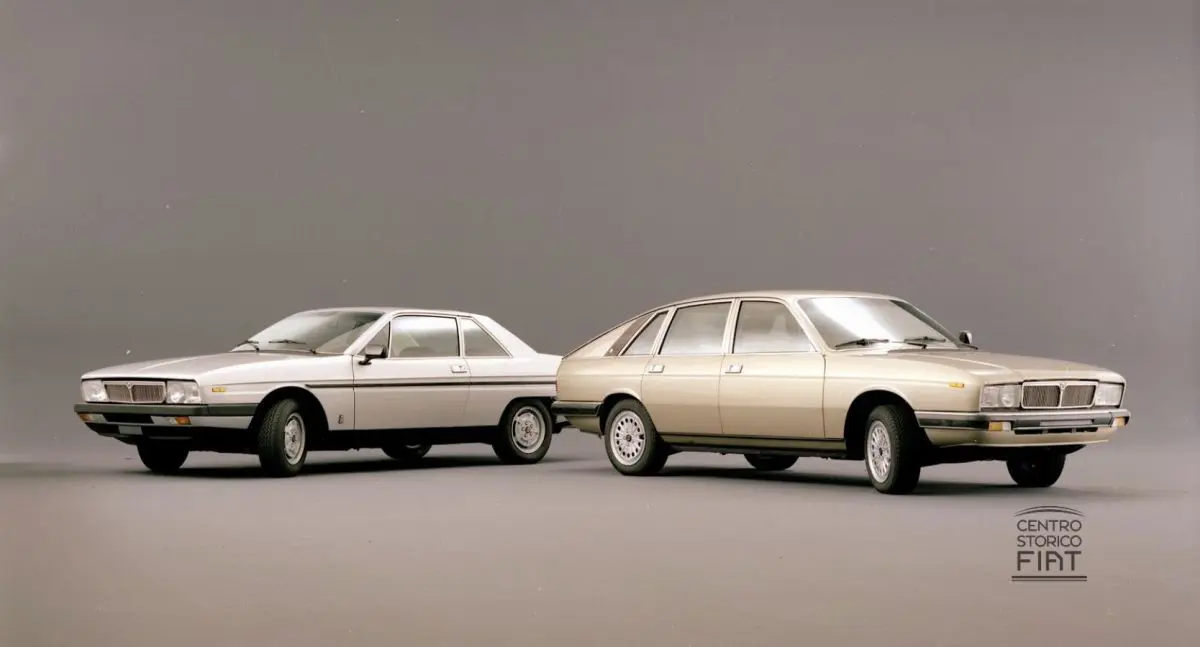
TORINO (ITALPRESS) – In these days the 50th anniversary of the Lancia Gamma, one of the most original and distinctive flagships of the history of the Turin brand. In fact, his debut was at the Geneva International Motor Show in March 1976, when on the Lancia stand both the saloon – a two-volume truncated yarn – and the elegant coupe proposed by Pininfarina on design by Aldo Brovarone. This is how a Lancia model is designed for the segment of representative cars, which contains the identity values of the brand: technical innovation, stylistic elegance and refinement of the interior. Half a century since its debut, the Gamma remains one of the most innovative expressions of Italian automotive design in the 1970s and continues to be an inspiration for the styling language of the Lancia del futuro.
The Lancia Gamma was born at a time of profound transformation for the brand. After the entry of Lancia into the Fiat group at the end of the Sixties, in fact, the Turin House starts an important program of renewal of the range. The first result of this route is the Beta, presented in 1972, but among the ambitious objectives of the management there is that – to return the Lancia in the segment of the flagships, remained discovered after the end of the production of Flaminia in 1969. The Gamma is therefore designed as the new flagship car of the Lancia offer, maintaining some of the technical principles that had characterized the Brand tradition of previous years: front traction, search for sophisticated engineering solutions and a distinctive stylistic language regarding competition. With these identity ingredients, refined over the years with the introduction of technical improvements and new equipment, the new Gamma flagship addresses the market with determination and audacity, finishing its production in 1984, with about 22,000 total specimens, to pass the witness to the new Lancia Thema, from all considered the blue car par excellence, able to merge elegance, luxury and performance. Finally, it should be remembered that, although during his commercial career he failed to fully exploit the European flagship market, over time the Gamma was progressively reassessed by fans and collectors for his stylistic originality and for the role he played in the History of the Mark.
To create the new Lancia Gamma the most intense design efforts focus on the choice of the engine that must have displacement, power and torque adapted to the car’s wheel. Among the different solutions, the glorious V6 of Flaminia that had previously made Aurelia famous, or the evolution of the Flavia boxer grown up to two litres. The V6 of Dino Ferrari and Fiat will be used for the Stratos, the choice is oriented towards the design and construction of a new 4-cylinder engine that in common with that of Flavia has only the boxer architecture. With a wide use of aluminium, the sophisticated new unit is among the lightest: the injected 4 cylinders 2.5 liters develops 140 CVs with a particularly round dispensing, just what needs a real flagship. In order to adapt to the Italian legislation that imposes the increased VAT for the displacement above two liters, from boxer 2,5 liters a unit of 1.999 cc is obtained that develops 120 CV.
In a period of strong transformation for the automotive market, also marked by the energy crisis, the Gamma represents a modern car of prestige, safe and efficient, as demonstrated for example the great attention to the aerodynamics (the sedan boasts a Cx of 0.37) and to the comfort of march, elements that reflected the approach Lancia to the design of the high-end cars. One of the most distinctive aspects of the Gamma is undoubtedly the design, realized in collaboration with Pininfarina, outside the straditional chemi for the time – two volumes from the spinning line with truncated tail – which is certainly a rather original stylistic solution for a representative car of the 1970s.
The spacious cabin is particularly bright with large glass surfaces: from the three side windows to the large fixed and very inclined window. In style with the tradition Lancia also care for the interior materials, the rear sofa is well shaped and offers two comfortable and enveloping seats as the front armchairs. Ideal for the family the remarkable load capacity of the trunk, closed by the trunk that opens the vertical part and the terminal portion of the volume that follows the lunotto with an original Venetian. Further refinements such as the fabrics of excellent quality, the adjustable steering wheel in height, the four electric lifts and the always electrical adjustment of the external rearview, help to define the elegance of thisstyle.
Pininfarina creates the Lancia Gamma Coupè by shortening the step of a frame on which the biellese designer Aldo Brovarone designs a Gran Turismo spinning mill two doors three volumes. The correct proportions are contained by net edges: characterized by windscreen and lunotto with pronounced inclinations and very similar, it flows a long and low bonnet motor and a trunk that, with two inclined ribs, brings the lower central part for an original and aerodynamic style. The large bumpers, also complying with the rules of foreign markets, are also well connected. Functional and technically refined the automatic adjustment of the height of the headlights. If the exteriors express elegance and formal rigour, the interiors are one of the most innovative aspects of the project. The cabin of the Gamma Coupè was defined as an authentic “travelling dream”, because it was conceived as a welcoming and refined space, able to recreate the atmosphere of an environment that, with a modern definition, we would define “living”.
The interior, designed by Piero Stroppa, stood out for a dashboard inspired by the product design of the 1970s, for the original combination of colors and for the quality of materials. The wide glazing helped to make the cabin particularly bright, while the seats, large and well shaped, ensured a high level of comfort in long travels. Among other things, the elegance and accuracy of the interior and exterior design of the coupe version is likely to put almost in the second floor the original sedan version but, although presented together in 1976, the coupe arrive in the dealers more than a year after the debut in Geneva, thus leaving room for the diffusion of the four doors.
A few mechanical modifications were made between 1978 and 1979 to improve reliability: the update also remains in the second series of 1980, which led to the adoption of the Bosch “L-Jetronic” electronic injection on the main engine of the Lancia Gamma 2.5 i.e. while version 2.5 a carburetor remains in production only for export. In addition to the engine, the novelties of the Lancia Gamma second series concern the calandra, which is uniform to that of all the other Lancias proposing, to horizontal development, the typical shape to shield present on the cars of the past. They also change the front bumper to facilitate the passage of the air in the new socket and the alloy wheels, redesigned to accommodate low tires. In the interior completely revived the dashboard, with digital clock already appeared at the end of the first series, knob and cover of the gear lever. New design also for the seats, also available with fabrics signed Ermenegildo Zegna, timed courtesy lights and an adjustable reading light. The Lancia Gamma Coupè is also renewed: the 2.5 litres are only available in the electronic injection version and is also available with four-speed automatic transmission.In the interior same modifications of the saloon to the bridge and in the lights on the ceiling, while the seats, already different from the sedan in the first series, are more enveloping both for the legs and for the shoulders. The driving position is one of the best GTs of the time, especially in terms of comfort, suitable for long travel at sustained speed.
At the same time as the second series, Lancia decided to explore new versions to expand the offer that will never be produced, although there are critical and public appreciations. It started in 1978 with a plated version derived from the coupe designed by Pininfarina: it is the T-Roof spider with openable roof and removable anchored to a robust central/posterior roll-bar. Pininfarina, at the end of 1980, bringing the design of the coupe on the platform of the sedan, proposes La Scala: a sports three-volume four-door, with silhouette very similar to the coupe but with two extra doors and the abitability of the sedan two volumes. Well before the market moves towards the wagon station, Pininfarina proposes the Olgiata, curious version with hatch but only two side doors: the character is also sporty by the spoiler that connects roof and hatch. The three specimens of the Turin body are flanked by two other proposals: the first, in 1978, by the Italdesign of Giorgetto Giugiaro called Megagamma. Giugiaro greatly raises the bodywork to increase the internal volume: thus a more than squared two volumes that recalls the project two years before made by Italdesign for New York taxis. The second proposal is 1980, edited by the House Style Center: the Gamma 3V, another three-volume interpretation of the Berlin Range. This car, still in perfect condition, is now part of the cars on display at the Heritage Hub Stellantis in Turin.
Today, fifty years after its birth, the Lancia Gamma continues to represent a stylistic reference for the brand. Not by chance, the Gamma Coupè is one of nine brand icons at the base of the new Lancia era: from Aurelia to Flaminia, from Fulvia to Beta HPE, from Gamma to Delta, from Stratos to 037. Models very different from each other, some children of an elegant and harmonious design, others characterized by a more radical and essential language, but all united by a style capable of crossing time and expressing in an unmistakable way the Italian design. The name Gamma was chosen for one of the key models of the new Lancia era: the New Range, which will be produced in the Italian Melfi plant. The new flagship will mark a fundamental step in the growth of the brand and will interpret in a contemporary way the historical values of Lancia: elegance, innovation and comfort.
– Stellantis press office photos –
(ITALPRESS).
