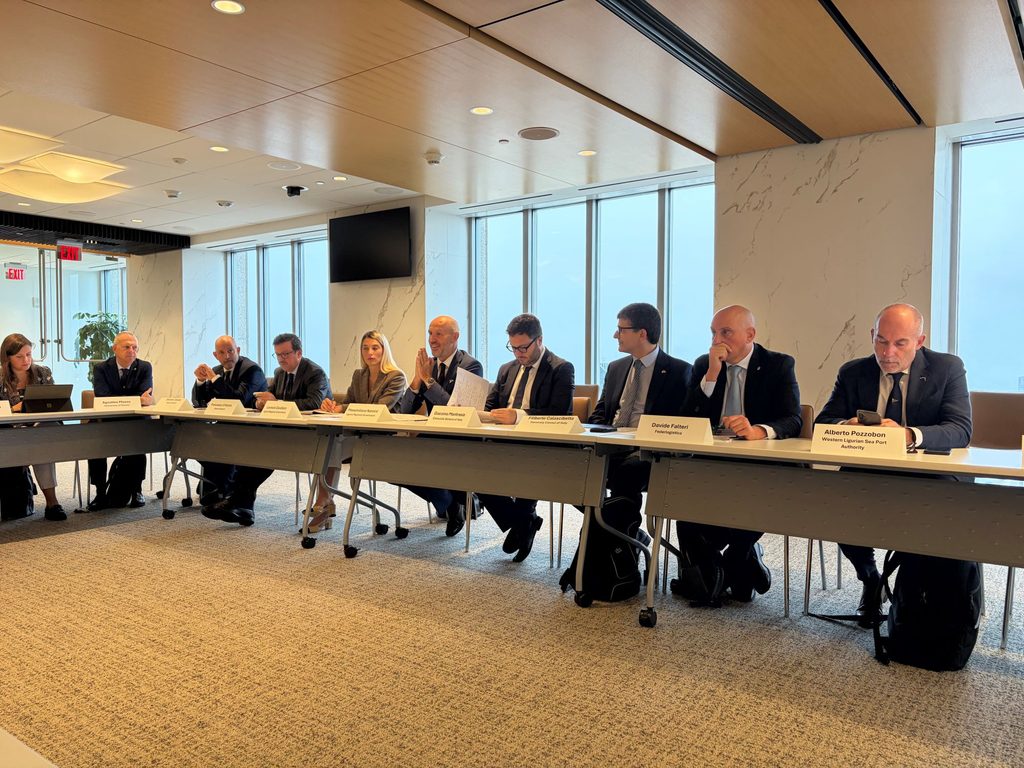
Port connections and the movement of goods inland were the main topics of the Liguria regional delegation’s first day in Savannah, Georgia. Led by Massimiliano Nannini, chief of staff to the region’s president, the delegation visited the Georgia Ports Authority and Garden City Terminal before meeting local business representatives at the World Trade Center Savannah.
The Port of Savannah handled 5.70 million TEUs, the standard measure of container traffic, in 2025, one of its highest totals on record. Five regular container services already connect Georgia’s ports with those in Liguria. Discussions focused on how the two port systems could build on these links and reach more inland markets through intermodal transport, which combines different modes of transportation.
Alberto Pozzobon, marketing manager at the Western Ligurian Sea Port Authority, outlined their respective goals: Savannah aims to strengthen its position as a gateway to the southern United States, while Genoa, Savona-Vado and La Spezia seek to serve the Mediterranean and southern Europe. He also identified digital freight corridors as a possible area of cooperation to make cargo movements faster and more efficient.
Nannini pointed to transport and digital infrastructure, including high-speed rail and submarine cables, as factors that could help Liguria attract business. Davide Falteri, president of Federlogistica-Conftrasporto, said the aim was to establish lasting logistics links between Georgia and Liguria, centered on Savannah and Genoa, and turn those relationships into opportunities for trade and investment.
At the World Trade Center Savannah, the delegation met local economic and business representatives to discuss international trade and potential cooperation. The meeting also introduced Liguria’s support programs for innovative startups.
Maria Nives Riggio, deputy director general of FILSE, presented the regional network connecting universities, research centers, businesses and institutions. She outlined the tools available to support startups from incubation through international expansion, explaining how FILSE’s BIC connects regional policies with companies’ practical needs. The discussions explored possibilities for future cooperation between the two regions.
Following Savannah, the mission’s itinerary included meetings in Atlanta on September 24 with the Metro Atlanta Chamber and representatives of the State of Georgia. The scheduled discussions covered economic ties, investment, technology, research and cooperation between businesses in the two regions.