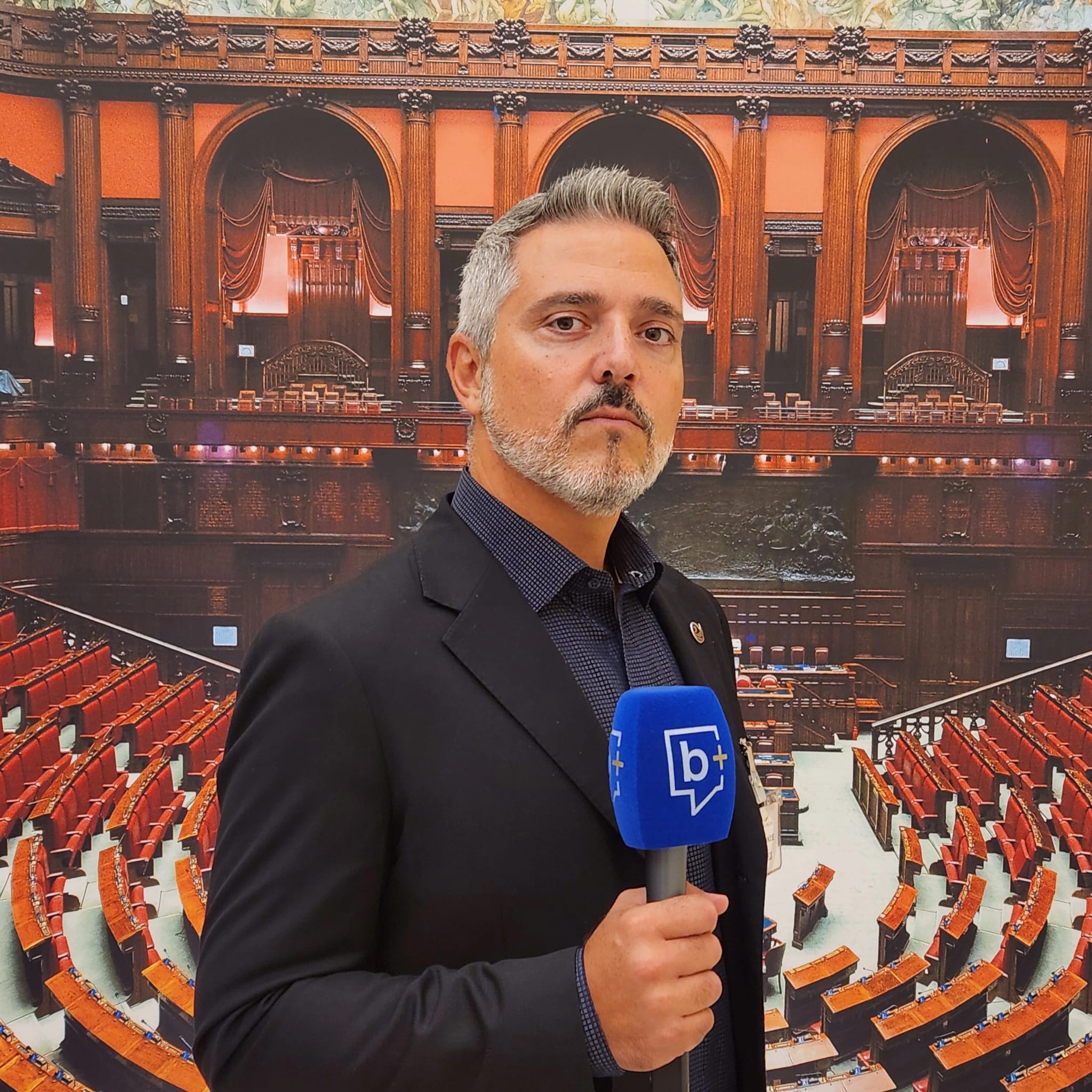

Marco Rebuffi, President and CEO of JAS (Jet Air Service), spoke at the microphones of ilNewyorkese in the Ritratti podcast, telling an entrepreneurial story that is also a human parable. A story that began in the Milan of the 1970s and landed, today, at the top of a global company based in Atlanta, Georgia. Rebuffi is the symbol of a made in Italy that has been able to expand without distorting itself, keeping its roots firm and, at the same time, accepting the challenge of innovation and globalization.
“Mine is the story of a person born in Milan in 1961, who started working in JAS in 1979. At that time I was still in high school, and from there I never left it.”
His career began as a “store kid” when JAS was a small business: “I did customer service, then from there I did many other things. The company grew, we were 25 people, today we are 8,500. And I have grown with the company.” A shared growth, the result of determination and vision. In 1989 he began traveling between Italy and the United States, and in 1994 came the final move overseas: “I was 33 years old, and I moved with the family. The idea was to return to Italy after five years, but those five years became thirty-one.”
The turning point came in 2006, when Rebuffi convinced ownership to move the decision-making heart of the company to the United States. “A change of perspective was needed. So I proposed moving management to the US. Mr. Bruni, who was then 60 and is now 80 years old-and is still in the office every day-approved the idea. He said, “At this point it’s your idea, you take it forward.” So I became Global CEO, while I was already CEO of the U.S. subsidiary, JAS USA. This was from January 1, 2006.”
Since then, JAS has accelerated its expansion: today it is present in 60 countries with more than 300 offices. The United States is the first market, followed by Italy, China and Germany, but there are other fast-growing offices, “Brazil, Mexico, the United Kingdom, the Netherlands…and all the others to follow.”
Central to Rebuffi’s vision is human capital. “I think we are a perfect meeting point between American and Italian business culture.” And he strongly emphasizes, “We are not just here for profit. “People make the difference for real.” The culture of humanistic enterprise, which looks at the long term and does not sacrifice people to quarterly numbers, is a non-negotiable value: “”We almost never lay off people. It would not be correct to say that we never do: in 2009, during the financial crisis, we laid off 200 people, much to our regret. But all of them were rehired within six months.” Trust in the strength of people is not just rhetoric, but operational foundation: “We are a service company: we buy and resell space on planes and ships. We do not operate means of our own. We are, to understand ourselves, what a travel agency is to a tourist, but to a parcel. We arrange transportation. In a business like this, people really make a difference. With the right people, you go far.”
Another pillar is reputation, both personal and corporate. “Reputation is everything a person has. Behaving well, being a citizen of the world, complying with the law, being present and helpful with co-workers-all these contribute to building reputation.” JAS, now a U.S. legal and tax entity, has never had compliance issues: “We spend a lot on training on what to do and what not to do. Being compliant is a priority for us. The client stays with you, or comes to you, precisely because of the reputation you have built.”
On the innovation and sustainability front, the approach is pragmatic but ambitious. “Innovation for us means trying to automate our work as much as possible, so that we free up people’s time and dedicate it to the customer,” he explains. “The new generation wants to do everything online, and we have to take note of that. I belong to a generation that was not born with this mentality, but fortunately younger people are working with me who are pushing us in the right direction.”
As for sustainability, Rebuffi does not hide the difficulties: “We do not operate our own means, so we are not directly responsible for emissions. The problem is that sustainability costs money. There are less polluting fuels, but they cost more. Customers say, ‘Yes, I like to be sustainable, but paying more doesn’t.’ It is a daily difficulty. In Europe, especially in Northern Europe, there is more sensitivity. In the United States it is different, and that creates an imbalance. However, we have a Sustainability Office here in Atlanta, with people all over the world. It’s part of our mission.”
Despite the successes already achieved, Rebuffi still has dreams to realize. “We would like to triple the value of the company by 2030.” But the biggest dream is to ensure continuity for an enterprise built over more than four decades: “One of our majority shareholder’s sons is already in the company, in the C-Suite. He should be the one to take my place when I decide to retire.” But he quickly adds, “Staying at home doesn’t interest me. My dream is to see this company remain independent, grow again. Because this is my legacy.”
And finally, Italy, which remains the point of departure and, in some ways, also the point of arrival: “After many years, for the last three or four years I have started reading only books in Italian again,” he says with a smile. “I was born in Italy, I came here when I was 33, today I am 63. But I will die Italian. That’s for sure. I have dual citizenship, but I feel 100 percent Italian. Period.” A declaration of love that closes the circle of a life lived between two worlds, but with one solid identity.
The article Marco Rebuffi: “From Milan to Atlanta, my JAS unites two worlds” comes from TheNewyorker.