
by Stefano Vaccara
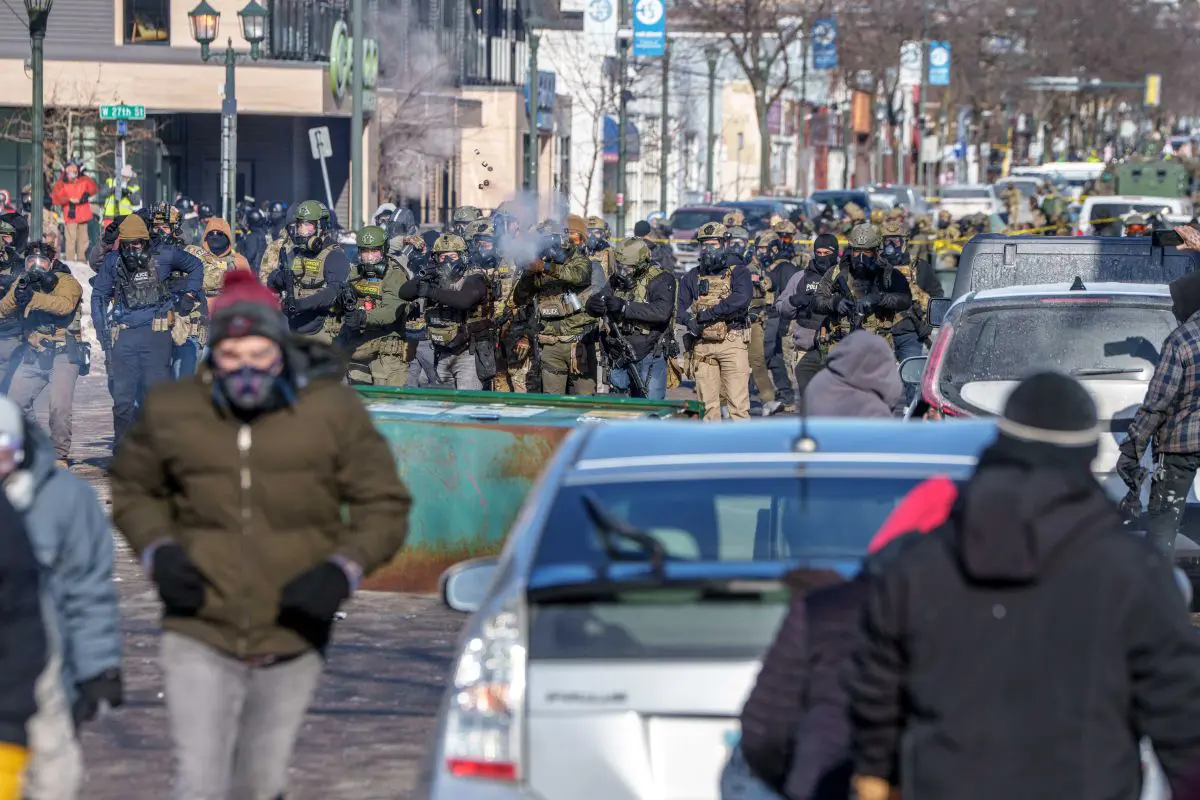
NEW YORK (USA) (ITALPRESS) – For about 48 hours the White House tried to close the Minneapolis case in a simple and politically useful frame: a armed man, federal assaulted, unavoidable reaction. Then the movies came, from more angles, and that frame began to crumble. Not for a marginal detail, but for the sequence that the videos make it almost impossible to “push”: Alex Pretti, 37 years old, an intensive care nurse at Veterans Affairs, appears with a phone in his hand while he intervenes to help some newly pushed and sprayed people, is immobilized on the ground, the gun is removed from his belt, and only after the close hits arrive. The New York Times and other media verifying the various videos available, write that Pretti was holding a phone, not a weapon, and that the weapon seems to have been removed a few moments before the shoots. Nine in all with the unarmed man on the ground.
Yet, just as the images circulated, the Trump administration relaunched the hardest version. The head of Border Patrol Gregory Bovino, who has become one of the faces of the federal offensive in the cities, has overturned reality in front of the cameras: “The victims are the agents”, claiming that Pretti would “kill” the feds. It is the same line repeated by the secretary at Homeland Security Kristi Noem, and by other spokespersons, despite the Minneapolis police said they did not see any evidence that Pretti had “branded” the weapon. In parallel, FBI director Kash Patel remained on the narrative of aggression, essentially saying that those who attack law enforcement “can’t get away with it.”
Then Trump changes his tone. It does not autocritical, does not condemn the agent, does not recognize the errors of his. But it opens the door to the back, and it does so in the most tricky way possible, that is without admitting anything but preparing the exit.
In a phone interview with the Wall Street Journal on Sunday evening, he refuses to say whether the agent has acted correctly and is limited to promising an internal “revision”, adding that, “at some point”, federal agents will leave Minneapolis, even if without indicating times. The WSJ describes the phrase as a signal of future withdrawal, and emphasizes that the administration is forced to confront the political cost of the scene, especially because the images challenge the official version.
If the phone interview was really looked for by Trump, as often happens when he wants to regain control of the narrative, then we are facing a reflection of political survival. Not moderation, but damage management. Minneapolis, with those videos that denied the “narrative” in defense of ICE agents, was becoming “toxic” for the White House: violence is no longer abstract, it is visible, repeatable, verifiable.
Here comes a significant element: the next editorial of the Wall Street Journal coming Monday morning. Murdoch’s WSJ called the case a “moral and political debacle” attacked DHS’ communicative management and asked to stop the surreal escalation, inviting Trump to change the way and focus the action on criminals, not on “force” operations in hostile cities. When the conservative newspaper near the Republicans, but above all followed by the financial elite, describes that the federal version does not hold, the White House is warned: The rope was pulled too much.
Stephen Miller, the man who most of all pushed the administration on aggressive deportations and demonstration actions in big cities, will come from now on really contained by Trump, or are we just in front of a strategic break? The WSJ itself talks about internal tensions in the White House, with some advisers concerned with political damage and others, Miller in the head, intent on continuing the hard line. The most realistic reading?
Minneapolis does not stop the project, compels it to change shape. If the goal is also to “educate” the country to fear, then the administration needs operations that intimidate without producing a media boomerang. Minneapolis, instead, produced a boomerang.
To say this in these clear hours is the expert of authoritarian regimes of the Atlantic Anne Applebaum: the theme is no longer just immigration. It is the model of power that is experimenting: masked agents, paramilitary presence, management of the square as occupied territory, and above all the idea of impunity. Applebaum, interviewed by the popular TV program “Morning Joe”, explicitly linked the point of impunity to a wider goal of the migration: to spread fear to make passive citizens, to disincentive the protest, and to the long to discourage even political participation. In other words, fear as a means of government to prevent citizens from voting in mass in November 2026.
It is the same picture that Jonathan Rauch, always on The Atlantic, has chosen now to call “fascism”. Rauch argues that it is no longer just opportunist authoritarianism or “patrimonialism” in a strong man style, but a constellation of increasingly consistent traits, from performative brutality to politicization of law enforcement forces, to a sort of national police acting as a political force on the territory.
Minneapolis therefore had become a test: how far can the “demonstrative brutality” be pushed without losing control of the story? For two days the White House tried to impose the story. Then reality washed the screen and had to go back.
Minneapolis is not an isolated incident, it is a piece of a larger design, that of normalizing an aggressive federal force, and also normalizing the idea that those who document and protest can be punished. If the administration takes a step back, it does so because this time the videos are too clear, and because the reaction risks widening, even on the front of the organized work, where even the hypothesis of a general strike remains a very rare event.
Trump today makes the “Taco”, the tactical retreat. But will it be a retreat to change the way, or a retreat only tactic and try again elsewhere? Minneapolis suggests that social resistance, and visual evidence of facts, can still impose a limit. The problem is to understand whether that limit will hold until November 2026, when fear, if cultivated long enough, could turn into resignation. Or, on the contrary, in a wider mobilization, precisely because America is beginning to see, without filters, what really means a federal state that demands impunity for its armed men in the street and death for those who exercise their constitutional right to protest.
– photo IPA Agency –
(ITALPRESS).
