
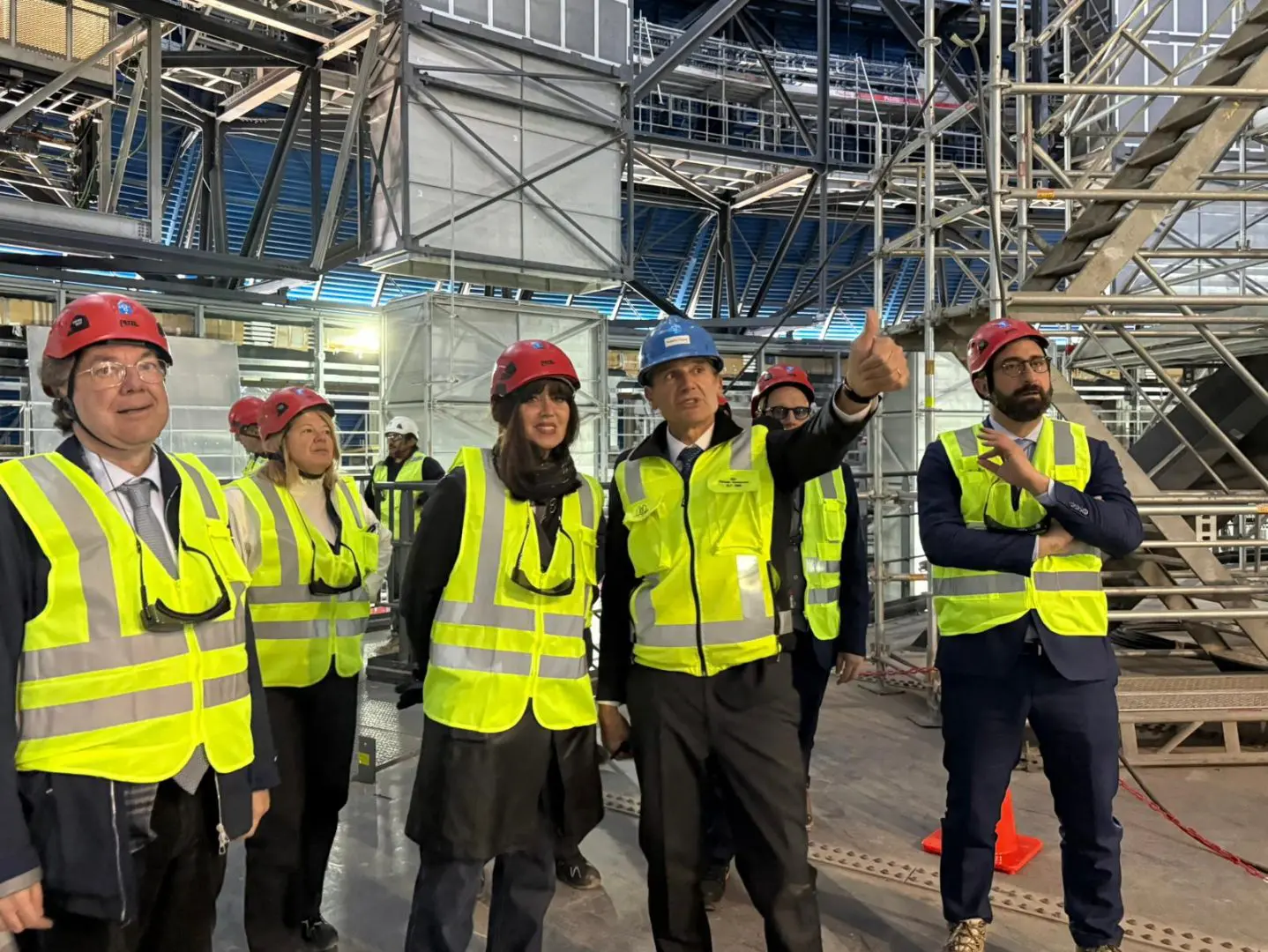
ROMA (ITALPRESS) – The Minister of the University and Research, Anna Maria Bernini, and the President of the National Astrophysics Institute (INAF), Roberto Ragazzoni, visited the sites of the European Southern Observatory (ESO) in the Atacama desert region in Chile, where the most advanced telescopes in the world arise. ESO is an international organization of which Italy has been a member since 1982.
The Italian delegation visited the site of the Extremely Large Telescope (ELT) of the European Southern Observatory (ESO), at Cerro Armazones, at more than 3,000 meters of altitude, where the largest telescope for observation in visible light and in the infrared ever made is being built. The project sees an important Italian contribution, both in research and in technological and industrial development.
The national scientific community, coordinated by the INAF, is committed to the development of key instruments and technologies for the telescope and contributes to the design and construction of high precision components. These solutions will allow you to obtain images with unprecedented clarity and significantly expand the possibilities of observation of the universe.
On the industrial level, on the other hand, a consortium of Italian companies was awarded the contract for the construction of the building, the dome and the support structure of the telescope, generating an economic return of more than 360 million euros. A result confirming that participation in the major European research infrastructure represents not only a scientific investment, but also a concrete leverage of industrial development.
“The Italian presence at the Extremely Large Telescope – Minister Bernini said – demonstrates in a concrete way how research is a strategic tool for international projection of our country. Participating as protagonists in one of the greatest scientific infrastructures in the world means affirming the quality of our scientific community and the solidity of our industrial system, capable of contributing to projects of high technological complexity. The commitment in the ELT – the Minister added – is also a political and strategic choice, because it means investing in knowledge as a leverage of competitiveness and, at the same time, offering new opportunities to young generations of researchers, who can measure themselves with projects intended to mark the future of astrophysics. Cooperation with Chile, which houses these unique infrastructures in the world, is also a concrete example of effective scientific diplomacy. As science contributes to building stable and lasting relationships between countries, helping to create mutual trust and generate shared benefits.”.
“Visiting with Minister Bernini the astronomical sites of ESO here in Chile, in one of the literally darkest places on the planet where European access to the southern sky resides, was an honor. Here we could see, and often touch with hand, how Italian research in astrophysics not only expresses itself at the highest levels in the globe but is also able to involve the entire academic, scientific and industrial chain of the nation”, comments Roberto Ragazzoni, president of the National Institute of Astrophysics.
The sites visited simultaneously host the past, present and future of Italian technological development. The industry of our country has in fact built the 4 telescopes of the Very Large Telescope (ESO), inaugurated in the early 2000s and since then among the world’s greatest telescopes. The future is now represented by the Extremely Large Telescope, which involves not only the national industry that deals with large structures but also high-specialization components.
“The adaptive mirror of ELT is a technological jewel, consisting of six “petals” that with their 5352 actuators will correct the effects of atmospheric turbulence by producing astronomical images of exceptional quality. A technology tested by the INAF, which has now become standard in all the big telescopes on the planet,” said Ragazzoni. “This visit is a further confirmation – of the attention of the Ministry, which translates into funding for the realization of infrastructure and the recruitment of new scientists. An opportunity that has allowed us to value observative structures with a strong Italian presence that, in short, will open new frontiers in astrophysical research, where INAF plays a role of absolute importance in the international scene. A leap forward for future generations of scientists who have already tested excellence and the ability to realize the entire national industrial chain.”.
During the visit, the delegation also went to the site that will host the Cherenkov Tele Arscope Observatory (CTAO), the largest and most powerful infrastructure in the world for the observation of the universe in the spectrum of gamma rays, able to investigate the most energetic phenomena occurring in the cosmos. The CTAO provides for the construction of over 60 telescopes of three different dimensions distributed in two sites, near the island of La Palma (the Canary Islands, Spain) for the northern hemisphere and, in fact, in Chile for the southern one.
Italy, in addition to being among the founding members of the project, contributing to the technological development, the construction and operation of the Observatory, is also the country that led the negotiations for its constitution and, in Bologna, hosts the headquarters of CTAO ERIC.
“We are just as excited – says Ragazzoni – for the recent start of the work linked to the construction of the southern site of the Cherenkov Telescope Arscoperay Observatory, which sees our strong contribution on the small and large telescopes in the advanced construction phase.”.
The visit took place in the presence of the Ambassador of Italy in Chile, Valeria Biagiotti, the Director General of ESO Xavier Barcons and the ELT Program Manager Roberto Tamai.
-Foto Mur-
(ITALPRESS).
